

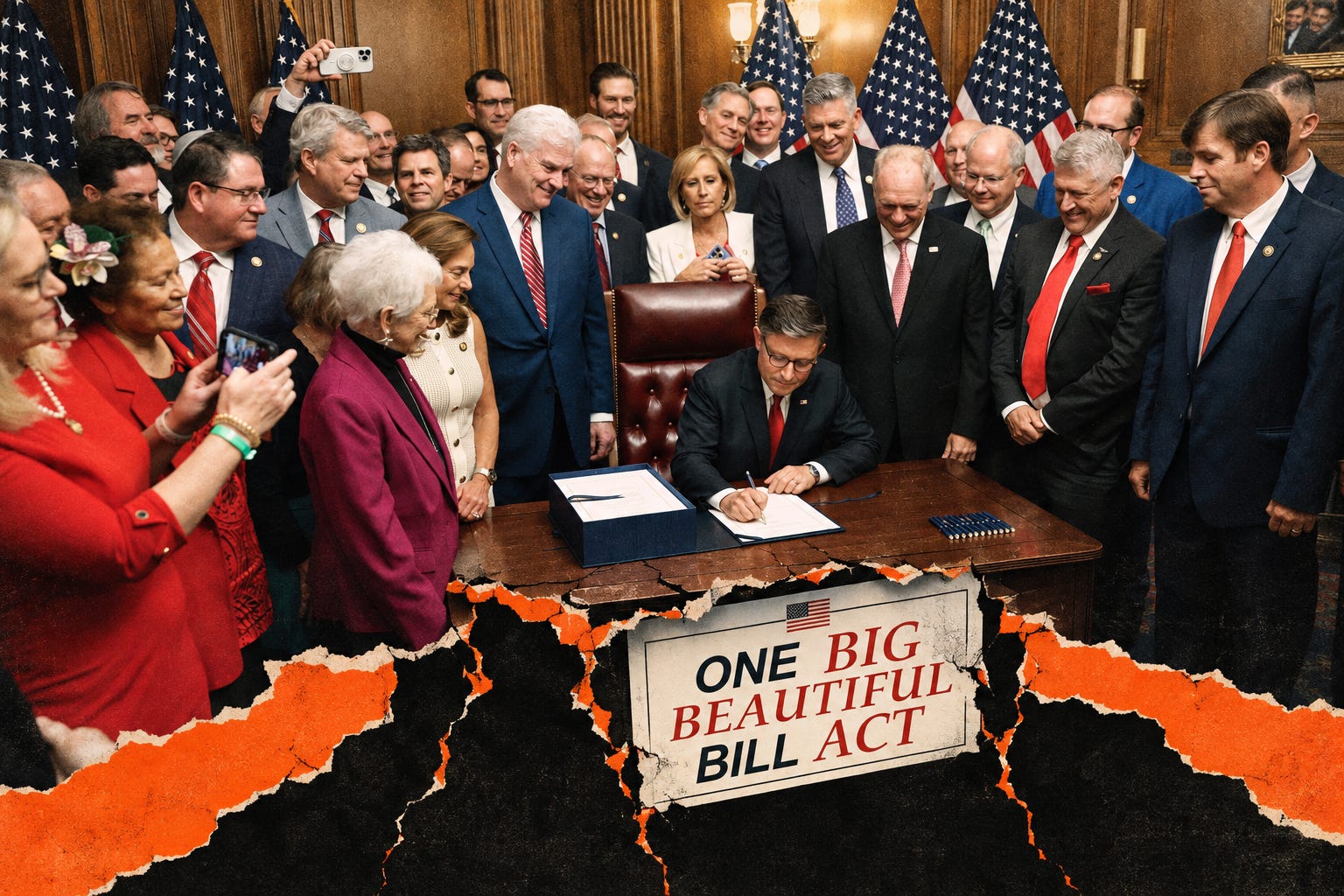
Last year, in the distinctly unbeautiful One Big Beautiful Bill Act (OBBBA), Congress added the first-ever federal work requirements to Medicaid, the joint federal-state program that provides health insurance for low-income people and covers 1 in 5 Americans.
If you’re an adult and you’re getting insurance from the government, argued congressional Republicans, you should either be working or have a good reason for not working. Medicaid is “not for 29-year-old males sitting on their couches playing video games,” as House Speaker Mike Johnson, R-La., memorably put it.
And so, Medicaid beneficiaries will now have to report their work hours on a regular basis. If they don’t, they will lose their health insurance.
But if the goal of Medicaid is to provide health insurance to people who are legally eligible for Medicaid, the results of this new requirement will be disastrous. We know that because, during the first Trump administration, Arkansas got a waiver to add work requirements to Medicaid. In just six months, nearly 17,000 Arkansans lost coverage. A court later paused the program.
Ninety-five percent of the target population was eligible for Medicaid. That means they were already working or were exempt from the new work requirements because they were pregnant, seriously sick, caring for a dependent, or eligible for other narrow exceptions. They just hadn’t done the paperwork.
As for Johnson’s hope that gamer bros would go get jobs — employment rates didn’t budge. Nationwide work requirements are all but certain to lead to a similar outcome.
You might have thought that studies like the one from Arkansas would have blunted Republican enthusiasm for work requirements. The truth is closer to the opposite. Studies in hand, Republicans could now be confident that work requirements would strip coverage from millions of people, regardless of their eligibility — which would, in turn, reduce federal Medicaid spending.1 Those savings went toward covering the Big Beautiful Bill’s huge tax cuts.
Now the Trump administration seems to be worried that the new work requirements won’t kick enough people off Medicaid. In June, it issued a rule to make work requirements even more punitive than the Big Beautiful Bill allows.
The rule is not only flagrantly unlawful, it is also a late-breaking change in position that has left states without the guidance they need to implement a massive new change. As a result, an estimated 1.8 million poor people, or about 1 in 10 Medicaid enrollees, will likely be forced off their health insurance for no good reason at all.
Making work requirements work harder
Congressional Republicans understood that many eligible people would lose Medicaid because of work requirements, but they didn’t want cancer patients to lose their coverage because of a paperwork screw-up. (Less charitably, they didn’t want to be blamed for that.) So they included an escape hatch: an exception for people who are “medically frail.” Those patients wouldn’t have to abide by work requirements to keep their insurance.
But “medically frail” isn’t a scientific or medical term. It’s an invented legal category. So who is exempt? And who isn’t?
Although Congress didn’t say much in OBBBA, it did set out some guidelines. The category would “includ[e]” those Medicaid beneficiaries who are blind, are disabled, have a substance use disorder, or have a “serious or complex medical condition.” If you have one of those conditions, you count as medically frail. You can keep your Medicaid, whatever your work status.
Or, at least, that’s the most natural way to read the law. And, in fact, for many months, that’s how the Trump administration appeared to read it.
In early communications, the Department of Health and Human Services (HHS) told states that they would have a lot of latitude to decide who was medically frail. In response, states began to develop lists of qualifying conditions. Nebraska, for example, issued a 295-page list of medical codes. Someone with heart disease, asthma, Type 2 diabetes, or migraines would count as medically frail if their condition was sufficiently acute.
The expansiveness of lists like Nebraska’s apparently raised alarm bells within the administration, which began to worry that too many exemptions would dilute the requirements. On average, Medicaid beneficiaries are sicker than the average American. Three in four nonelderly beneficiaries have a chronic condition; about one-third have a mental illness.
Not all of these beneficiaries would qualify as medically frail, but many would. A team of Harvard researchers estimated that even a narrower-than-Nebraska definition, if applied nationwide, would exempt between one-fifth and one-third of adult beneficiaries from work requirements.
The Trump administration wasn’t standing for it.
