

Last week, the Stanford Digital Economy Lab released its 2026 update to “Canaries in the Coal Mine?” one of the most widely cited reports covering AI’s impact on jobs. I sat down with Bharat Chandar, one of the authors, to discuss the latest findings.
The main finding is that the employment gap between entry-level workers in AI-exposed professions and their peers in less exposed professions has grown to 19%, up 4 percentage points from the original version of this report.
This is mostly a story about young workers. In AI-exposed industries like software engineering and call-center work, the researchers find little effect on mid-career and senior-level roles.
That junior-senior divide is especially pronounced when you look closely at specific roles subject to AI displacement, like software engineering, where employment for some groups of tenured engineers rose at rates much higher (14% to 21%) than the study’s sample overall (6%):
I asked Chandar what explains this, and he pointed to one of the key distinctions in the report, between codified knowledge (stuff that can be passed along with a how-to guide, like processing reimbursements) and tacit knowledge (stuff that you pick up on the job, like the best way to handle a touchy vendor).
This may come across as obvious, but it’s sort of shocking to think that tacit knowledge can even protect workers in roles where the main part of the job is automated! To me, the best way to understand this is to dig a layer below tacit knowledge and situate it next to other data on the way jobs themselves are changing.
When economists study labor, they break each job down into its composite tasks. I am a journalist, so “research,” “report,” “write,” and “host a live interview” might be some items on the list.
Following 20th-century technological changes, the biggest observed employment effect was a change in the content of jobs, not forcing people to switch between them. For instance, one study found that while a newspaper ad for the job “cashier” most closely resembled an office assistant in the 1950s, by the 1990s, it more closely resembled the job “accountant.”
In other words, automation doesn’t just cause jobs to disappear — it causes them to evolve.
In our discussion, Chandar referred to a study by OpenAI showing that 16.8% of work-related ChatGPT messages are for tasks associated with another profession. So, a marketer coding something quickly to aid their work, for instance. Similarly, recent data from Revelio Labs shows that the churn in the list of tasks in the economy has spiked in recent months:
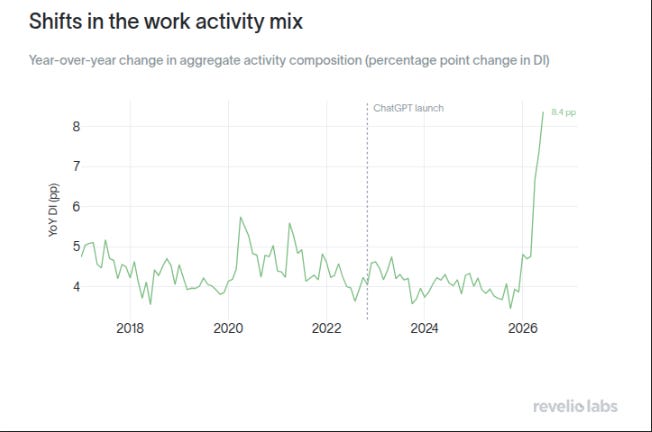
“Most of this change is happening within occupations,” Revelio researchers wrote, “rather than because the economy is shifting from one set of occupations to another.”
We’re in the (extremely) early stages of job evolution. That evolution is likely doing what we might expect, placing greater emphasis on intrinsically human skills, many of which are honed through long experience in the labor market. And that, more than large-scale job loss, might be the biggest effect in the early days of AI.
There is a very common intuition that, at the end of the day, we’ll all be teachers, artists, coaches, and therapists — that jobs with interpersonal soft skills will be the only ones to survive as AIs tear through the labor force.
But there is another path to that world. One where jobs you don’t associate with these soft skills evolve in that direction. One where a software engineer is valued, little by little, for the less technical aspects of their job until that job becomes unrecognizable to the people who tapped out the code of every app on our phones by hand.
Watch the video above to learn more about where we are on that path.
Recommended reading:
AI could destroy the labor market. We already know how to fix it.

Stop overthinking this. In reality, the most boring, well-established social democratic policy approaches will work perfectly fine.
The Tinder-ization of the job market

AI may not have collapsed employment, but it has turned job seeking into a modern dating nightmare.


