

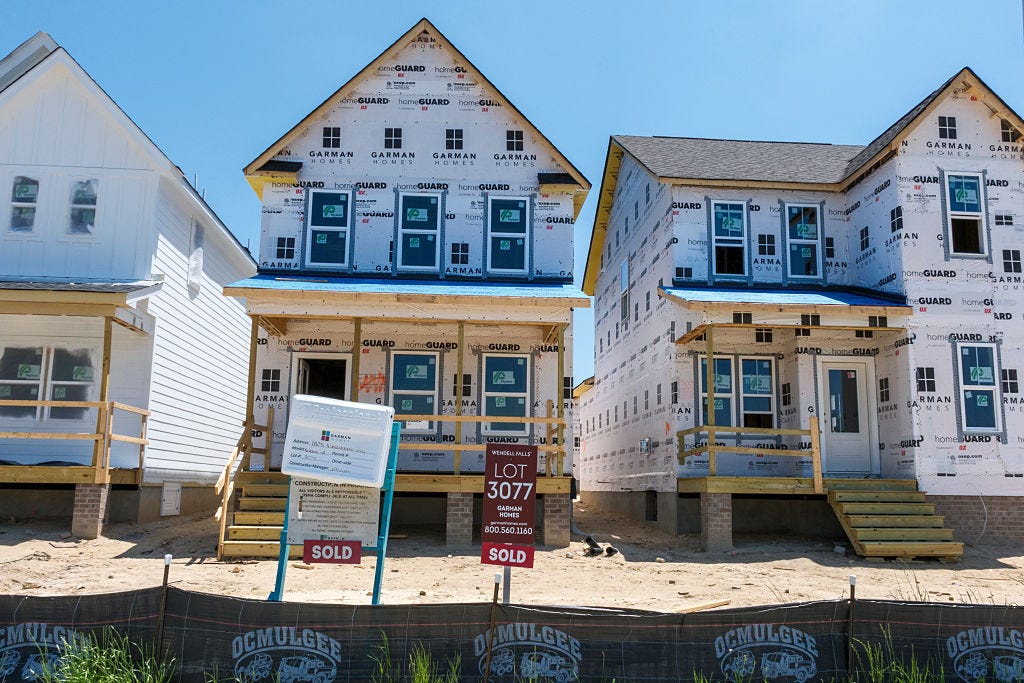
Compared with 20th-century norms, the U.S. is building astonishingly few homes, even as its population continues to grow. The result is a persistent housing shortage and record prices.
The country has only built 44 new homes per 1,000 people across the last decade, down from 57 in the 2000s and 63 in the 1990s. In fact, the U.S. currently builds at a more sluggish pace than it did even during the recessions of the 1970s and 1980s. Thanks to this persistent failure of supply to meet demand, more and more Americans are now convinced they will never be able to buy a home.
Decades of underbuilding have left the U.S. with an aging housing stock that is only poised to get grayer: Today, the average American home is 37 years old, a record high. That number has shot up from less than 30 years old in just two decades.
In a healthy housing market, the age of the housing stock would be kept down by a steady supply of new construction to meet the needs of new families, a growing population, and rising incomes. Stringent land-use restrictions prevent much of this new construction from happening, particularly in the metro areas where demand is the highest.
Yet Americans’ growing housing needs don’t vanish just because homebuilders are turned away. In 2025, Americans spent more money on home improvements and renovations than on building new single-family homes — a historical first, excepting a brief period during the Great Recession. Total renovation spending now exceeds $430 billion per year, an increase of 36% in inflation-adjusted dollars over just the past decade.
Higher housing costs mean lower mobility. That pushes homeowners to renovate rather than move into more appropriate new homes when they experience major life events like getting married, having kids, or becoming empty nesters. Restrictive permitting processes make replacing many old homes a nonstarter, so an entire cottage industry has erupted around renovating and flipping existing homes to meet the needs of new buyers.
Thanks to dynamics like these, what initially looks like American homeowners’ insatiable appetite for renovation may actually be a structural shift in construction activity that is directly caused by — or is perhaps a kind of relief valve for — the country’s chronic housing shortage.
If that’s the case — that a large share of housing investment has been redirected from building new homes to fixing old ones — then we may already be doing more to address the housing shortage than pure homebuilding and permitting data indicate. After all, converting a two-bedroom home to a three-bedroom does expand the housing supply (though it doesn’t directly address the problem of depressed household formation). And the booming business of energy-efficiency upgrades, while not increasing housing supply, can nevertheless make a big dent in the broader cost-of-living crisis.
Yet the housing market’s increasing dependence on renovations has inherent drawbacks:
