

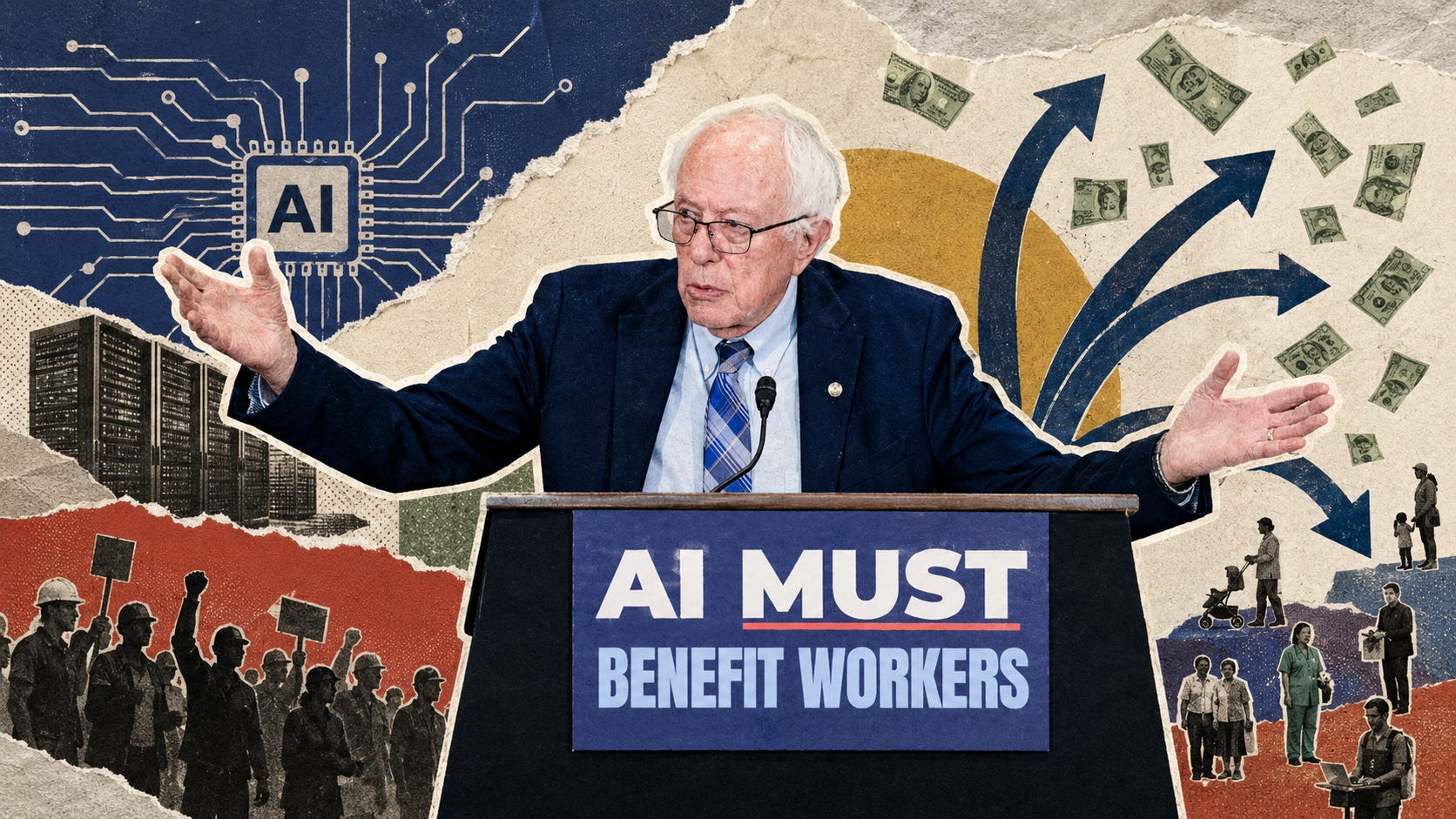
Right now, the financial future of American labs like OpenAI and Anthropic is built upon their ability to charge a premium for their services. Elected officials like Sen. Bernie Sanders are also counting on the dominance of these Big Tech companies to fund massive expansions of the welfare state. Open models could destroy both OpenAI’s current business model and the case for nationalizing AI labs.
Last week, one Chinese company struck a blow to both of those dreams: Moonshot released an open model that is near the frontier of AI capability: Kimi K3.1
In contrast to proprietary models like Claude and ChatGPT, an open model is one that can be downloaded from the internet and customized without a pricey subscription or annoying usage cap.2
Just like most businesses don’t need the smartest guy from Harvard Law to run their legal department, most businesses don’t need the frontier capabilities promised by leading proprietary models. They just need 90th-percentile versions they can adjust to fit their particular needs.
In June, Sanders proposed that the federal government take a 50% equity stake in the biggest labs in order to seed a public wealth fund, the idea being that the fund would redistribute income to counteract the economic fallout of AI. Sam Altman floated the same idea to the administration — he’s proposed a smaller 5% stake — and Donald Trump mused aloud about it on Air Force One. Early polling suggests strong public support for these schemes.
But there is simply no guarantee that the businesses currently at the technological and financial frontier of the AI boom will be the ones to capture its largest upsides. That distinction — between creating value and capturing it — is one of the oldest problems in the economics of innovation. Modern history is full of technological breakthroughs where the benefits wound up accumulating in unexpected places.
An influential 2004 paper by economist William Nordhaus argued that for every dollar of social value innovators create, they capture only about 2 cents. Nordhaus suggested that the dot-com bubble arose because investors believed that just because the internet had enormous social value, particular internet companies would be great bets. Yahoo, valued at roughly $125 billion in 2000, was ultimately sold for just $4.48 billion in 2017.
Policymakers should have a high degree of uncertainty about where we think most of AI’s value will accrue — and they should design tax policies that don’t assume all the tax revenue should come from a couple of leading modern labs.
In other words, whatever policies exist to distribute the gains of AI wealth should be agnostic to who exactly wins out in the marketplace. When the dust settles, old-school progressive tax reform — raising corporate taxes, closing loopholes, making sure CEOs pay higher taxes than their secretaries — will capture more value across the whole economy than policies like selective public ownership, since those are narrowly targeted at present-day incumbents.
We are in the very early days of figuring out how AI gets monetized. OpenAI and Anthropic may have valuations approaching $1 trillion, but that doesn’t mean their investors have taken all the right bets — and it doesn’t mean the American public should be taking the same ones.
Open models rush in
Earlier in the AI race, open models tended to be six to 10 months behind the frontier, but newer models like Kimi K3 now seem to be achieving top-tier capability only about three or four months after the leading models. The more this gap closes, the more the free models will be considered good enough for most use cases.
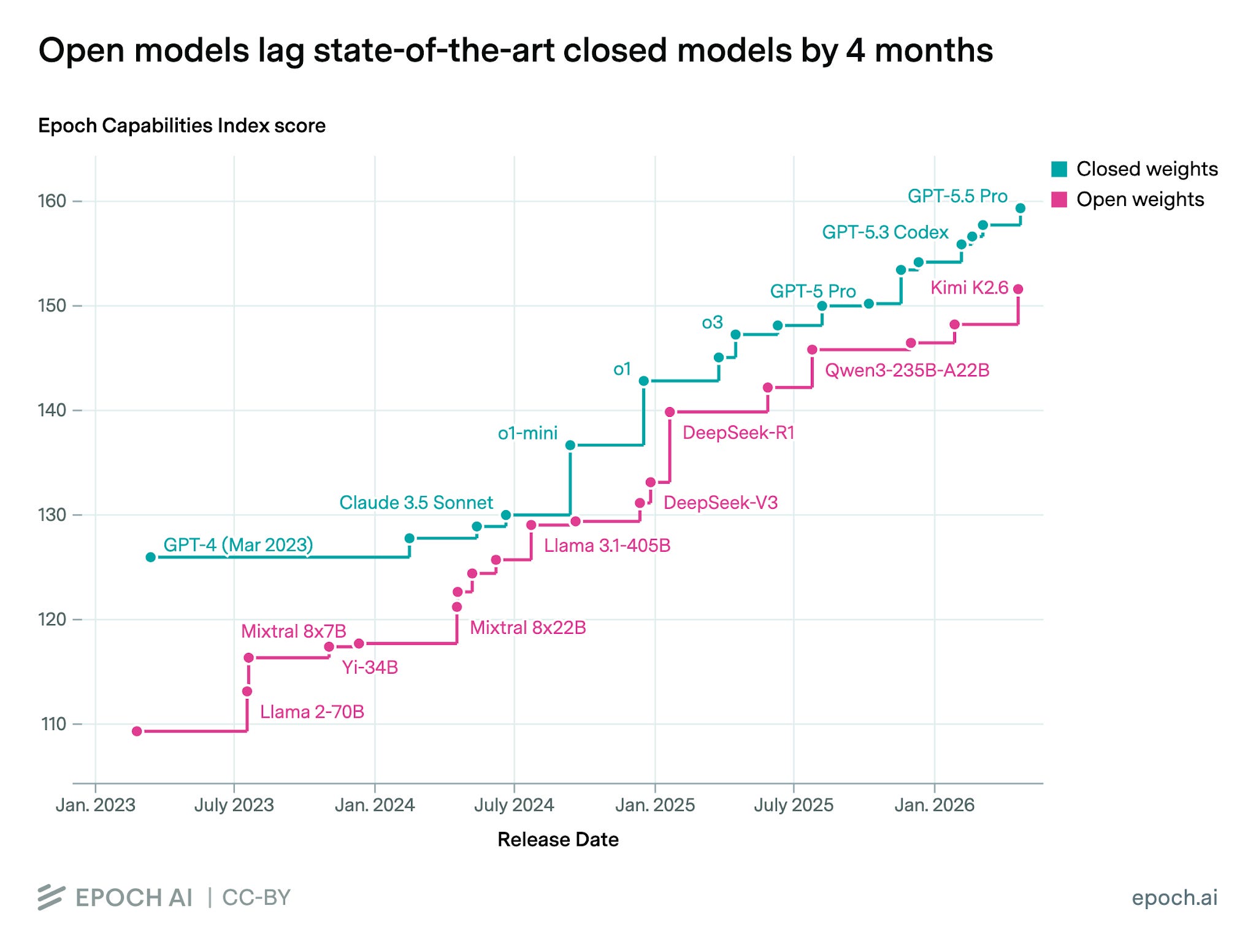
Even if the capability gap stays where it is, the market effect may be the same. In addition to Moonshot, the Chinese company Alibaba has previewed an equally competitive version of its open model, Qwen, while Z.ai’s top model already outcompetes all of Google’s proprietary models (though not OpenAI’s or Anthropic’s).
Meanwhile, more American companies are getting in the game, too, even if they lag behind Chinese open models on capability.
Last week, Thinking Machines Lab (founded by Mira Murati, formerly the CTO at OpenAI) released its first open model. Reflection, a company dedicated to open models, has touted a first release coming later this year. And Nvidia, the famous chipmaker, has both released its own open models and convened a large coalition of companies, including the French lab Mistral, to create more.
In other words, downward pricing pressure on the leading labs can come from more comparable models or just a flood of new entrants.
Of course, these open model providers are businesses, too; they are giving away the model so they can monetize other parts of the AI ecosystem. Maybe that’s infrastructure (chips in Nvidia’s case) or perhaps the service of helping an end user tailor the model (Reflection’s likely approach). In other words, the “AI market” is not one thing — it’s a stack of infrastructural and software elements.
To understand which part of that stack open models threaten, consider what happens each time you ask ChatGPT a question: OpenAI takes care of what’s called “inference,” or the actual computation of your prompt and its response. OpenAI may not own the chips that help with this. But it guarantees that its top-tier model will be available for you so you don’t have to find the chip capacity yourself.
This is likely a large part of what drives your subscription pricing, and it’s why more complex AI use cases are billed by usage. Each request costs more inference.
With open models, businesses can shop for the lowest inference price through third-party providers, and they also aren’t paying the markup for accessing state-of-the-art models themselves.3
It’s not like the big labs don’t know all this. It’s not like their investors are ignorant. The question is how they are planning to capture value and justify their massive valuations regardless.
Competition around every corner
Once multiple labs can make models that are all good enough, customers will stop caring so much about which one they use and will instead compare mostly on things like price. Arvind Narayanan, one of the influential authors of the blog AI as Normal Technology, and Akash Kapur, a visiting fellow at Princeton, argued that once this happens, firms can either become more like software companies or more like infrastructure businesses.
The trouble with infrastructure is that it tends to be hard to differentiate the core product. Electricity is the same regardless of which company generates the electrons. That makes it difficult to sustain unusually high margins unless companies can create some other source of differentiation or market power (which electric utilities have because they are regulated monopolies).
So Narayanan and Kapur concluded that, historically, capital-intensive industries have avoided becoming interchangeable when they make it difficult for customers to switch away from their products. (Imagine switching your company from Slack to Teams. It’s doable, but it’s a hassle.)
For this reason, they argued that, to become profitable, AI labs need to move “up the stack” rather than down it, toward software rather than infrastructure. The labs need to try to lock their large consumer bases into their software platforms through more valuable software services, they said. This could look like Anthropic or OpenAI creating and licensing digital remote workers or specializing in helping companies redesign their workflows around the product.
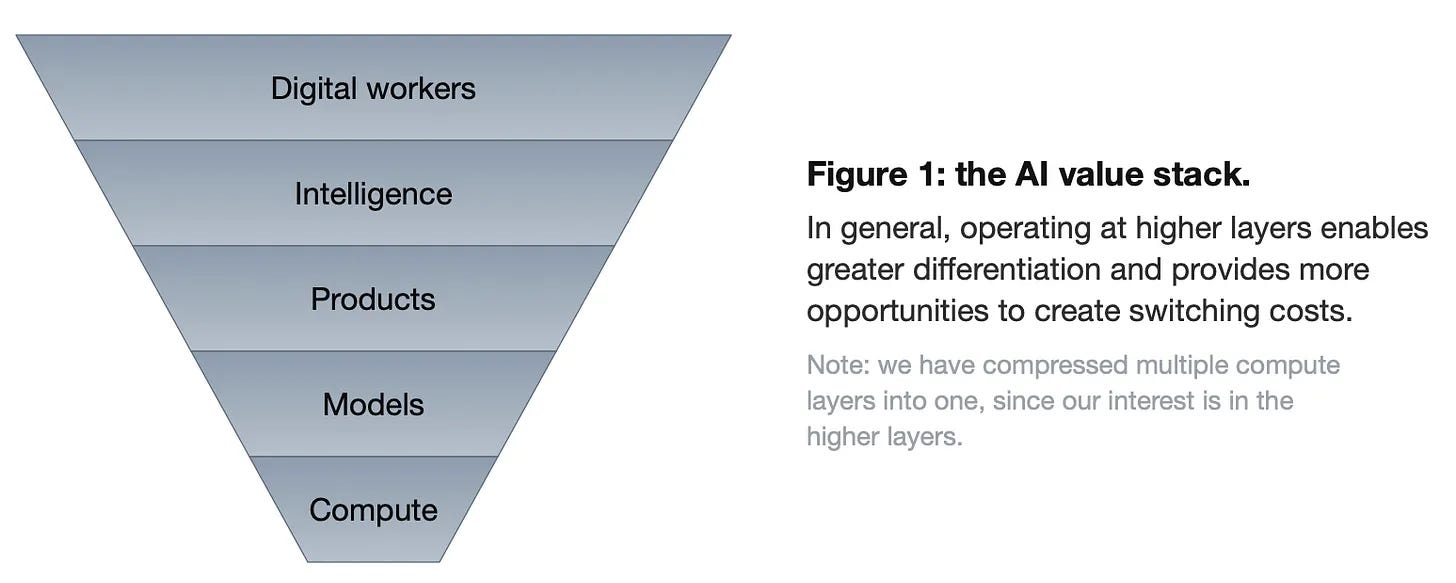
For our purposes, it’s enough to say that anywhere they turn — up or down the stack — the major labs face significant competition. Even in this seemingly preferable “up the stack” scenario, Anthropic and OpenAI face incumbents like Google and Microsoft, while turning down the stack subjects them to the low-margin trench warfare like that waged in the telecom and airline businesses.
The labs may still figure out how to hold a winning place in the market and justify their valuations — but even that is not the same as being the primary winners of an unprecedented windfall by controlling the top-tier version of a transformative technology.
Creating value isn’t the same thing as capturing it
Even if OpenAI ends up becoming enormously valuable, its profits may still end up being small relative to the amount of growth AI produces across the rest of the economy.
Railroads are the best example. Yes, the firms that built railroads made a bunch of money off passengers and firms using their infrastructure, but that profit paled in comparison to what it did to land values near train stations. Removing the entire 1890 railroad network would have reduced the value of U.S. agricultural land by 60% — landowners, not railroad companies, captured the majority of the benefit.
Electricity showed the same pattern. Almost every business in the modern world uses electricity, from the deli running its meat slicer to the chemical plant running complex industrial processes. But in those cases, most of the value is going to the business that uses electricity, not to the generator or the distributor.
While the early electricity industry did generate a few moguls, in the long run, owning a utility was not the way to the top. The emblematic fortune of the electrical age was not the utility owner; it was Henry Ford, whose factories used electric power to produce a more valuable downstream product.
As Narayanan and Kapur pointed out, the same thing applied to telecom and fiber. “During the telecom and fiber buildout of the late 1990s, capacity exploded 186,000-fold in seven years, prices crashed, and roughly $2 trillion in market capitalization was erased,” they wrote. “The value generated by the infrastructure primarily accrued to industries and applications built on top of it.”
While telecom had its boom, the trick was to be Jeff Bezos, building an internet company that put instantaneous global communication to good use. And the original dot-com boom itself saw this same dynamic.
The IBM PC is an even closer analogy to open models. To get to market quickly, IBM used off-the-shelf components, licensed Microsoft’s operating system, chose an Intel processor, and published technical specifications. The open architecture made the IBM PC the industry standard — and allowed competitors to clone it. Its PC market share fell from roughly 80% in the early 1980s to 20% a decade later, while firms like Microsoft and Intel reaped most of the profits.
So, in the present context, trying to fund a massive public policy through taxes on the AI labs themselves amounts to a nested bet: first, that AI actually does produce returns at some unprecedented rate, second, that the labs themselves are the ones to capture that wealth, and third, that the particular layer occupied by today’s labs remains scarce and defensible rather than becoming a low-margin input that shifts profits somewhere else.
The old tax solutions are the new tax solutions
All of this is why a narrow tax or equity stake on a few notable model developers is a very bad way to go about redistributing the wealth gains from AI.
The wealth from AI will be in the pockets of people whose business may have nothing to do with models, chips, or clouds. It may accrue to lawyers who become able to serve three times as many clients as they did before AI, a manufacturer whose widgets leave the line twice as fast, or a landowner whose property becomes more productive and valuable.
In fact, the more economically transformative AI is, the more it follows that value is going to spread to non-AI businesses. The wealth of any boom goes to those who capture productivity gains and invent novel products. AI will make the capital class as a whole more wealthy. And if that’s the case, we need a funding mechanism that captures all this wealth.
The point is not that model labs can’t become huge and durable companies — some pioneers do build moats — the point is that the magnitude of a technology’s social value tells us remarkably little about how much of that value any one pioneer will capture.
An idea like taking an equity stake in the labs could produce a lot of money, but that’s a risky bet when a broad-based tax hike is sure to produce a lot of money.
In a recent The New York Times op-ed about the equity stake proposal, the Council on Foreign Relations’ Sebastian Mallaby put some figures on an optimistic scenario (assuming Altman’s 5% figure wins out over Sanders’ 50%). He calculated that even if the major labs’ shares rise at 20% per year — about double the S&P 500’s average over the past two decades — the public wealth fund would yield under $30,000 per U.S. citizen after 10 years.
For context, that’s only a quarter of the per-capita value of Alaska’s sovereign wealth fund (which is supported by the state’s oil revenue). And that fund only pays out $1,000 per year.
This is not remotely close to a basic income. It’s at best a small buffer against a turbulent economy.
Any proposal that takes the possibility of massive job losses seriously has to look more broadly at the issue. It has to be premised on the notion that we can’t predict where gains will accrue, that the value from a general-purpose technology does not always show up as income connected to the technology itself. It will show up across the economy. In the case of a labor-displacing technology, it could show up mostly as returns to capital.
AI growth requires getting ready for a world where we don’t — and can’t — know who will get rich off it. The tax base has to follow the gains wherever they appear, not bet the welfare state on owning today’s top performer.
Recommended reading:
AI could destroy the labor market. We already know how to fix it.

Stop overthinking this. In reality, the most boring, well-established social democratic policy approaches will work perfectly fine.
The Tinder-ization of the job market

AI may not have collapsed employment, but it has turned job seeking into a modern dating nightmare.
Measures of capability like Artificial Analysis’ Intelligence Index or Epoch AI’s Epoch Capabilities Index aggregate and weight across a number of benchmarks. What this means is that individual models that appear close to each other in the index might be better or worse on some given task type — so if Kimi K3 lags GPT 5.6 overall, it may still do better at, say, math problems.
On top of that, since open models can be further tuned by their users, an open model can be trained to improve in a specific domain such that it is indistinguishable from “frontier” intelligence on that task (a point open model expert Nathan Lambert raised in his recent podcast).
There is a distinction between open-source and open-weights models. Open source means that the training data and the code are released in addition to the model weights, while open weights only releases the model weights. In this piece, open model refers to the latter, which is what most labs mentioned here are doing.
Importantly, Moonshot is releasing its weights on July 27, almost two weeks after the initial model release.
I think this places too much weight on the words open and free. K3 is very much not free in the conventional sense. It's about 30% cheaper than GPT 5.6 Sol, on openrouter right now. It's true that companies could run it on their own infrastructure but that's also not free, and also true that this price will come down, like the prices for all models.
Agree that the govt. should NOT make these bets. Consistent with Sanders' ignorance of how capitalism works.