


-Welcome to The Weekly Scroll!
The Weekly Scroll is a once-a-week roundup of the most interesting, strangest, and funniest stories from around the social internet.
This week, we’re talking about Massachusetts lesbian bar drama, Clavicular’s criminal charges, and why hit music seems to stick around forever.
What Western Massachusetts lesbian bar drama says about our news environment
This week’s incredibly viral story from The Boston Globe kicked off when the Last Ditch Bar in Greenfield, Massachusetts, announced a new policy on Instagram: On Saturday nights only, the bar will lift its normal requirement that guests wear KN-95 masks. The new “mask optional” policy was received about how you would expect from patrons of a bar that still has a mask mandate in 2026.
“People like you kill disabled people in the name of your own leisure and convenience,” said one commenter.
“I hope your venue gets firebombed for robbing my fellow immunocompromised people of their Saturday plans just to scrape extra revenue from ablists [sic],” said another.1
Accusations of eugenics ensued, and the drama only snowballed from there. The story itself became more and more absurd:
The bar was forced to apologize, but the Instagram apology post sparked controversy because it lacked alt-text and was thus inaccessible for the visually impaired.
The bar’s most strident critic is a self-described gender-expansive lesbian who uses he/him pronouns named Soe Noire.
When Jackie Matellian, one of the bar’s owners, broke down in tears during a facilitated mediation session because she was paying off a $50,000 loan trying to make the bar function, Noire accused Matellian (who uses she/they pronouns) of “WHITE THEY THEM TEARS” on social media.
The bar had two other founders, by the way, though Matellian is the only one still involved. The second is a drag performer who uses it/its pronouns. The third abandoned the bar to attend clown college. (I swear I am not making this up.) Presumably she enrolled with a number of credits already fulfilled.
The bar, which boasts a native plant garden and a free community store, describes itself as a welcome space for unhoused people. Poor people don’t have to pay if they can’t. The bartender? Also not being paid a salary.
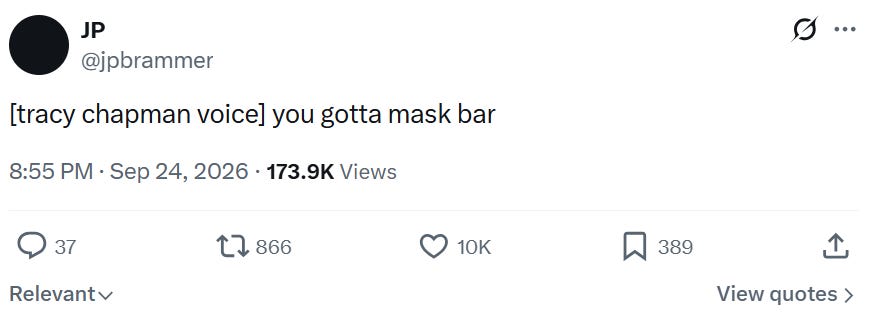
Remarkably, the bar’s latest Instagram post is asking people to Venmo Noire money. I can only speculate as to why, but an enormous number of “queer spaces” seem to end up less about LGBT people hanging out or hooking up and more about “practicing revolutionary politics” in the form of being insufferable. Or in other words:

The entire incredible story is filled with the kind of insane little details that separate good reporting from great reporting.2 But while I can’t stop thinking about this story, I also can’t stop thinking about what it says about the state of the news industry. According to Semafor’s Max Tani, the article is on pace to shatter records at The Boston Globe and is the newspaper’s best performing story of the year, leading to more than 1,000 new subscriptions.
The decline of the news industry is (sigh) old news at this point, but what if the key to reviving it is simply to keep finding weird, insane stories like this?
News has always worked best as a business when it’s part of a bundled package. In generations past, newspapers bundled traditional news with sports, weather, stock information, and the funny pages — someone who wanted a subscription to access one of those things had to pay for them all. But the internet unbundled these functions, making each less valuable on its own.
That said, you can still see the virtues of the business model in some of the few news success stories of recent years: Today’s The New York Times has been called a “games company with a newspaper side hustle.” Maybe the new bundle looks something like this: viral slop stories that generate outrage and drama, which bring in eyeballs and subsidize more serious journalism for the rest of the publication.
After all, this is the same week that The Philadelphia Inquirer published the revelation that a white Jewish teacher in Philadelphia spent years pretending to be both Black and Palestinian, a story that would have consumed a whole week’s worth of discourse if not for the exceptionally crowded field this week.
Stories that take over the discourse do sometimes serve a serious public purpose. Nikole Hannah-Jones’ viral story about betraying her own daughter by sending her to a dysfunctional public school spawned a lot of productive arguments about the state of low-income schools and education policy. It was discourse-generating, sure, but in a potentially useful way.
But other stories are pure slop with no real value other than making people laugh and argue like lunatics on social media. New York Magazine’s The Cut vertical is the undisputed master of this genre in recent years, with pieces about a personal finance columnist who put $50,000 in a shoebox and handed it to a stranger, a mother who was cyberbullying her own daughter, and a bestselling author who divorced her husband to begin a relationship with a friend who was dying of cancer, only to help said friend relapse on heroin and cocaine and then abandon her just before she died.
It seems like publications of all types are now relying on viral stories of questionable news value to generate traffic. This harkens back all the way to the very first era of mass-distributed newspapers in the United States, when the so-called penny press featured a mix of wild sensationalism and normal reporting on public affairs. It’s a very, very old truth that most people don’t want to pay for sober, professional reporting by itself without some sort of sweetener. If you want the public to eat its vegetables, you’d better be offering some form of dessert. So maybe this kind of discourse slop is what can ultimately save journalism?
Just one more post about the bar
Clavicular gets charged
Earlier this week, I wrote a column arguing that it’s a bad idea for political parties or actors to associate with scumbags.
The scumbag style in American politics

Earlier this month, the Effective Altruist (EA) funding platform Manifund made a shocking announcement: It had hired convicted fraudster Caroline Ellison.
The basic logic is simple: Nominating scumbags as candidates makes your party more susceptible to future scandals. Hanging out with them on the campaign trail will come back to bite you later. And they’re almost always unreliable partners, the first to turn on you when they sense an opportunity to benefit. Even if you think there are some short-term benefits, they rarely outweigh the costs.
My article was mostly focused on political actors, but the same logic can easily be transferred to other walks of life. If you’re a company, don’t hire a known scumbag as a spokesperson. If you’re a media personality, try not to buddy up to scandal-ridden influencers, no matter how cool or intriguing or famous they might be. If you do, you might be forced to explain why on earth you were associating with them when the next big scandal drops.
Anyhow! You’ll be shocked to learn that Braden “Clavicular” Peters, the influencer famous for his nihilistic view that enhancing your own physical attractiveness (“looksmaxxing”) is the sole defensible aim of life, has been charged with drugging and raping an underage woman in Massachusetts. It’s always the ones you most suspect.
Clavicular had been on a publicity tour recently, appearing onstage at the All-In Summit (he rated cohost Chamath Palihapitiya a 4/10) and going on Howie Mandel’s podcast, among others. If only there had been signs that Clavicular was not on the level. All we had was his penchant for hitting his own face with hammers, allegedly shooting at an alligator, getting arrested for battery, and singing “Heil Hitler.”
It’s a very simple rule, folks. Just don’t cozy up to scumbags!
Why is THIS becoming the most successful song of all time?
Earlier this week, Ella Langley’s smash hit “Choosin’ Texas” broke the all-time record for nonconsecutive weeks at No. 1 on the Billboard Hot 100. It’s in the top slot for the 23rd week, and the 13th in a row.
I, like many people, find this a bit hard to believe. Before writing this article, I had literally never heard the song once. And I’m not alone; I’ve seen dozens of posts expressing incredulity that this could be the biggest song ever. Granted, I’m not a regular country music listener, and I live in New York City; I’m not the target demographic. But I do follow cultural trends closely, and I’m online all the time. It feels odd for what is now the most successful song of all time (at least by one metric) to be something I could just completely miss.
So what’s going on here?
At least part of the story is an increasingly fragmented and polarized media landscape. For as much as I’ve never listened to her, Langley is authentically very popular. Her tour announced a second leg, and she’s got legions of fans (including male followers who call themselves Ella’s Fellas). Maybe those of us who are confused by all this just aren’t living in the right part of the country.
But that can’t be all of it. If you look at the top 15 songs with the most time spent at No. 1 on the Billboard chart, almost all of the 20th-century hits were truly and unavoidably omnipresent. You could not escape Whitney Houston’s “I Will Always Love You,” Elton John’s “Candle in the Wind,” or, God forbid, the “Macarena.” It didn’t matter what subculture you were in: Those songs were everywhere. “Choosin’ Texas,” for all its genuine popularity, is no “I Will Always Love You.” So how has it stayed at the top so long?
There’s something else funny about the list I linked above: Around half of the longest runs at the top of the chart have occurred in the last decade. This isn’t a coincidence. There’s research showing that songs that hit the top 200 on Spotify now hang around in the top 200 more than twice as long as they used to. The problem has grown so acute that Billboard changed its rules last year to prevent the same songs from charting for several consecutive years.
There are two main reasons why this might be happening, and both have to do with how the internet has changed music. In the past, the charts were calculated based on sales and radio play. Today, streaming is by far the most important distribution channel for music, and Billboard is constantly updating its formula to give streaming numbers more weight. A fan of a song in a previous era was counted once when they bought the single or the album. But streaming is an endlessly renewable vote; rather than measuring a one-time purchase, streaming measures attention, which can last for years.
In addition, success on streaming platforms now creates an algorithmic feedback loop. Once a song becomes popular, it starts getting heavily recommended across the platform. It gets added to a wide variety of playlists that people use for background listening. And because it’s being recommended and it’s got a semi-permanent spot on so many playlists, it remains near the top of the charts, sometimes indefinitely. Teddy Swims’ hit “Lose Control” was in the Hot 100 for 112 consecutive weeks. It only dropped off because Billboard changed the rules to kick it out.
I think this is what really explains the mystery of the popularity of “Choosin’ Texas” — every hit song is much, much stickier today than it was in the past. Current popularity becomes algorithmic evidence that it’s what people want to hear, and that in turn leads streaming platforms to recommend a song even more heavily. Throw in a polarized media environment, and you end up with one of the most successful songs of all time (that a giant chunk of the country has never heard).
Links
After Trump banned various press outlets from the White House, he had an embarrassing episode where no press showed up for one of his appearances and therefore the event had disrupted audio. To counteract this failure, the White House launched Trump TV, which is essentially a YouTube livestream playing reruns of past Trump commercials and events. Last time I checked, there were fewer than 500 people watching, so, you know, great job to Team Trump.
A Roblox creator is suing a partner for at least $35 million in damages in a messy dispute over who owns a massively popular game on the platform. Roblox, which is the largest video game/game platform in the world by a mile, continues to be one of the most overlooked but quietly influential tech platforms in the world.
Meta’s Muse AI agent will tell you that it can place calls on your behalf. But Meta is actually testing using a team of humans to make some calls instead.
I’m normally dismissive of attempts at AI-generated video, but this music video made by Claude Opus 5.5 is … pretty dang impressive?
AI-generated “actress” Tilly Norwood gave an interview to Piers Morgan during which she, for no discernible reason, began speaking in Cantonese.
MrBeast has filed a trademark application for “Beast Band,” a wearable fitness device.
The hot new social app is the NPR Spotify comment section.
An army of paid creators is carpeting the web with political content.
Posts
Amazingly, this commenter is the same account of “hijab-inspired secular accessorization“ and “Irish people are the only people who should be drinking milk” fame.
One of the best: “Just after midnight, one patron is left at the bar, a regular who works at the Mexican restaurant next door. She wonders aloud about holding a Lady Gaga themed night, but Mixxy demurs. ‘Gaga is canceled,’ she says. ‘Gaga is Zionist.’”
I think conservative media already recognized that this kind of reporting is catnip for both the laptop class and those who resent them. The interesting thing about the globe story is that it opens the Overton for struggling mainstream outlets to run the same playbook — and frankly, great!
Good for business, good for truth, good for liberalism. Let’s get after it. Doesn’t even have to be critical — best part about the globe story was that it just let the facts speak for themselves. One could have done a similar story comparing Socialism 2026 with Canada’s similar event from a few months prior. Just the facts. The oh so juicy, irresistible, can-you-believe-she-just-said-that facts. Lot of opportunity for y’all at the Argument here!
I'm surprised you and your circle hadn't heard of Langley's song. The entire album is worth a listen. She's a talented artist, not just label-boosted pop country. Wrote that song with Miranda Lambert, herself an under-recognized icon, based on a story of Miranda getting pulled over in a convertible when she had a kangaroo in the front seat of her car. In WA and ID where I work and play it's all over the radio + IG + line dancing bars. Though I suspect there aren't as many of those in NYC.