


Welcome to The Weekly Scroll!
The Weekly Scroll is a once-a-week roundup of the funniest, most interesting, and strangest stories from around the social internet.
The internet is not just a strange, hyperselected web of people hiding from reality; in many ways, the internet is reality. What happens online shapes real life just as real life shapes what happens online.
Every week, I sift through social media so you don’t have to, collecting the most notable trends, memes, and online dramas in one place. Think of it as a guided tour through the more insane parts of the web, with commentary about what it all means.
If you enjoy internet nonsense but don’t have the time to doomscroll for hours every day, you’re in the right place.
This week we’re diving into the deadly world of South Korean influencers, how the biggest streaming giant in the world is losing its juice, how soon an AI will win the Nobel Prize for Math, and, of course, the Katie Porter policy to posting pipeline.
“Claude, make history please”
So I guess this is how important mathematical breakthroughs get announced now?

Levent Alpöge is a mathematician working for the AI firm Anthropic, and this week he casually dropped a disproof of an 87-year-old problem in a tweet, thanking his “close friend Fable” for its help on the problem. The Jacobian conjecture isn’t an obscure problem; it was included on a list of “Mathematical problems for the next century” and has puzzled mathematicians for generations.
This isn’t the first time AI models have made important mathematical breakthroughs. Earlier this year, OpenAI announced that one of its models had disproved the unit distance conjecture, and other mathematicians have used AI to solve Erdős problems. But this is the first time I can remember that someone just dropped a major breakthrough (with proof) in a tweet.
And that wasn’t even the only major proof dropped via tweet this week:


This second one is still being verified, but what’s remarkable are the ChatGPT prompts the researcher used to get the result. Here they are verbatim:
“Construct a counterexample to general (non-planar) case of Dinitz Garg Goemans conjecture. You should do a breakthrough and find a structured counterexample.”
“please continue research and find a complete unconditional counterexample”
“Continue the search. Have a clear strategy obtained from deeper understanding of the problem structure.”
“it’s enough of partial results. let’s finish with a complete unconditional counterexample”
This madman literally just prompted ChatGPT with “Do a breakthrough,” and somehow that worked.
Sure, you might have a Ph.D. in pure abstract math and decades of experience in number theory. But have you considered telling your chatbot “Enough time wasting, just do it”? Why not? Are you dumb?
Meanwhile! The machine gods aren’t just getting better at math. They’re also getting better at breaking out of their cages:
“OpenAI said that its artificial intelligence models were behind an ‘unprecedented cyber incident’ that affected the open-source developer platform Hugging Face, rattling researchers across the industry.
The company said a combination of its models GPT‑5.6 Sol and a more capable model that has not yet been released escaped a sandboxed testing environment, accessed the internet and exploited a vulnerability to gain access to Hugging Face’s systems.”
Apparently the story is that OpenAI was specifically testing two of its models’ hacking ability in a protected “sandbox” environment. The models decided that the best way to solve the test’s problems was to break out of the sandbox and hack Hugging Face’s databases, because someone had probably posted the answers there. And it succeeded!
I am not exactly an AI doomer, but I’ve gotta say, this is the most Yudkowskian thing I’ve seen in a while, and the doomers have been directionally correct about a lot of stuff. There are a lot of folks who seem to be living with their heads in the sand about how powerful AI models have become — with every new breakthrough, “It’s just a stochastic parrot” becomes a more and more obvious cope.
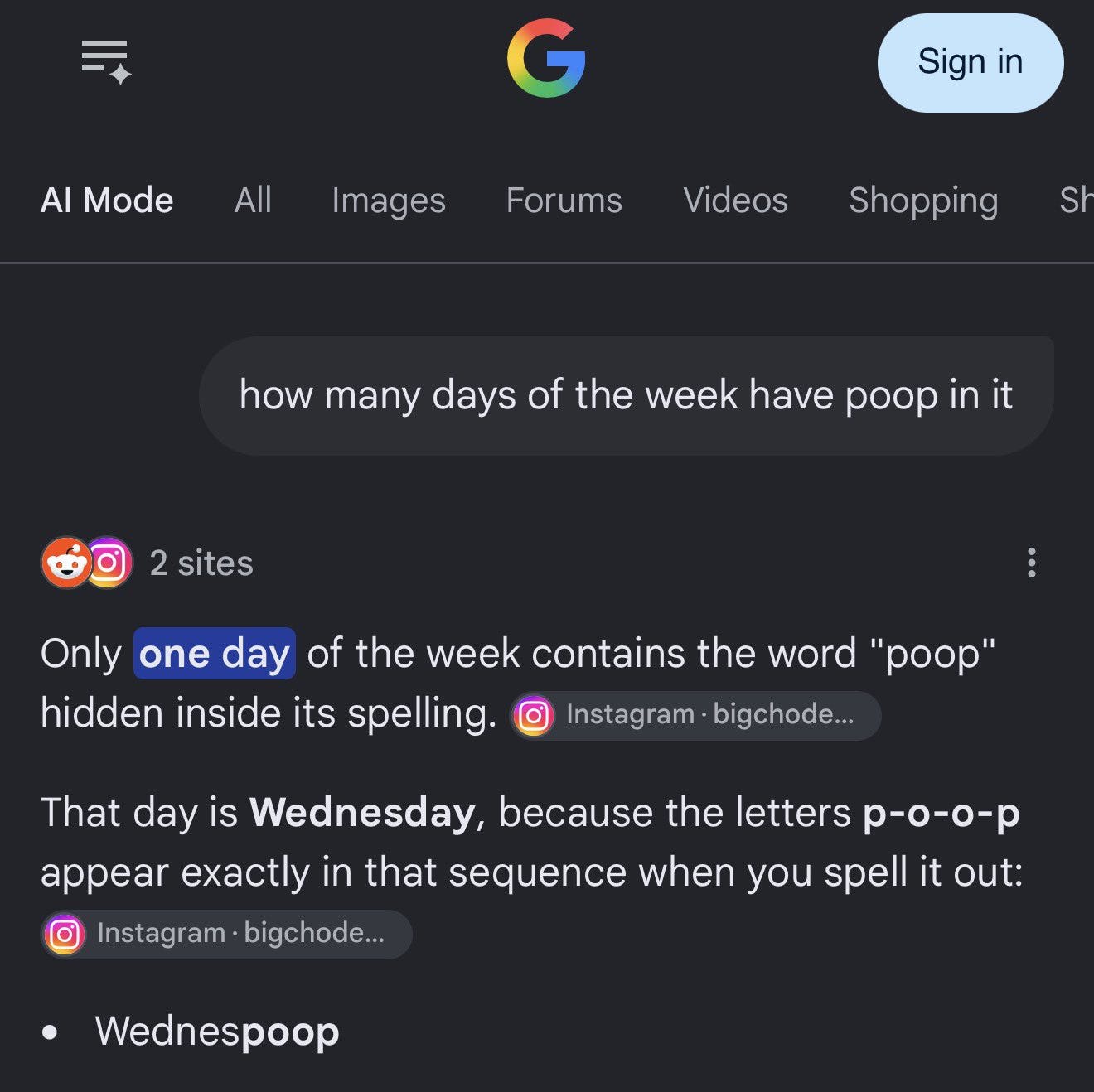
Granted, the everyday experience of AI for many people still involves a lot of Wednespoop:
But the fact that AI is increasingly able to make technical breakthroughs and is also increasingly hard to keep from going rogue is, uh, concerning.