

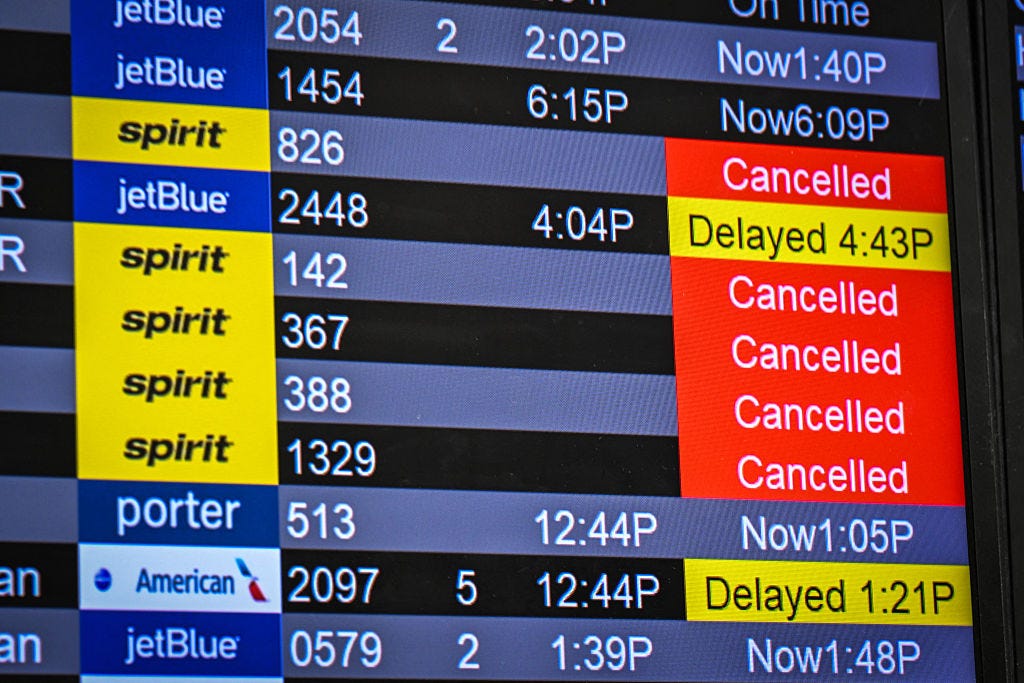
Spirit Airlines is dead, and the right, true to form, is blaming Joe Biden.
The immediate cause of Spirit’s demise is pretty clear: The war with Iran spiked jet fuel costs, and the already-battered airline couldn’t absorb the hit to its bottom line. Last I checked, Joe Biden didn’t start any wars with Iran.
Spirit also had some other problems — a Pratt & Whitney engine recall that grounded a huge share of its fleet, legacy carriers copying its unbundled-fare model and capturing some of its customer base, a failed strategic pivot toward premium offerings…
If Spirit Airlines merged with JetBlue would it still be around? Maybe. Or maybe the expanded JetBlue would be bankrupt, too.
The Biden Department of Justice argued successfully against the JetBlue-Spirit merger on the grounds that we needed to preserve Spirit as an independent, ultra-low-cost carrier disciplining legacy fares. And while the right’s shrill attempts at deflecting from Trump’s death spiral of a presidency are unpersuasive, I do find the deflections of the anti-merger crowd to be a bit “The lady doth protest too much.”
Matt Yglesias has been bugging me for a while about how the airline deregulation discourse is a “skeleton key” for understanding what the modern “anti-monopoly” movement is really about. I had sort of brushed him off because it was very much giving conspiracy theory.

But when he proposed we talk about it for this week’s episode of The Argument, I also fell down the rabbit hole.
As Matt says of the Biden administration’s antitrust intervention: “It’s not that they caused Spirit to go bankrupt … it just calls into question what they were trying to accomplish here.”
Anti-monopoly implies a focus on competition, so much of what this crowd does sounds like that’s the focus. The Open Markets Institute, the American Economic Liberties Project? These sound like organizations focused on increasing competition and free enterprise. But that’s just not what’s going on.
Take airlines: The single biggest unlock for lowering prices for consumers and raising competition is allowing foreign airlines to compete against domestic airlines. But, as far as I can tell, not a single one of these organizations is focused on making that happen.
As proof, many European countries similarly deregulated their airline industries a decade or two after the U.S. and allowed much more competition than the U.S., including making them accessible to foreign ownership and foreign carriers. As a result, the top four airline groups now control just 40% of the market. (In the U.S., without this competition, the top four control 74%.)
And, importantly, the pre-airline-deregulation decades that the anti-merger crowd yearns for were straightforwardly anti-competitive. The Civil Aeronautics Board regulated basically everything about air travel, and it wasn’t trying to pave the way forward for new airlines to compete against existing ones for the purpose of lowering consumer prices; it was actively making it difficult for new entrants to join the market in order to artificially keep prices up.
Flights in the previous era cost travelers 20% to 100% more than they would have in a competitive market.
And all of that is justified by the idea that airlines are such a weird market that, if allowed to go unregulated, it will lead to something called “destructive competition.”
We talk about that and more on this week’s episode of The Argument.
Watch or listen wherever you get your podcasts.
The Argument. Libbing out.
(Illustration by The Argument, image by Justin Sullivan via Getty)
The transcript will be after the paywall in this post for paying subscribers.
New episodes post every Thursday.
For an ad-free version and full transcript, subscribe at TheArgumentMag.com.
Subscribe: Apple Podcasts | Spotify | YouTube | Overcast | Pocket Casts
Time stamps:
0:00-Spirit Airlines is dead
7:07-The blocked JetBlue merger
14:54-1960s airline nostalgia
21:12-Matt’s tinfoil hat theory
26:29-Pre-Carter airline monopolies
35:26-The dawn of deregulation
47:17-Anti-monopolists want less competition
54:19-America’s protectionist policies
58:22-Peer review: Marriage and gender-coded purchases
Corrections:
At 0:55:00, Jerusalem says the EU began creating its single aviation market starting in 1992 and going through 1997. While the full package of legislation did take effect in 1997, the first legislative package was passed in 1987.
At 0:55:24, Jerusalem says that the five largest European aircraft control 45% of the European market while the four largest U.S. aircraft control 80% of the U.S. market. Those figures were accurate, but slightly more recent analysis shows the markets have shifted somewhat. A 2018 analysis showed the four largest European airlines controlled 40% of the EU market, while a 2025 analysis showed the four largest U.S. airlines controlled 74% of the U.S. market.
Show Notes:
Coverage of the Strait of Hormuz, through which 20% of the world’s oil and natural gas travel, being closed since Feb. 28: Brookings article, CBS News article
Coverage of jet fuel composing 20% to 30% of airlines’ costs: OpenAirlines article, Seeking Alpha article, IATA article
Coverage of Spirit attempting Chapter 11 bankruptcies to save itself before shutting down under Chapter seven: Law.com article, OAG article, Las Vegas Sun article
Coverage of Spirit blaming rising fuel costs in bankruptcy filing: AirlineGeeks article, Time article
Podcast hosted by conservative comedians Stu Burguiere and Dave Landau that blamed Spirit’s failure on the Biden administration’s decision to block Spirit and JetBlue’s merger: BlazeTV podcast episode
Coverage of Transportation Sec. Sean Duffy blaming Spirit’s failure on the Biden administration’s decision to block Spirit and JetBlue’s merger: Fox News article, ABC7 article
Coverage of JetBlue losing money: Reuters article, Quartz article, The New York Times article
Coverage of Pratt & Whitney’s recall of its geared turbofan engine, which impacted more Spirit aircraft than all other airlines combined: Simple Flying article, FlightGlobal article
Coverage of Spirit receiving over $150 million in compensation from Pratt & Whitney due to recall: Aerospace Global News article
Coverage of a Reagan-era judge blocking JetBlue’s merger with Spirit Airlines after President Biden’s DOJ sued to stop it: AP article, CNBC article
Coverage of Spirit boosting premium offerings after its merger was blocked: Reuters article, Upgraded Points article, Spirit Airlines release
Coverage of Delta president grudgingly introducing Basic Economy fares to compete with Spirit, even though “People don’t really want the product when they see exactly what it is.”: Conde Nast Traveler article, CNBC article, AJC article
Photos shown depicting 1960s and 1970s air travel: Getty image, Getty image
Coverage of plans at low-cost European airlines, including Ryanair, to offer short flights with small, vertical, stool-like seats that resemble leaning more than sitting. Prices for these flights could be as low as five Euros: EuroWeekly News article, Thrillist article
Coverage of 1978 airline deregulation changes, initially under Jimmy Carter: Journal of Transport Geography article, Air and Space Museum article, EBSCO article
Coverage of Trump Shuttle’s operations and failure: The Washington Post article, AeroTime article
“Amazon’s Antitrust Paradox,” article by Lina Khan on Amazon’s e-commerce domination: The Yale Law Journal article
“Terminal Sickness,” article by Phillip Longman and Lina Khan attacking airline deregulation: Washington Monthly article
“Why Flying Is Miserable: And How to Fix It,” book by Ganesh Sitaraman arguing that airline deregulation was a mistake: Goodreads page, Amazon page
“The Anti-Bigness Ideology,” article by Matt Bruenig about why bigness isn’t a huge concern for his socialist ideology: Mattbruenig.com article
Federal Aviation Report of 1935, which defended the lack of competition created by strict airline regulations, saying “To allow half a dozen air lines to eke out a hand-to-mouth existence where there is enough traffic to support one really first-class service and one alone would be a piece of folly.”: Govinfo page
Article profiling former Sec. Mayor Pete Buttigieg’s conversion to the anti-monopoly cause: Politico article
“How Airline Markets Work… or Do They? Regulatory Reform in the Airline Industry,” paper by Severin Borenstein and Nancy L. Rose arguing that the price volatility in airlines can be explained by normal macroeconomic conditions: NBER chapter
Abundance, book by Ezra Klein and Derek Thompson: Goodreads page, Amazon page
“Airline Deregulation, Revisited,” essay by former Justice Stephen Breyer expressing regret about the effect airline deregulation had on workers: Bloomberg Businessweek article
History of the United Fruit Company’s actions in Latin America: Harvard Review of Latin America article, Retrospect Journal article, The World article
“Why airlines are always going bankrupt,” article by David Oks about competition in the airline industry: David Oks article
“We Fly Congress: Market Actions as Corporate Political Activity in the U.S. Airline Industry,” Temple University study showing airlines increase flights to districts where members of Congressional transportation committees live: Organization Science article
“The Secret to Reindustrializing America Is Not Tax Cuts and Tariffs. It’s Regulated Competition,” 2025 article by Phillip Longman, cited by Matt: Washington Monthly article
Red Plenty, book by Francis Spufford about communist abundance: Goodreads page, Amazon page
49 USC § 40102(a)(15), U.S. law that states domestic airlines must have 75% of voting stock and a majority of equity owned by U.S. citizens: GovInfo U.S. code
Fact sheet on EU air transport rules to form a single aviation market, which began in 1987 and were implemented through 1997: EU fact sheet
2015 analysis showing the five largest European airlines (Ryanaid, EasyJet, Lufthansa, Air France-KLM, and IAG) control 45% of the European market: European Commission page
Slightly more recent analysis (2018) showing that the four largest European airlines (Ryanair, Lufthansa, Air France-KLM, and IAG) control 40% of the European market: Global Finance article
2025 analysis showing the four largest U.S. airlines (United, American, Delta, and Southwest) control about 74% of the U.S. market: Spherical Insights analysis
“Do Airlines in Chapter 11 harm their rivals?: Bankruptcy and pricing behavior in U.S. airline markets,” paper by Severin Borenstein and Nancy Rose showing that bankruptcies can cause prices to dip briefly: NBER working paper
Peer review: “Gender-Specific Economic Shocks and Household Bargaining Power,” paper by Rania Gihleb, Osea Giuntella, and Dor Morag: NBER working paper