Was the 2026 election a referendum on moderation?
In the week since the biggest blue wave in a half-century, takes have flown fast and furious. Moderates like Third Way say that moderation made the Democratic majorities, while more progressive academics say that its impact was near-nonexistent.
I think both of these takes tell an incomplete story.
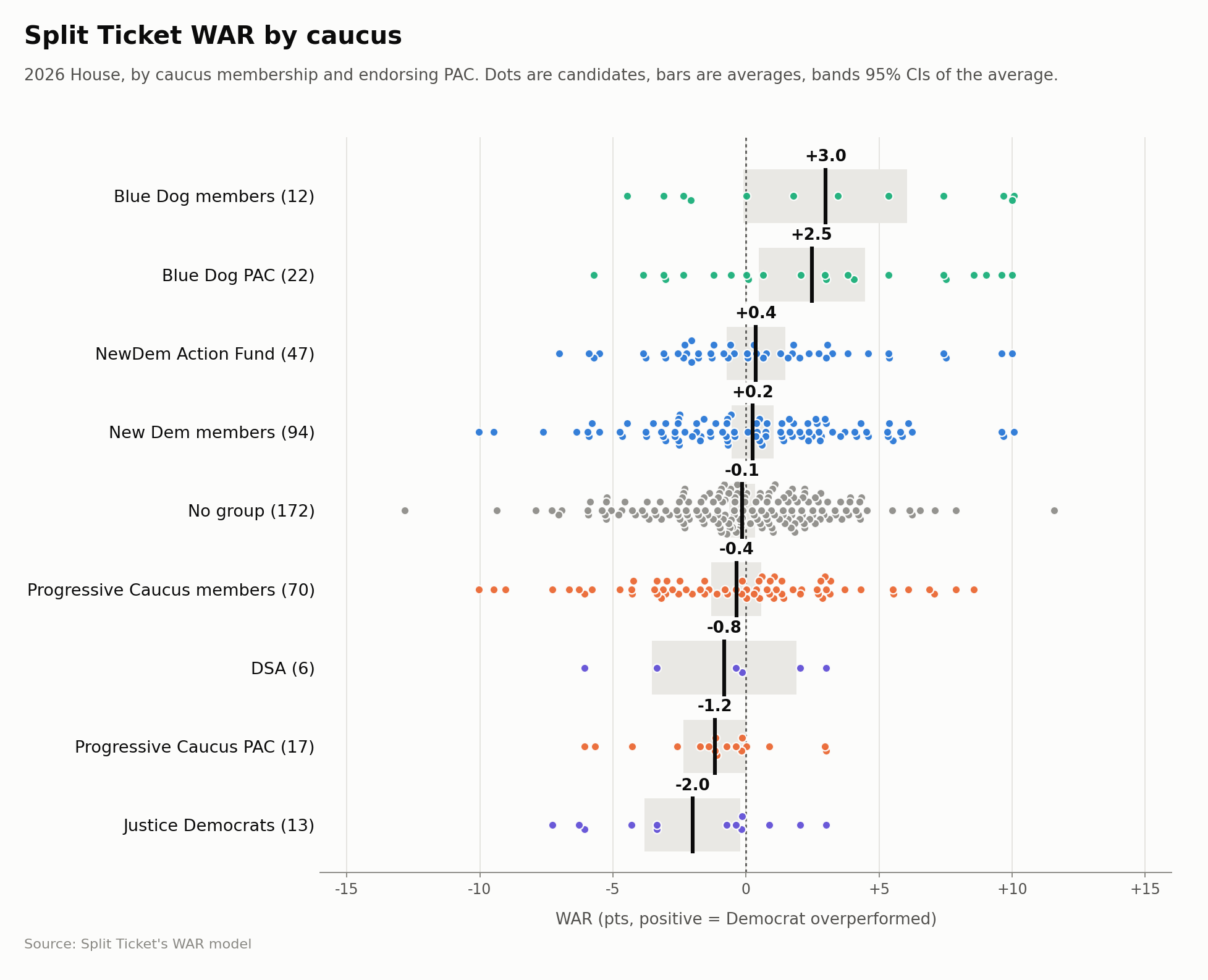
We won’t have full results for a while; ballots are still outstanding in several states, after all. But current tallies of the 2026 vote give us a fairly comprehensive picture — one in which moderation does seem to systematically advantage a Democratic candidate by as many as 3 percentage points. This advantage absolutely helped Democrats build their majority: In races like the Mississippi and Alaska Senate contests, which are close enough that they haven’t been called yet, a 3-point swing would probably have resulted in a Republican hold.
But while moderation still clearly helped candidates from both parties perform better than they would have otherwise, moderate politicians may have had less of an advantage than ever before.
There’s a metric Split Ticket has developed over the years called Wins Above Replacement (WAR). Similar to its baseball analogue, WAR for elections tells you how strong or weak a candidate was relative to a race where a generic Democrat squares off against a generic Republican.
For instance, take Texas, where we estimate James Talarico’s WAR against Ken Paxton to be in the neighborhood of D+5. That means we would expect a generic Democrat to do 5 points worse against a generic Republican than Talarico did against Paxton.1
This has turned out to be a pretty robust metric that demonstrates predictive power when we incorporate it into our modeling. It not only significantly improved our 2024 and 2026 projections relative to earlier forecasts — it also improved our past forecasts when we apply it retroactively.
And in every election where we’ve looked closely at WAR, moderate politicians have consistently overperformed by quite a bit, compared to generic Democrats (let alone progressives). Between 2018 and 2024, the most conservative Democratic caucus did nearly 5 percentage points better than the most liberal one (the Congressional Progressive Caucus).
In 2026, however, the effect shrank. The moderate Blue Dog caucus did a little over 3 points better than the progressives. And while candidates supported by the left-wing group Justice Democrats still underperformed the party’s baseline, they also did better than ever before.