

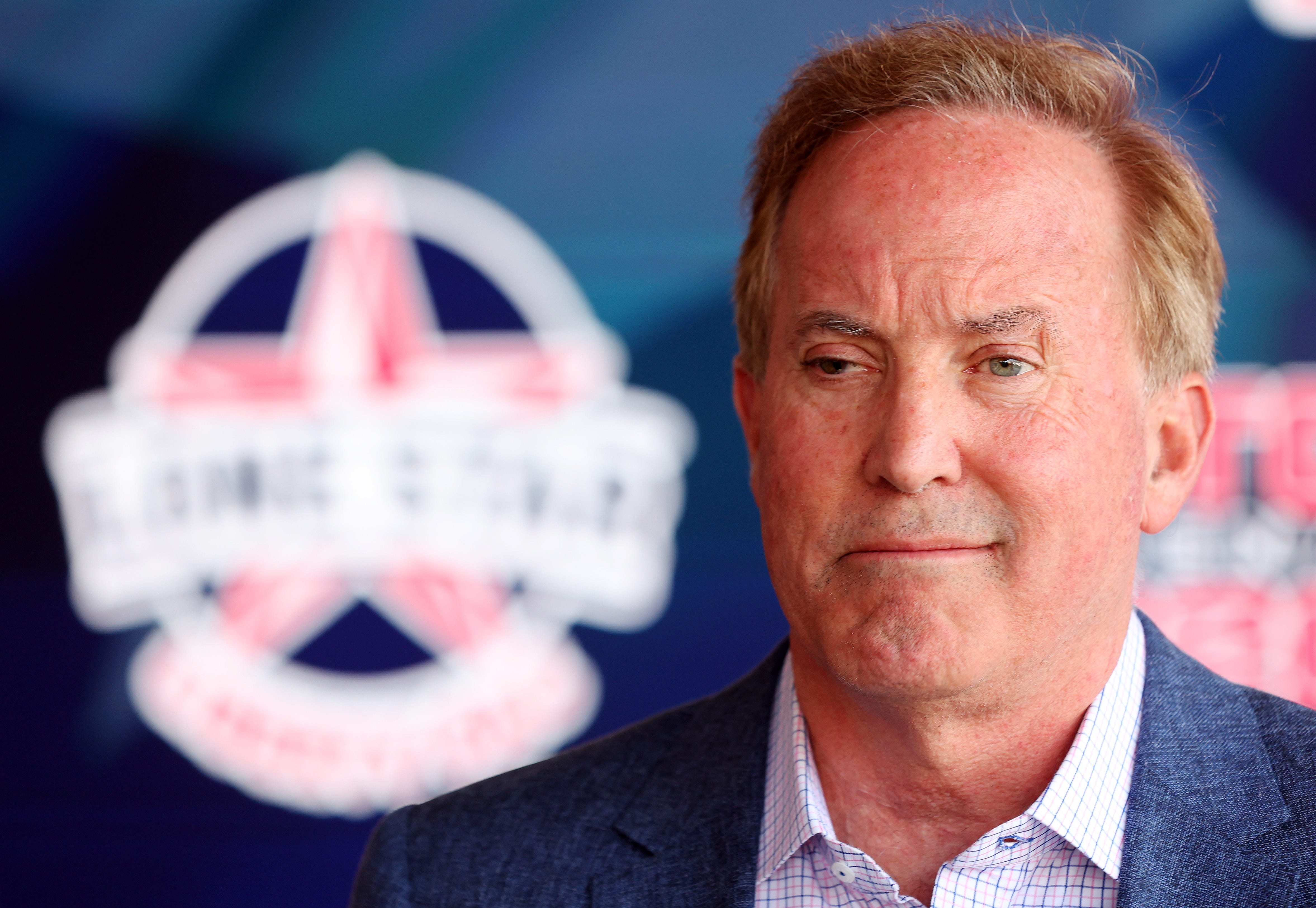
Stop us if you’ve heard this one before: A firebrand Republican challenger, plagued by scandals and riddled with vulnerabilities, has nevertheless mounted a serious, credible challenge against a generic Republican, the epitome of the old-school establishment.
You might expect the MAGA base to coalesce around the firebrand and for Trump to come through with an endorsement that delivers the final hammer blow to the establishment candidate.
But in Texas, it’s not so clear that this story, which began in such a familiar way, is going to play out quite as expected. After last week’s primary, incumbent Sen. John Cornyn is showing surprising strength headed into a runoff against Texas Attorney General Ken Paxton, and the race is anyone’s game.
It’s not an overstatement to say that the result could quite literally decide control of the United States Senate.
Polls — and the conventional wisdom — previously suggested that Cornyn was in deep trouble. But in a first round that set spending records, Cornyn actually finished ahead of Paxton by a slim margin of 42% to 41%.
And Congressman Wesley Hunt, who underperformed1 pre-election polling, finished a distant third with only 13.5%. Data suggested that he may have taken more votes from Paxton than from Cornyn (an effect that ran counter to what Republican operatives initially feared).
Since the election, the atmosphere has modulated, with reports surfacing of Trump preparing to endorse Cornyn. And you would be excused for thinking that, on its face, this would settle the election; after all, Trump has maintained a solid track record with his endorsements since his first term.
But it’s not perfect. Readers may remember Trump endorsing establishment candidate Luther Strange in Alabama, only to see him lose to MAGA favorite Roy Moore. Early polling suggests that a Texas-sized repeat of this can’t be ruled out just yet.
So, even if Trump endorses the incumbent, Paxton might still be able to come out on top. Polling from Texas Public Opinion Research found that Paxton leads Cornyn 49% to 41% at the moment, and that he would still lead 44% to 43% even if Cornyn received a Trump endorsement. (Perhaps relatedly, talk of an imminent endorsement for Cornyn has suddenly died down.)
And the outcome of the runoff has significant general election implications.
Texas, which backed Trump by double digits in 2024, remains a reliably Republican state on paper. But a favorable national environment gives Democrats an outside chance — especially if Paxton were to win the runoff.
Paxton may be the most problematic Republican candidate since Herschel Walker. During his tenure as attorney general, he has been indicted for securities fraud, divorced for infidelity, and impeached by a Republican House chamber for abuse of office.
Meanwhile, Democrats avoided a serious candidate quality issue by nominating the affable James Talarico over the uncompromising Jasmine Crockett. While neither of these candidates is moderate, Talarico is, at the very least, perceived by voters as being closer to the median Texan than Crockett is.
And while Republicans have found plenty to attack in Talarico’s record, an energized Democratic base, supplemented by independents and perhaps some moderate suburban Republicans repulsed by Paxton’s scandals, could make the race competitive. (It’s also worth noting that Talarico has already made a very, very good impression on Joe Rogan.)
Strategically, from a Republican perspective, Trump would be mistaken not to endorse Cornyn. Why? Just look at the math.
Our last poll placed the national environment at D+6, which means Democrats hold a six-point advantage over Republicans in the generic congressional ballot. In this environment, Texas, which is roughly 12 points to the right of the nation, would be R+6.
Cornyn is an incumbent, and incumbent members of Congress generally get an average baseline boost of three percentage points in margin. So Talarico would need a nine-percentage-point overperformance to beat a relatively uncontroversial Cornyn, and a six-percentage-point one to beat Paxton.
On paper, those both seem totally doable. After all, 12% of the Senate races in the Trump era (2016 onwards) have seen WAR scores of D+9 or more, and 28% have seen overperformances of D+6 or greater.
But this is a bit misleading. Most of those strong performances came from extremely strong, entrenched incumbents like Joe Manchin, Amy Klobuchar, or Jon Tester, whose circumstances simply aren’t anything like Talarico’s.
Here’s a more relevant datapoint: Since Trump’s 2016 election, only four nonincumbent Democratic candidates have managed an overperformance of 9 points or more: Phil Bredesen (a popular, former two-term governor), Doug Jones (who ran against a pedophile), Amy McGrath (who ran against Mitch McConnell), and Mike Espy (who was a former Congressman).
In other words, it’s extremely hard for Talarico to muster up the overperformance necessary to beat a generic, relatively scandal-free incumbent in John Cornyn, considering his circumstances. But overperforming by six points when you’re facing a scandal-plagued candidate like Paxton is much more doable.
And we have precedent for this — Ruben Gallego overperformed by seven against Kari Lake in 2024, and there’s a good case to be made that Paxton is a more problematic candidate than Lake was.
No matter the result of the primary, the Republicans are still favored; a Paxton vs. Talarico general election would still yield a Republican win as the modal outcome.
But it’s a lot easier to see the case for a Talarico victory if he’s facing Ken Paxton.
The reason for this is similar to the reason that third-party and independent candidates frequently fall short of their polling numbers. Hunt was a serious longshot, and his supporters eventually coalesced behind a candidate with a better shot of winning. People don’t love wasting their vote.
It’ll be interesting to see if Paxton continues to succeed framing the runoff around the SAVE act. GOP primary voters seem to really love the SAVE act, at least from what I see online.