

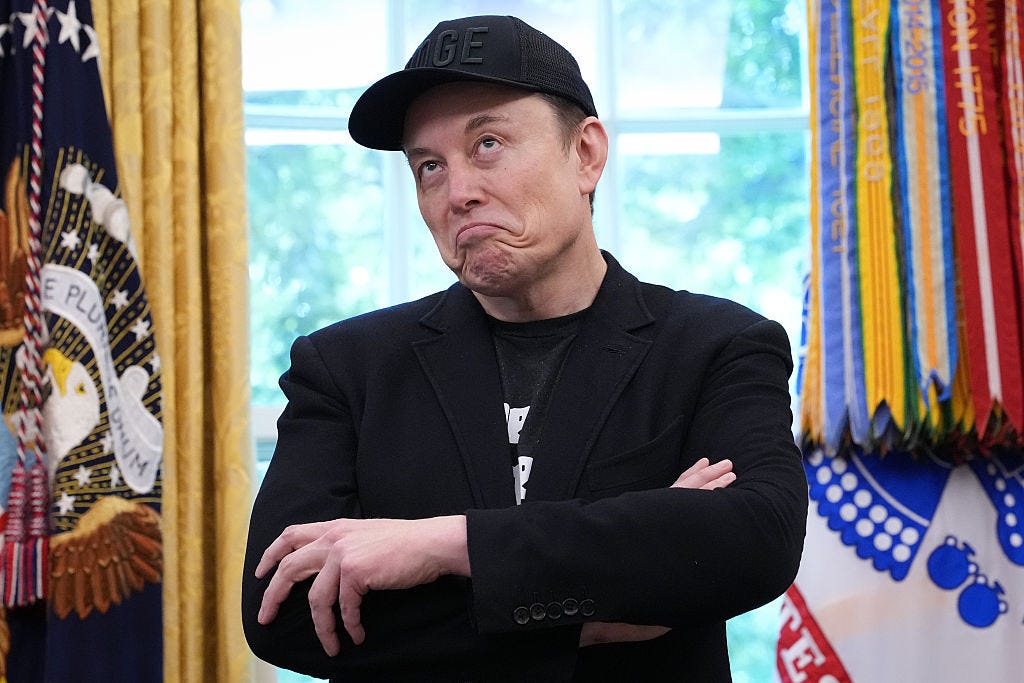
Elon Musk really doesn’t want you to say he’s responsible for the deaths of millions.
Earlier this week, Musk threatened to sue Rep. Ro Khanna for charging him with destroying the U.S. Agency for International Development (USAID) and putting millions of lives at risk around the world:
“There needs to be accountability for Elon Musk,” Khanna said. “You know, they’re celebrating that he created 4,400 millionaires [with his SpaceX IPO], but they don’t talk about the 4.5 million children around the world who he possibly sentenced to death by dismantling USAID.”
In response, Musk called Khanna a liar, threatened to sue, and said he should be in prison.
But Khanna is making a perfectly reasonable claim here. In that quote, he is (carefully) citing a peer-reviewed study that estimated the effects of dismantling USAID. It found that Musk’s Department of Government Efficiency (DOGE) will result in 14 million deaths overall by 2030, of which 4.5 million will be children under the age of 5.
This is probably a high-end estimate, but even lower end projections with different methodologies sit between 670,000 and 1.6 million annual deaths compared to a fiscal year 2023 baseline.
In other words, the toll from USAID cuts seems to be at best around two-thirds of a million people annually1; that’s about as many people as were killed during the Civil War. At worst, Musk is tied to the deaths of 14 million.
If DOGE had managed to cut tens of billions of dollars from the federal budget, Musk and his defenders would certainly have taken credit. It’s bizarre then to disclaim responsibility for the tragic consequences of the cuts they did make.
Yet Musk and his defenders insist that Khanna is somehow slandering him.
There are a couple of interlocking issues worth separating here: one is the factual question of what actually happened to USAID, where Musk is now downplaying his actions. A second question is what is likely to happen out in the real world to real people without USAID. And the final issue is whether Musk should be subject to basic Congressional oversight for wrecking whole government agencies as an outside adviser to the president.
Unfortunately for Musk, he’s on the wrong side of each one.
Did Musk cut global health aid?
It’s best to start with a simple timeline of events, given Musk’s slipperiness with the facts here.
On Jan. 20, inauguration day, Donald Trump froze USAID funding for 90 days. On Jan. 24, Secretary of State Marco Rubio executed this freeze, and then on Jan. 28, amid chaos on the ground, Rubio issued a waiver to the freeze for “core life-saving medicine, medical services, food, shelter, and subsistence assistance.”2
Days later, on Feb. 3, Musk issued his infamous tweet saying that he had “spent the weekend feeding USAID into the wood chipper.” That was one day after he’d called it a “criminal organization,” adding, grimly, “Time for it to die.”
It’s important to note that as USAID offices shuttered, contract officers asked for the appropriate paperwork to show the cancellation. According to the Associated Press, a Musk associate merely replied that the order had come from “the most senior levels.” Despite his braggadocio online, Musk seemed to keep his fingerprints off the formal actions as much as possible.
Finally, the next month, on March 10, Marco Rubio announced the end of 5,200 USAID programs, or 83% of its programs. The other thousand programs would be moved to the State Department. In his announcement, Rubio thanked DOGE for this “historic reform.”
All the while, DOGE’s abrupt stop-work orders literally left USAID workers stranded abroad fearing for their lives.
“We heard the mobs outside our gates, right? … We heard explosions. We heard gunshots,” Kenneth Bledsoe said, an attorney working with USAID in the Congo, but “because all the leaders were gone … I was worried we might be abandoned there.”
Despite all of this happening in plain sight, as of this Tuesday, Musk contended that “All DOGE required was contact information of the recipients to confirm that funding was not fraudulent.”
I find it genuinely absurd to construe the well-reported evaporation of U.S.-funded programs on the ground in dozens of countries as a simple fraud verification layer. Musk and others involved were clearly aware this wasn’t some skimpy payment issue.
At the time, Nicholas Enrich, USAID’s acting assistant administrator for global health, wrote a series of memos laying out the likely consequences of DOGE’s actions, which included things like 71,000 to 166,000 additional annual deaths from malaria and 1 million additional children facing malnutrition annually. Enrich was placed on leave for this.
But let’s say Musk was just combating fraud, one pesky payment verification at a time. Even that would point to his detachment from the reality on the ground.


Musk was fond of tweeting that only 10% of payments made by USAID made it through to their intended targets, which was the apparent motivation for this fraud detection scheme. But that 10% number is actually the percentage of funds that go to local organizations in order to deliver aid — a larger share went to international organizations that deliver aid at scale. The debate was between which kinds of organizations the money passed through, not whether it got to recipients.
Now, there is legitimate, good faith, cross-partisan criticism that says a larger share should go to local organizations and less money should run through big international ones. Atul Gawande, assistant administrator for global health under the Biden administration from 2022 to 2025, has said that he aimed to get the 10% number up to 30%. But this is a wholly different issue than saying aid is not getting out into the world to help its intended recipients.
Musk’s whole venture, even in the narrow way he framed it, was a blind ideological attack against an agency that performed lifesaving work at low cost to people who need it most.
How many people will die as a result?
Once we set aside the notion that Musk isn’t responsible for the massive withdrawal of U.S. global health funding, the next question is what the effect of that withdrawal has been so far and will be going forward — the crux of Musk’s assertion that Khanna is lying.
Start from the basics: Until last year, the U.S. accounted for about 40% of government-funded global health funding,3 including malaria prevention, HIV/AIDS prevention, nutritional assistance, maternal health, disease monitoring, and more. It’s a reasonable starting assumption that if this aid disappears, it would cause worse health, even death, in the places that receive the aid.
The Lancet study that Khanna referred to merely quantified this, as best as the researchers could.
It started by looking to the past, finding a 15% reduction in all-cause mortality and a 32% reduction among children under 5 due to U.S. aid over the past 21 years. That amounts to 91.8 million lives saved overall, including 30.4 million children under 5, over the past two decades. It then applied its model to the future, aiming to capture deaths by 2030.
Now, a critique of this study says that there were only 79 million lives saved on net since 2001, so a 92 million figure would have to attribute all lives saved to USAID plus some number of phantom lives saved. And if they’re overshooting by that much on their model of the past, they could be overshooting their projection of the future, too, the author argued.
The issue is that the critique assumes the 2001 death rate stays constant without intervention. It measures lives saved (79 million) by counting the observed death rate below 2001 in each year, but the global population both grew and aged in this period. Holding to the 2001 death rate would have been an efficacious intervention in and of itself, without lowering the death rate at all. Beyond that, lowering the death rate by, say, 79 million lives is a further success.
So, in principle, it’s not impossible to have greater than 79 million lives saved through an intervention. That doesn’t make the Lancet study correct in and of itself, but it’s also not logically invalid, as the critique suggests.
I do think the Lancet study is a high-end estimate.
More conservative estimates by the Center for Global Development (CGD) put total additional deaths between 670,000 and 1.6 million annually by using estimates of lives saved per dollar and then matching this to funding cuts.
According to a modeling tracker built by Brooke Nichols, a Boston University associate professor of global health, USAID cuts are estimated to have caused roughly 260,000 adult and over 500,000 child deaths at the one-year mark.4
If all you did was draw out this trend, which is roughly in line with CGD’s in terms of magnitude, it would be at least 2.5 million people who had passed, because of USAID cuts, by 2030.
The world is, of course, dynamic and messy. It’s hard to say how a reduction in funding at one clinic translates into deaths. Maybe someone finds a way to get their antivirals by travelling to the next township, or maybe a new funder comes in to maintain the clinic, even if it means that funder also has to withdraw public health funding elsewhere. On top of these inherent difficulties, the U.S. government is also not releasing data right now on the two largest bilateral health programs, which are for HIV/AIDS and malaria.5
You can take issue with the assumptions and methodological choices that go into these estimates, but it’s ridiculous to suggest that DOGE’s program cancellations won’t cause any deaths. The range of numbers here seems to be between a few million and tens of millions, and neither end of that spectrum absolves Musk.
In fact, Musk’s defenders inadvertently admit that there must be some significant number of deaths as they try to defend him.
In an article defending Musk, which Musk tweeted out, Pirate Wire’s Max Weiner said that The Lancet study posits a “fake world” because it assumes “A world in which DOGE’s funding reductions remain in place through 2030,” which Weiner says is unlikely.
That means his number one reason DOGE cuts will not cause millions of deaths is that… they will be reversed? That’s just an admission that the cuts will, in fact, cause millions of deaths!