

What would it mean to be human in a world where AI has made our labor obsolete? Jerusalem and Matt use Hannah Arendt’s The Human Condition as a jumping off point to tackle this question in their latest book club podcast episode. Paid subscribers can watch or listen to the episode ad free or read the transcript. Free subscribers can watch the episode on YouTube or listen at their podcast provider of choice.
Subscribe: Apple Podcasts | Spotify | YouTube | Overcast | Pocket Casts
The U.S. is facing a daunting fiscal future. The federal government’s publicly held debt roughly equals our annual economic output, $32 trillion, representing a debt-to-GDP ratio nearly the highest in history and about twice the average of the past 50 years. And we’re still digging — in fiscal year 2026, the federal government spent nearly $2 trillion more than it collected. Even as the economy was growing due to an AI boom, the deficit was around 12% larger than the year before.
The current fiscal debate in Washington is trapped in a bleak binary: The only “serious” solutions offered to address our mounting national debt are tax hikes or painful spending cuts. The math, as it has been presented since at least the Obama-era deficit fights of the 2010s, seems to demand nothing less.
However, viewing the deficit solely as an exercise in subtraction is a failure of the liberal imagination.
Democracies crumble when they are locked in a zero-sum battle over a stagnant economy. If our only answers to the deficit are tax increases and spending cuts, liberals will miss out on a whole host of growth-enhancing measures — embracing high-skilled immigrants, building abundant housing and energy resources, investing in the capabilities of children, and aggressively funding innovation — that can make budgetary trade-offs less painful.
Think of the debt-to-GDP ratio as a race between the growth of our debt and the growth of our economy.
Policy changes that raise GDP growth necessarily hold down the debt-to-GDP ratio — they increase the denominator even if the numerator holds steady. Furthermore, higher GDP implies more taxable income, which brings in more revenue and reduces deficits and debt. (Doug Elmendorf, Glenn Hubbard, and I described this in greater detail in a recent paper.)
The sensitivity of our national debt to productivity — the rate at which capital and labor are transformed into economic output — is staggering. Total factor productivity growth averaged nearly 2 percent per year for the first few decades after World War II, the peak of the New Deal order that liberals are so often nostalgic for. In fact, this productivity growth was a precondition for postwar prosperity.
But productivity growth plummeted to just a few tenths of 1% from the mid-1970s to the mid-1990s, and recently has sat well below historical averages. If we could increase productivity by an additional 0.5 percentage points each year, relative to Congressional Budget Office expectations, the debt-to-GDP ratio would be stabilized within three decades, according to our findings. The debt-to-GDP ratio would be 42 percentage points smaller at that time.
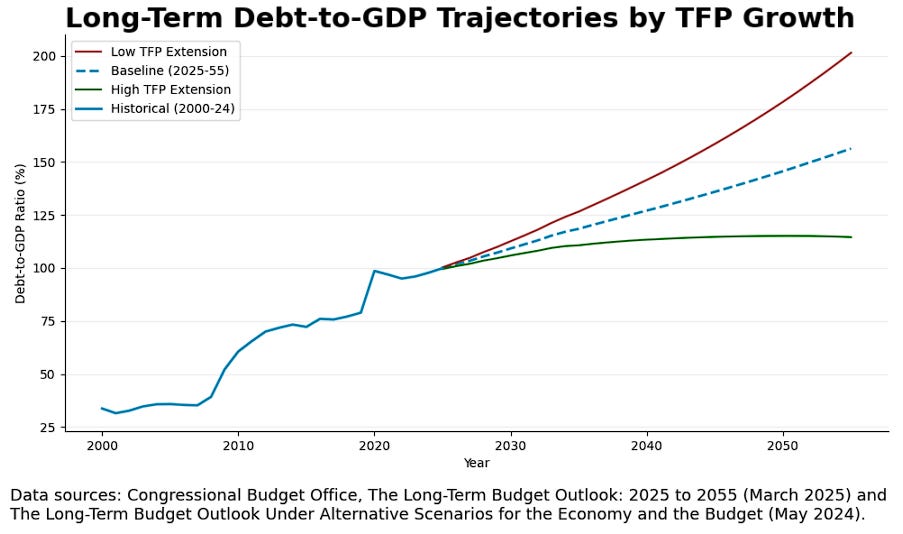
Some of the measures I’m proposing could be achieved at a low-enough budgetary cost that they would significantly reduce the severity of the austerity required to stabilize our debt. And many of them promote equity and other liberal priorities besides: High-skilled immigration, more housing, cheaper energy, and investments in poor kids are all more likely to benefit those at the bottom of the distribution than the top.
Here are the four areas where it makes perfect sense for equity-minded liberals to become apostles for growth.
