

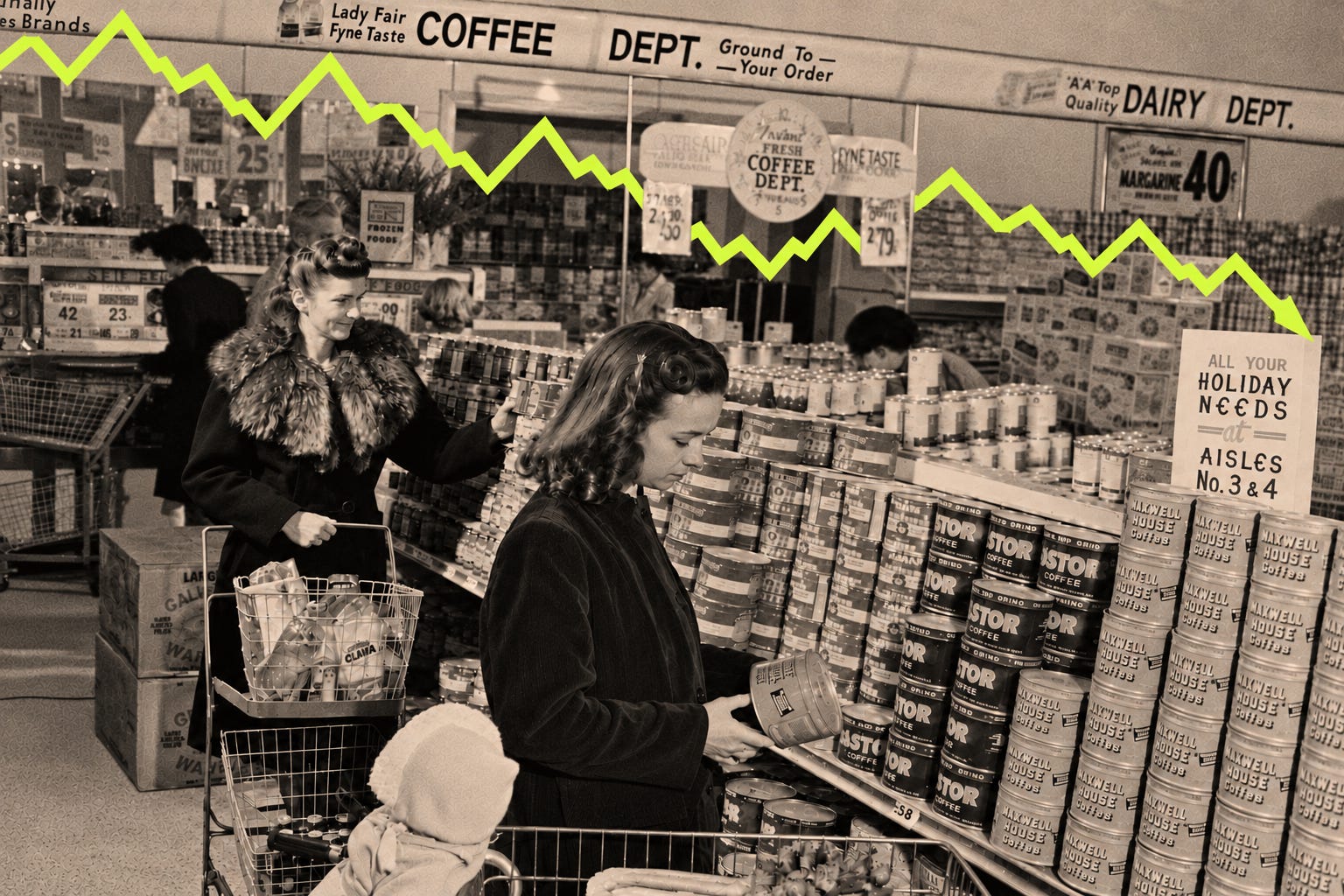
The American people do not want to pay for your political project.
You might think to yourself, she doesn’t understand that in the long run my political project will make everyone happier, healthier, more prosperous, beautiful, and filled with that je ne sais quoi that exudes from runway models and serial killers. But you would be wrong, reader. Because today’s voters don’t seem to want to pay for much of anything.
The 2024 and 2026 electorates spoke as clearly as possible: They are mad about the price of consumer goods and services. They want something that probably no one can promise to deliver: for a burger and fries at a diner to cost $10. But they do really want it, and there’s no use pretending they secretly want something else.
Yet for the past two weeks since the Democrats’ decisive victory in the midterms, all I keep hearing and reading about is how finally the voters have given the party a mandate to do “economic populism.” Pundits and politicians argue that voters are clamoring for the new Congress to tackle “corporate greed” and enact a $20 minimum wage. Seven months before the midterms, the left-populists at the Open Markets Institute somehow already knew that it would be a mandate to confront “concentrated corporate power.” (It does kind of give the game away if you claim to know the will of the voters before any of them have had a chance to vote.)
What is economic populism? Is it, as the vast majority of Americans support, expanded healthcare access and higher taxes on the wealthy and corporations? If so, that would mean famed technocrats Hillary Clinton and Barack Obama were economic populists. Hell, it would even mean Bill Clinton was an economic populist.
This is obviously not what is being meant by this term in the capital-D Discourse — in which populism appears to be a rejection of standard economic theories. Unfortunately, rarely does any self-described economic populist offer a comprehensive definition. Some refer to it as mere rhetoric that honors the working class and attacks economic elites; others just blithely say it’s about “economic power.”
In practice, economic populism appears to be the belief that greed is what makes things cost too much, that the fix is for governments to overrule markets and cap prices, levy tariffs, and shield jobs from competition. It is, roughly, the list of things economists tell you not to do.
This isn’t just my read. Populist economist Isabella Weber recently wrote that “economic populism also means dethroning economics.”

Barry Lynn, founder of the Open Markets Institute, said economics “rewards those who do the best job of excluding reality.” Matt Stoller calls economists’ work “fake science.” This is all a mirror image of the aftermath of the 2024 election, when MAGA supporters treated Donald Trump’s victory as a rejection of wokeness and “transgender ideology,” as well as a mandate for “counterrevolution.”
Remarkable how fast the electorate changes its mind. Or, perhaps, it has had the same overriding priorities the entire time.
It’s not cost of living and something else
Perhaps it’s because everyone is in thrall to the rule of threes — or because they fear the shame of being branded a monomaniac — but people can’t help but add additional causal factors to the simple truth that people really want things to be cheap. It happens in discussions of why Kamala Harris lost the 2024 election and why Republicans lost the Senate and House two weeks ago.
For a year, The Argument has surveyed thousands of American voters every single month. Every month, among other questions, we have asked what voters’ top two most important issues are. Cost of living consistently emerged as the most common priority selected — and it wasn’t particularly close. (More on healthcare, which consistently placed in a distant second, later.)
To the extent voters have one common concern, it really is cost of living and nothing else.
Some on the left have read voters’ anger over prices as evidence that the people have finally turned against free enterprise, but there’s little evidence that voters have turned their frustration over high prices into a broad rejection of successful companies. In The Argument‘s May survey, 63% of Americans viewed Amazon favorably, while only 19% viewed the company unfavorably. Majorities also viewed Google and Microsoft favorably.
Even Sen.-elect James Talarico, who criticized billionaires’ political power on the campaign trail, has drawn a clean distinction between a critique of the wealthy and a critique of free enterprise. Like our survey respondents, he seems quite favorable to the latter, calling himself a “big fan of SpaceX, of Tesla,” and praising Elon Musk as an innovator. (This despite the fact that Musk spent over $100 million to try to defeat him!)
In short, there seems to be little evidence that voters want politicians to wage war on the companies whose products and services they enjoy.
Many on the left want “affordability” to be about protecting jobs rather than lowering prices. The problem is that protecting jobs from competition makes the goods produced by those jobs more expensive.
Tariffs are the cleanest example of this: A tax on imported goods only preserves a job stateside if it eliminates the foreign good’s cost advantage. But the broader dynamic was on full display during President Joe Biden’s presidency: Low-income wage growth took off, and so did steep price increases. As a result, Biden left office with a 40% approval rating as voters decided that a second round with another historically unpopular president was preferable.
Earlier this year, we asked voters whether they would pick lower prices or lower unemployment if they could only have one. They decidedly chose the former.