

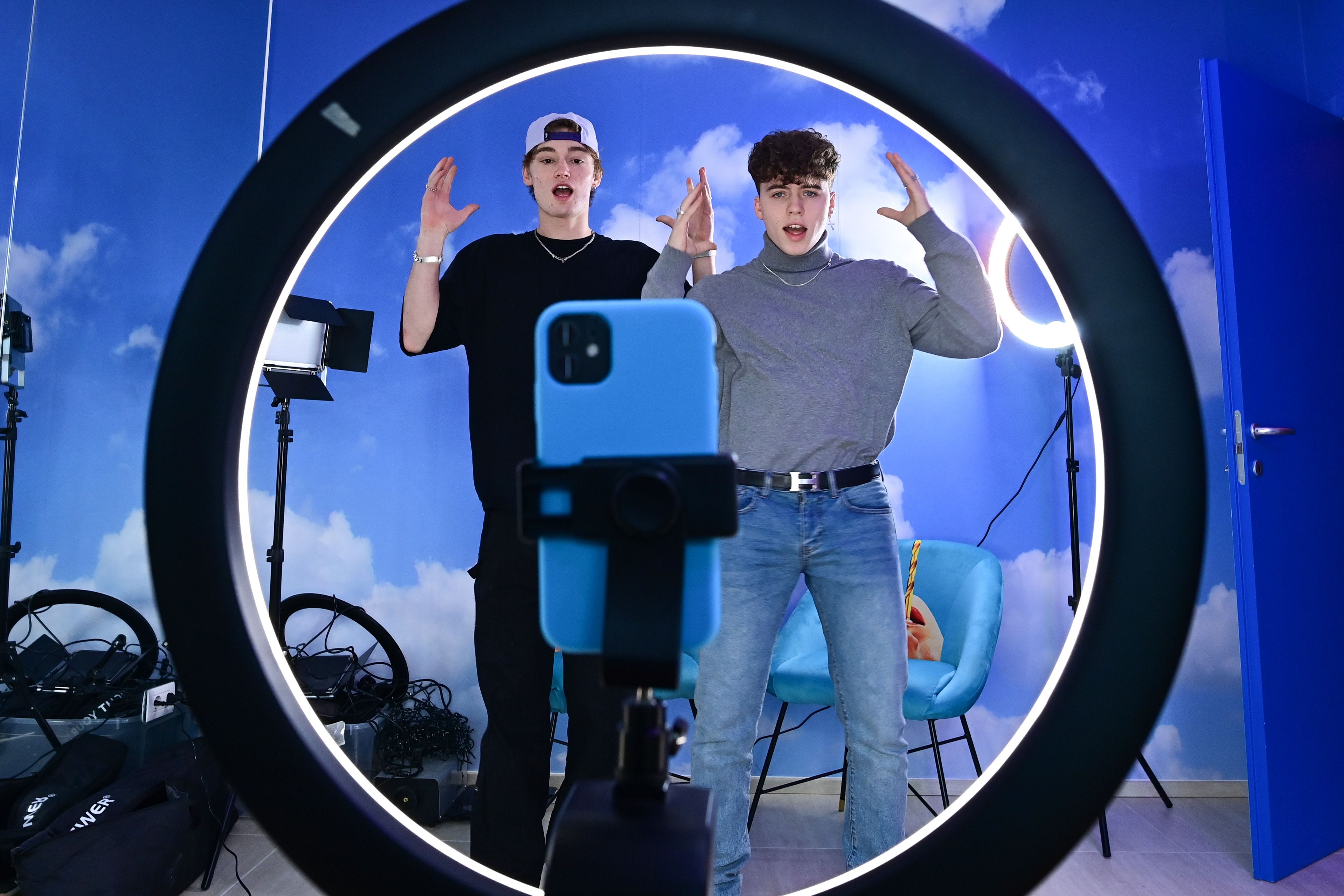
We’re taking The Argument to San Francisco! On May 13, Kelsey Piper and Jerusalem Demsas are debating a question that feels unavoidable right now: Is AI actually changing how science gets done, or are we in the middle of a very expensive illusion? Jerusalem is bullish; Kelsey is skeptical.
And you won’t just be watching. You’ll get to join in on the argument, too.
Join us May 13 at The Chapel from 7 to 10 p.m. Come argue with us! RSVP here
Short-form content gets a bad rap these days. TikTok, Instagram reels, YouTube Shorts — all of it nothing but brainrot and digital dopamine, a modern “hypodermic needle,” in the words of Stanford psychiatrist Anna Lembke.
This is a moment of legal accountability for Big Social Media.
But this should also be a moment of cultural reckoning and artistic recognition. These companies have built their modern empires on an astronomical volume of short-form video content, mind-boggling in its multiplicity and universal popularity.
Kids don’t just spend time on social media because they are screen junkies who can’t read. That would be too easy. They spend time on social media, in large part, because social media has become brilliantly, absurdly, unprecedentedly, entertaining.
Even if you wish it weren’t, vertical 30-second video is the creative medium of our time. Taking seriously the merits of any new formal paradigm is in the spirit of how we have met every technological rupture in art history.
So here are several broad categories of short-form content that I think are worth appreciating on their own creative terms, beyond the addictive infrastructure and AI-generated slop they are embedded in.
1) The vocation vlogger
Why do any of us consume art? One reason (arguably the main reason) is the desire to escape into the lifeworlds of others. These worlds can be fictional, as in the case of Tolstoy’s Anna Karenina, or based in fact, like the hit reality series The Secret Lives of Mormon Wives.
Vlogging taps into a similar vein of curiosity. Take the TikTok videos posted by flight attendant Maisha Prather. She documents her life working for Swiss International Airlines, like in this video of her long-haul flight from Zurich to Hong Kong, captioned “Work a night flight with me.”
Or this post by an ER nurse who brings viewers along for a 13-hour shift, featuring details about tracheostomy care and catheter placement. Or lawyer Carrie Jernigan, who has amassed over 1 million followers by sharing footage of her daily life as an attorney in Arkansas. I call these creators “vocation vloggers.”
Social media is often accused of promoting unrealistic lifestyle standards and glorifying the Kardashians of the world. But by sheer volume, even if not by algorithmic amplification, the normy masses make up a vast slice of today’s creator base, posting down-to-earth footage of the many forms that 21st-century existence can take.
This content is not valueless. The vibe of the vocation vlogger is a reality check, a window into the tough financial or emotional realities of professions that most of us will never work. The genre scratches the same itch as any good-old workplace drama, like The Pitt or The Bear or The West Wing, all TV shows that revolve around specific occupational settings.
As patients, customers, or passengers, we see only the public-facing performance. As content consumers, we are invited backstage. And following people into rooms we normally don’t have access to — crew sleep compartments or the Oval Office — is endlessly intriguing.
2) The craftsman
A close cousin of the vocational vlogger is the craftsman. This genre is all about watching people do things they are very good at. It complicates the straightforward depiction of social media content being nothing but a race to rock-bottom degeneracy. On this side of social media, it is competency and perfection that drive views.
Take, for instance, Jungle Builder. The account posts videos of men building luxury constructions by hand in rural Cambodia. This video, captioned “You Won’t Believe How This 3-Story Bamboo Home Was Built” has over 4.6 million views on TikTok. The footage is disorienting. No further context about what purpose these elaborate structures serve is ever provided. (Aerial drone footage suggests that they actually serve absolutely none). But negative production externalities aside, the mass consumption of this content, however absurd, seems primarily to satisfy a fascination with human skill.
The popularity of Nonna Netta, a New Jersey-based grandmother who produces vast quantities of spaghetti and baked goods in her snug kitchen, points to this same appetite for skilled execution. Here she made 41 loaves of Crescia for Easter, seemingly without a recipe.
Also in this world of craftsmanship are accounts dedicated solely to meticulous pottery wheeling or immaculately detailed painting, like artist Werner Bronkhorst’s miniature illustrations.
Evaluating the artistic value of this content is complicated. The final physical product is typically impressive on its own — so much so that it is often tempting to skip to the end just to marvel at the end result.
And yet, I would argue that there is something more going on. I’m not sure I like Bronkhorst’s paintings all that much or actually find Nonna Netta’s meatballs that appetizing, but I do know that I find their TikToks entertaining to watch.
The skill that has won these accounts huge followings is only secondarily the skill being recorded on video. First and foremost, it is the skill of being a short-form video artist.
3) The comedian
A more straightforward example of people mastering the specific art of short-form video is skit comedy. This content ranges from the universally funny, like Senegalese Khabane Lame’s silent reaction videos, which have garnered him over 160 million followers, to highly select cultural references catering to niche audiences.
Last week, my teenage brother sent me an obscure Instagram Reel of an elderly German woman giving names to Lord of the Rings characters. Gandalf becomes Otto, Legolas becomes Eberhard, Lady Galadriel becomes Rotraud.
How to convey the comedic value of this strange little video? Both my brother and I have a particular fondness for the franchise, so that helps. We also have a German grandmother, which makes the whole set-up particularly comical. Whatever the reason, the reel felt as entertaining as any other form of conventional entertainment, say a stand-up set or an episode of South Park.
The true thrill of this humoristic content often comes down to relatability, to seemingly idiosyncratic experiences being revealed as much more ubiquitous.
As I was writing this piece, a friend of mine from Pune, India, sent me a video captioned “That one rich girl from Bombay.” For me to find it funny, he had to explain some references: like that “SoBo” stood for South Bombay and that “Cathedral” refers to a prestigious private school in the region.
It is an exciting thing to be allowed entry into a fictional world; it is even more exciting to be allowed entry into the real world of someone you care about. Often that happens by way of shared art or entertainment.
Critics of entertainment-driven social media have pointed out that there is nothing very social about these platforms anymore. Where once users logged onto Instagram to see pictures of their friends, they now consume Reels by content creators. A pro-social byproduct of this trend, however, has been the mass sharing of content between users.
I am not saying that sending videos back and forth is a replacement for genuine in-person socializing. Yet, it may be a meaningful complement. And it is certainly different from the kind of isolated online experience that tends to dominate public outrage about social media.
4) The aestheticist
Perhaps most mysterious, and most distinct from art that has come before, are the videos that draw you in for no reason other than downright wackiness. Some of this is really weird slop, like mass-produced videos of AI cats.
But some of it is very much a product of spunky human ingenuity. Adrian Patterson and RJ Chumbley, known on TikTok as TheGoddessBoys, are a content creator duo that make theatrical mixology videos. Glammed out in bangles and immaculate manicures, the two perform a kind of chaotic choreography that culminates in an extravagant creamy beverage. They have their routine perfected down to a T.
Similarly inexplicable is the pull of someone like Remygumbs, whose main schtick is high-energy content of her 12 guinea pigs. She calls them “the piggies” and hosts dance parties that involve her in a bathrobe and huge piles of lettuce.
The aestheticist is not trying to offer the world anything but wacky, visually appealing entertainment. Watching TheGoddessBoys mix a “lemon lime sweet and sour green grape rock sugar yuzu foam soda” is not like reading a novel, but, then again, neither is strolling through MOMA.
What is art?
New media always falls under scrutiny. There is no formal rupture in art history that has not been challenged by existing institutional voices.
When photography emerged in the 19th century, many were skeptical — particularly painters and illustrators, who feared the technology would put them out of business. Poet and art critic Charles Baudelaire was also an outspoken opponent, in 1862 deriding the French public’s reception of photography in a letter: “And then they said to themselves: ‘Since photography provides us with every desirable guarantee of exactitude’ (they believe that, poor madmen!) ‘art is photography.’”
In the early 20th century, it was cinema’s turn, looked down upon as a lowbrow fairground attraction, not serious art like theater or literature. And this was well before the dawn of lightweight sitcoms, reality television, or music videos, which famously killed the radio star and marked an end to audio-only music.
Every formal rupture in art history is usually met by critique that accuses the new medium of being easier to produce and easier to consume, and thus less refined, less intellectual, and less valuable.
But the best TikToks are usually not easy to make. To make a single engaging video, one that actually is likely to go viral, requires an involved production process: scripting, lighting, editing, visual effects, and audio. And then do that enough times to actually build a following.
Content creator Zach King’s 15-second optical illusion videos take him and his staff about two weeks to make. That production time-to-runtime ratio easily surpasses the average Hollywood feature film.1 TikTok star Nara Smith has revealed that a single one of her from-scratch cooking videos takes up to seven hours.
The question of consumption poses a more serious challenge. This content rarely prompts profound introspection or moral grappling. And yet, brain friction is a disputed metric by which to delineate what is and is not art.
In his Critique of Judgement, Kant argued that aesthetic experience occupies a unique category irreducible to cognition, which engages the mind without producing knowledge. Leo Tolstoy, in What is Art?, defended the “activity of art” as simply the transmission of feeling, a definition capacious enough to include “jokes,” “home decorations,” and “church services” — and, I would argue, many short-form videos.
The image of the slack-jawed social media addict, desensitized and detached, does not actually capture a more complicated truth, which is that this content often evokes strong emotional responses: amusement, joy, sorrow — certainly as much as the last Rothko painting I saw.
Regulatory precision
A fair question to ask is whether any of this content is actually what shows up on people’s feeds. Maybe my “For You” page skews toward the content that most plausibly passes for valuable.
But a closer look at the most-viewed short-form videos suggests that the above categories resonate with a broad user base. As of January 2025, the most-watched TikTok globally was one of King’s optical illusion videos. His top-performing video, “Magic Ride,” is of him dressed up as Harry Potter and seemingly levitating on a broomstick. It has over 2.4 billion views. Three of King’s other videos also made the top 10. I would place all four squarely in the “craftsman” box.
Also on that list, with 1.3 billion views, is this lip-sync video by Australian model Leah Halton. It’s not rocket science why Halton, crowned “the most beautiful girl alive,” has so many clicks. The video is hardly a prime example of sophisticated creativity, and yet it is also a lot more innocuous than you might expect.
This is not to say that any of us should be watching this stuff for 10 hours a day. Most people, especially children, should spend less time on social media. As Derek Thompson recently wrote for The Argument, the real concern is that smartphones are displacing other, more meaningful, activities, like hanging out with friends or exercising.
A Gallup poll from a few years ago found that over half of U.S. teenagers spend at least four hours daily on social media. Across all age groups, the number is lower, but still over two hours.
The opportunity cost of mindless scrolling is a problem — as is the toxic, depressive content that flows directly to the most susceptible users via self-reinforcing algorithms. New research coming out on how short video content negatively affects our attention spans is also alarming — and bolsters the case for any long-form entertainment, even The Secret Lives of Mormon Wives, being better for our brains than TikTok.
This is not meant as a defense of Big Tech. It is meant as a defense of our collective cultural appetite. Public debate seems to have settled on social media as a vice that needs to be tamed. We need to be saved from ourselves and our own craving for content.
This is a particularly moralizing moment in American politics. Many lawmakers on the right are building a case against the undisciplined and debaucherous human soul. But our compulsion to watch people do weird things on the internet reveals the best in us as much as it does the worst.
In the second season of HBO Max series The Pitt, med student Victoria Javadi gets in trouble when a senior attending thinks he’s caught her making one of her popular TikToks. “When I was in medical school...” he begins to scold before she storms off. Later, another doctor defends Javadi’s videos: “You ever watched one?” she asks. “They’re not what you think.”
It’s a generational spat that is somewhat on the nose. Yet the scene captures an important disconnect. Most public commentary about screen use, mental health, and why TikTok is bad, bad, bad, also has me asking: but have you actually watched the videos?
Recommended reading:
I could watch TikTok for 10 hours a day

While I’m open to some of the social media regulation ideas being bandied about, I’m not sure this rises to the level of a policy problem.

If we assume that an average feature film has a production time of around 2.5 years and a runtime of around 1.5 hours, this equals a ratio of around 14,600 minutes of work per minute of content. That compares to a ratio of around 80,640 minutes of work per minute of content for a 15-second TikTok that took two weeks to make.
Good article! Social media has become a problem, but the paternalistic moralizing from many with power and influence is so nauseating
Great post, gang