

There are a few books that I think everyone should read. One of them is The Nature and Origins of Mass Opinion by John Zaller.
It’s a fascinating, if a bit dense, text that develops a comprehensive theory of how people form and express political opinions. Zaller argued that most of public opinion is downstream of elite discourse, and his theories provide a good framework for understanding how Gaza became the new Vietnam.
The book’s big idea is that most people don’t actually hold political preferences or structured belief systems from which they can derive policy preferences. Instead, Zaller argued that public opinion is heavily influenced by elite political discourse. He described the precise mechanism of elite influence as the “Receive-Accept-Sample” (or RAS) model.
Briefly, people have varying propensities to receive political information. If you subscribe to this magazine, you probably have a high propensity to receive political information; if you’re someone who rarely consumes news, you’re probably low-propensity.
Once you receive a piece of political information, you can choose to either accept or reject it. How likely you are to accept a given bit of information has a lot to do with your existing attitudes; for example, a registered Democrat is much more likely to accept a fact if it comes from Fareed Zakaria than if she hears it from Tucker Carlson.
Finally, people sample from their bank of existing ideas when they are asked to express a political preference — whether that’s in a conversation, in a poll, or at the ballot box, with different circumstances leading to different types of sampling.
In Chapter 9, Zaller turned to Vietnam as a case study of how opinion changes when people receive two different flows of elite messaging. Specifically, liberal voters received reasons to support the war from the Democratic president, Lyndon Johnson, as well as reasons to oppose the war from a growing group of journalists, intellectuals, and young activists.
Zaller measured the intensity of pro- and anti-war reporting using newspaper coverage. Discussion of the war increased over the period, with the number of pro-war messages peaking in 1966 and falling afterward, while anti-war messages steadily increased over time. He classified respondents as foreign policy doves and hawks based on how they responded to a series of questions on how the United States should conduct foreign policy in general, and he measured their level of political awareness using a series of factual questions.
In 1964, there was little difference in support for the war between doves and hawks, with more politically aware people being more supportive of the war. But by 1966, this pattern began to break down — highly informed hawks remained pro-war, but highly informed doves began to turn against it. By 1970, support for the Vietnam War had become polarized.
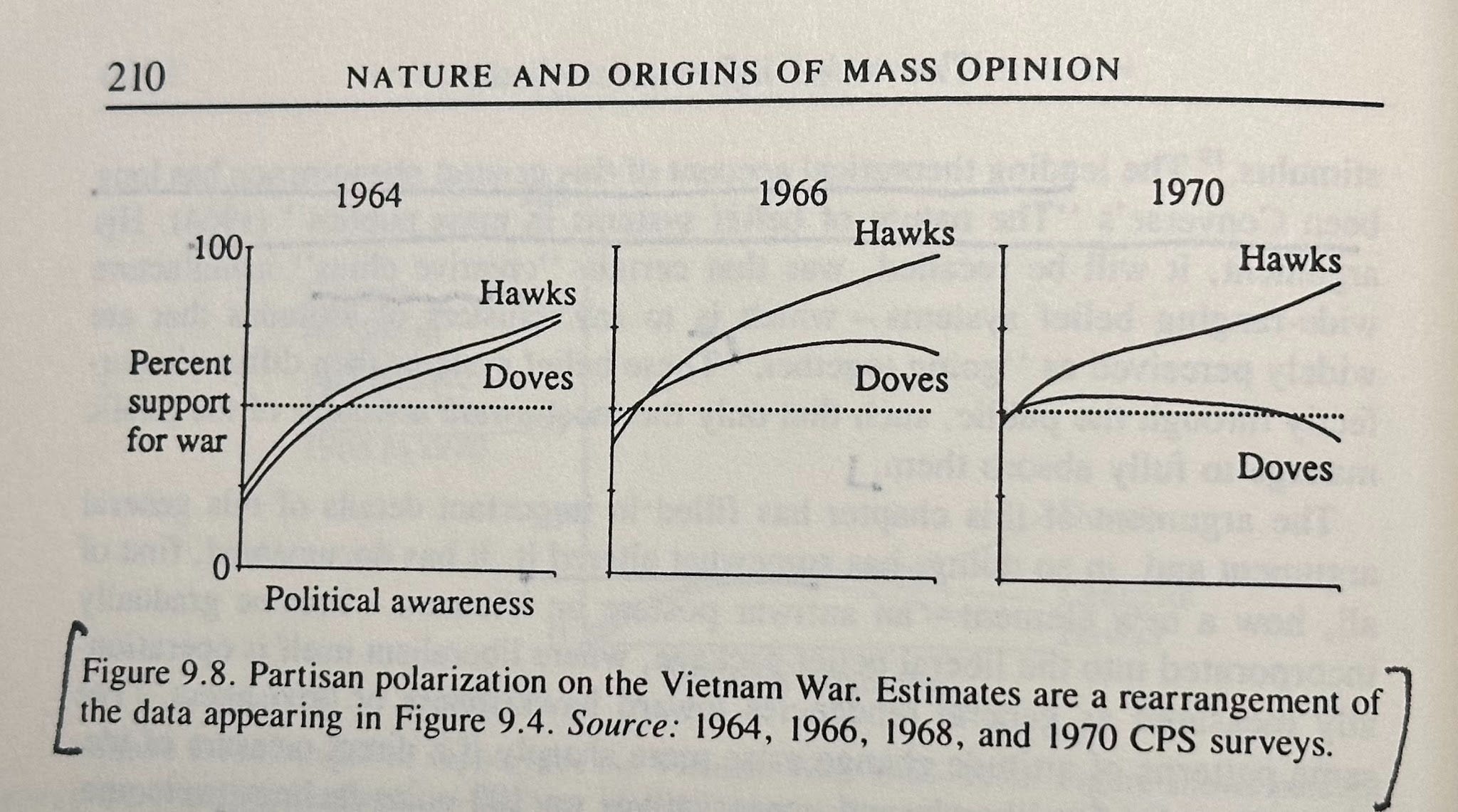
What caused this pattern? Zaller noted that “the biggest antiwar shift in liberal opinion occurred after Richard Nixon took over the presidency in 1969. With the war effort being led by a Republican rather than a Democrat, many doves found it easier to oppose the war.”
It wasn’t just partisanship. Zaller argued that liberals — particularly older and highly politically engaged ones — “who moved in a prowar direction between 1964 and 1966 may have thought, if they stopped to reflect on it, that they were moving in a liberal direction. After all, internationalism had been a core element of the liberal belief package for some thirty years, and the principal advocate for the prowar policy was the liberal Democratic president, Lyndon Johnson.”
But over the course of the war, liberal opinion leaders became increasingly anti-war.
If ideology is defined as knowing “what goes with what,” then one might say that opposing the Vietnam War was made into a part of the broader package of American liberal ideology. Younger liberal voters had less crystallized belief systems, so they turned against the war first in response to anti-war messages from liberal elites; once Johnson left office, older liberal voters did too.
This same type of opinion formation was observed by political scientist Hans Noel in his study of how views on civil rights within the two parties switched in the 20th century. The shift toward associating pro-civil rights views with anti-business economic views (rather than pro-business views) began among pundits and opinion leaders in the 1930s and 1940s. It was followed by shifts in congressional voting behavior in the 1960s and, finally, the exodus of white southerners from the Democratic Party after Lyndon Johnson pushed civil rights legislation through Congress.1
We have seen exactly this pattern play out with opinions on Israel.