

If you’ve been enjoying The Argument and would like to share it with friends and family for the holidays, you’re in luck! You can save 15% now through Dec. 24 when you gift a subscription to The Argument using the link below.
And for those of you looking for something more tangible, we’ve also got merch — our hats and “Libbing Out!” stickers are now online. Order ASAP to receive them before the end of the holiday season!
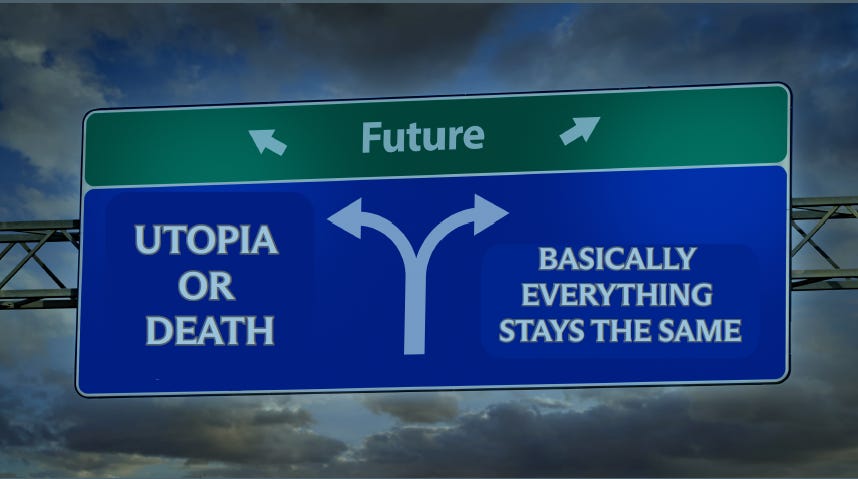
There’s a fairly extraordinary graph in a recent Financial Times article about the difficulty of forecasting AI. It drew on an analysis from the Federal Reserve Bank of Dallas and showed three lines:
One, “technological singularity: end of scarcity,” in which AI creates such unfathomable wealth and productivity that by 2034, real GDP per capita is roughly 10 times what it is today.
Two, “technological singularity: human extinction” (GDP per capita goes to zero, though the AIs are probably still around doing AI things).
Or three, with the assistance of AI, GDP will continue on about its existing trend of growth over time.
Here is another version of that chart, including a line showing the current GDP per capita trend.
This kind of forecast is, of course, almost comically unhelpful (which the author clearly knows). But it’s also more honest than many other analyses of AI, which tend to fall into the trap of “I hate AI, therefore it is not going to be economically impactful” (I wish that were how hating things worked) or “I like technology and progress, therefore, like the internet, it is going to make us richer in a nice, smooth, not-very-disruptive way.”
These are bad ways to reason about the stakes of AI. As the beginning of 2026 rolls around, I’ve been reviewing people’s 2025 predictions about AI to see how they held up, and I’ve been struck by how badly these predictions-from-vibes have done.
I don’t blame anyone for hating AI, but I will say this: It makes you really bad at predicting it. Disliking AI (reasonable!) leads people to assume it must either be incompetent or useless or both. But these are separate questions, and it’s worth thinking through them separately.
AI sucks
“AI is just a word guessing program, because all it does is calculate the most probable word to go next.” You used to hear this mostly from bitter machine learning academics complaining about stochastic parrots (a poetic, but ultimately misleading, way to claim that AIs, by their nature, can’t do anything but repeat their inputs). Then it was mostly embittered artists complaining about the plagiarism machine.
These days, I hear it mostly from embittered denizens of the internet complaining about its vital beating heart — actual content, produced by humans — being replaced by slop with its characteristic patterns of speech.