

We’re hiring a Senior Editor to join our team. Are you a liberal? Do you love to argue? Do you read social science research for fun? Apply!
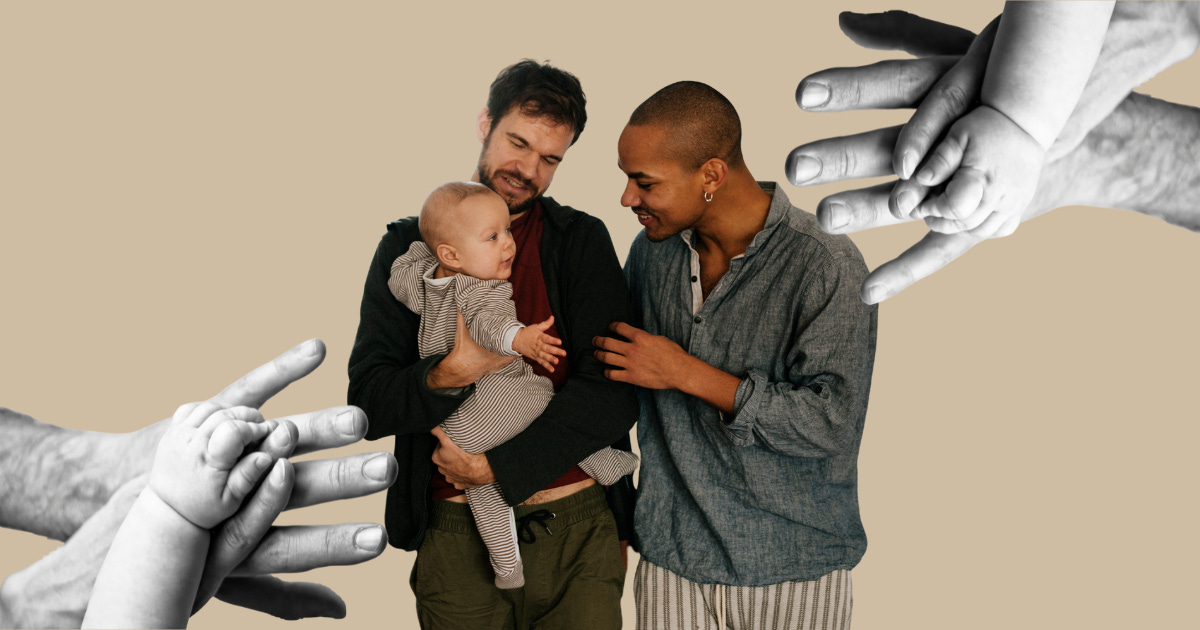
“Children’s rights are greater than adult desires.” This is the rallying cry of the Greater Than campaign, a new push to end same-sex marriage. Leading the charge is Katy Faust, founder and president of nonprofit Them Before Us and longtime critic of all-things-gay.
For years, Faust has railed against Obergefell v. Hodges from the fringes, decrying marriage equality in the name of children’s well-being. Now, backed by 47 nonprofits and a long list of right-wing celebs, her movement is making inroads.
For anyone trying to overturn gay marriage, children are a smart place to start. Although the public remains remarkably supportive of marriage equality — with 65% of registered voters in our recent survey agreeing that same-sex marriages ought to receive the same legal protections as traditional marriages — less than half of Americans viewed same-sex parenting as “completely acceptable” in a 2023 Pew Research Center poll.
Anxieties around children also currently play a central role in uniting the disparate projects of Trump 2.0. If there is one thing Silicon Valley pronatalists, MAHA moms, and Evangelicals can agree upon, it’s that children need protection from modernity’s many evils — like vaccines and woke ideology (but not, it seems, deportation or climate change).
This is why liberals must set the record straight on same-sex parenting. If the 2022 reversal of Roe v. Wade taught us anything, it’s to hold no truths to be self-evident. Not even that gay people are fit to raise children.1
“The natural right of children to their biological mothers and fathers”
The main claim of the Greater Than campaign is that children fare worse when raised by parents who are not their biological mother and father. It is biology, Faust told me over the phone, that is the best predictor of whether a child will be “safe and loved.”
Of course, the majority of children being raised by someone other than their biological parents are not, in fact, being raised by same-sex parents. They’re largely the children of single parents or of opposite-sex couples who struggled to conceive and so turned to assisted reproductive technologies (ART), adoption, or surrogacy.
There is no denying that natural conception poses an obvious challenge to same-sex couples, but while LGBTQ+ Americans are overrepresented in the sample relative to their population share (which for all the fuss remains a mere 9%), any movement opposing ART will have to contend with the fact that most Americans pursuing these treatments are not same-sex couples.
According to Cryos International, the world’s largest sperm bank, only 35% of its private clients are lesbian couples seeking to start a family. And while data on couples having a baby via surrogacy remains limited in the U.S., an informal survey of fertility clinics found that just 10% to 20% of donor eggs were going to gay male parents.
Anyone in doubt about this demographic reality need only remember Donald Trump’s panicky pivot on IVF in 2024 after the Alabama Supreme Court ruled to upend the procedure. Once it became obvious that fertility treatment was overwhelmingly popular among the American public, and that it wasn’t just lefty weirdos who couldn’t get pregnant, the Trump campaign’s initially neutral stance became a full-blown endorsement.
While religious conservatives are largely opposed to ART, even for straight couples, adoption is a harder problem. Before dedicating herself full-time to what she describes in our interview as defending “the natural right of children to their biological mothers and fathers,” Faust was the assistant director of an international adoption agency. She is also an adoptive parent.
If you are new to the internal logic of the Christian Right, you may wonder how Faust squares this particular circle. Fear not: “There are two legitimate ways to unite a child to adults,” she clarified in the Greater Than launch video. “One is biology,” and the second is adoption, in which case, “a child has experienced loss, to which a just society responds by placing them with parents who have undergone screening, vetting, and background checks.”
Part of that screening, in Faust’s view, should be the sexual orientation of prospective parents. As Faust put it: “the impact of gay marriage [was] to normalize something that, for the child, is always going to be harmful, which is the loss of their mother, father, or both.”
The problem with this argument is that existing research simply does not support the idea that children are harmed when raised by same-sex parents.
Gays are not bad parents
That the campaign views homosexuality as one of the characteristics to be vetted for goes tactfully unsaid in the campaign’s promotional material. But on her own Substack, Faust played less nice in an article titled: “5 Things to Say if Someone Claims ‘Gay Couples Have the Right to Adopt’.” Here, she recommends punchy lines, such as “children don’t need familial experimentation, they need restoration,” to any righteous soul taking on the fight against same-sex adoption.
With over 70,000 children awaiting adoption in the U.S., limiting the pool of eligible parents seems a questionable proposal coming from a self-proclaimed “children’s rights movement.” Faust’s solution to filling the gap left by same-sex couples — who are seven times more likely to adopt or foster children than straight couples — is to encourage more adoption among her fellow Christians. How much comfort you take in that particular quick fix depends, I suppose, on your faith in Katy Faust’s Instagram followers.
But let’s cut to the chase. Yes, 1 in 6 people worldwide are infertile and, yes, gay people reliably adopt children. However, neither of those facts refute the argument that, ideally, if we could wave our magic Good Samaritan wand, all children would be raised by their biological mothers and fathers.
“We’ve been studying family structure for decades,” Faust told me, “and we know that children benefit from a male and a female parent, that men and women offer distinct and complementary benefits to child-rearing.” Her tone was almost regretful, as if she wishes things could be different but, unfortunately, facts don’t care about your feelings.
The only trouble is that this is definitely not what the facts say. A 2015 analysis of temporal citation patterns (a fancy literature review) showed that since the 1990s, there has been broad scholarly consensus around children of same-sex couples faring no worse than their peers raised by opposite-sex couples.
According to Faust, this “no-difference” paradigm in the academic community is rigged, “junk science” built on research that is not randomized, longitudinal, nor based on large sample sizes.
(Not that Faust herself seems particularly concerned with this evidentiary standard, often relying on her “story bank” of testimonials from children supposedly depressed about their gay parents.)
It also goes without saying that there’s a good reason we lack extensive randomized trials that test whether children do better in same sex households: because randomly assigning children to parents is generally considered unethical.
Still, hypocrisy is a bad argument, so let’s limit ourselves to her professed “gold standard” of large, population-based research. Even then, it’s nearly impossible to argue that same-sex parents are harming their children.
In a 2020 review in the Journal of Marriage and Family, sociologist Corrine Reczeck of Ohio State University synthesized major studies from 2010 to 2020 derived from nationally representative survey data, which she concluded “consistently [show] that children in same-sex households experience similar health, behavioral, and educational outcomes compared to children in different-sex households.”
One of the studies Reczeck cited found that children of lesbian and gay parents in the 2013 to 2015 population-based National Health Interview Survey did not differ from children of heterosexual parents in terms of emotional or mental health outcomes.
Meanwhile, a 2020 study drew on an even more robust dataset, tracking the entire population of children born in the Netherlands between 1998 and 2007 — nearly 3,000 children with same-sex parents and over 1 million with different-sex parents. Testing for educational outcomes, the researchers found that children raised by gay or lesbian couples in fact performed slightly better than their peers.2
For those concerned specifically about adoption, the case seems similarly settled. Although nationally representative data is even harder to come by on this question, numerous longitudinal studies reported that adopted children’s behavioral challenges are predicted not by parents’ sexual orientation but by earlier adjustment difficulties and levels of parenting stress.
There is one prominent outlier study in the literature, which famously found worse socio-emotional outcomes in children of parents who have had a same-sex relationship, based on a large, random survey of young Americans.
Yet, the widely cited flaw of this research is that the author chose to classify someone as having a gay or lesbian parent even if they were not raised by a same-sex couple. In fact, only 23% of respondents who reported having a lesbian mom also reported having lived in a household with their mother’s partner for at least three years. That share was less than 2% for respondents who reported having a gay dad.
The author, Mark Regnerus, acknowledged this limitation in his introduction, pointing out that the same-sex families in his treatment group are almost entirely the product of a “failed heterosexual union.”
His dataset, in other words, “does not evaluate the offspring of gay marriages, since the vast majority of its respondents came of age prior to the legalization of gay marriage.”
So, unfortunately for Faust, the flagship study of her campaign said almost nothing about the population she has identified as her primary opponent: married same-sex couples intentionally pursuing parenthood. If anything, it suggests that compelling gay people to conceive children within precarious straight marriages probably isn’t a great idea.
Why stability is more important for children than having straight parents
None of the above is to say that social science is neutral on family arrangements. While there is little to no evidence suggesting that, once you control for stability and economic factors, same-sex parenting harms children, research on income and divorce consistently finds children do best in a stable, dual-income home.
Melissa Kearney, Notre Dame economist and author of The Two-Parent Privilege, is an outspoken proponent of marriage for precisely this reason, arguing that the benefits marriage confers on children stem largely from the resource advantages and stability it provides, not from the genders of the parents themselves.
When I asked her about the Greater Than campaign’s claims, Kearney reiterated that: “to the best of [her] knowledge, it has not been empirically established that children raised by married same-sex parents have different outcomes than children raised by similarly situated married opposite-sex parents.”
If the facts reveal very little about same-sex parents being harmful and a great deal about lifelong, stable relationships being beneficial, then by Faust’s own child-centered logic, it follows that the state should optimize for the conditions that make such stability possible.
In the event that the Greater Than campaign notches any successes in reversing the right of same-sex couples to marry, this wouldn’t bring an end to same-sex couples raising children, simply an end to the economic pooling, parental presumptions, and social legitimacy that the legal framework of marriage might have provided.
It was this argument that earned the gay rights movement a pivotal ally on the Supreme Court in 2015. In the majority opinion in Obergefell, Justice Anthony Kennedy wrote:
“Without the recognition, stability, and predictability marriage offers, children suffer the stigma of knowing their families are somehow lesser ... relegated through no fault of their own to a more difficult and uncertain family life.”
But maybe Faust is less willing to put the well-being of children over her own desires than she thought.
Read more:
Karine Jean-Pierre is not a #GirlBoss

The Karine Jean-Pierre press tour was perfect group chat fodder but I didn’t really have much to say about it until I saw Sarah Jones’ piece in New Y…
How getting richer made teenagers less free

In 1913, journalist Helen Todd talked to hundreds of 14- to 16-year-olds working in American factories. Most of their fathers were dead or had crippling health issues thanks to decades of work in unsafe factories, and their mothers were supporting an average of five children on low wages. By doing pieceme…
It is not entirely clear how imminent the legal threat to Obergefell is. On the one hand, the Supreme Court rejected an appeal to revisit its landmark ruling just last November. On the other hand, Justices Clarence Thomas and Samuel Alito have explicitly called for the ruling’s reversal, and resolutions challenging same-sex marriage were introduced in at least nine states in 2025.
The authors acknowledged the reasonable concern that this positive outcome could be driven by omitted variable bias, i.e., maybe same-sex couples are just wealthier and more educated, especially those able to afford IVF or surrogacy. They addressed this through a “bounding estimator,” a statistical technique that calculates how large any unmeasured advantages would have to be to cancel out their findings entirely. In this case, that hidden bias would have to be three times larger than all the measurable advantages already accounted for, which is a threshold the authors consider implausibly high.
Also, even if the studies had turned out differently, "we shouldn't allow members of demographic group X to marry and have children because some studies found their children are statistically slightly worse off than the children of non-members" is an argument you could apply to so many different values of X that at some point you might as well give up on marriage and children entirely.
There’s such irony in all these activists, 90%+ of whom would consider themselves pro-life, advocating for preventing lesbian and gay couples from having children. They are literally saying people like me (conceived with IVF by lesbian parents) should not exist.