

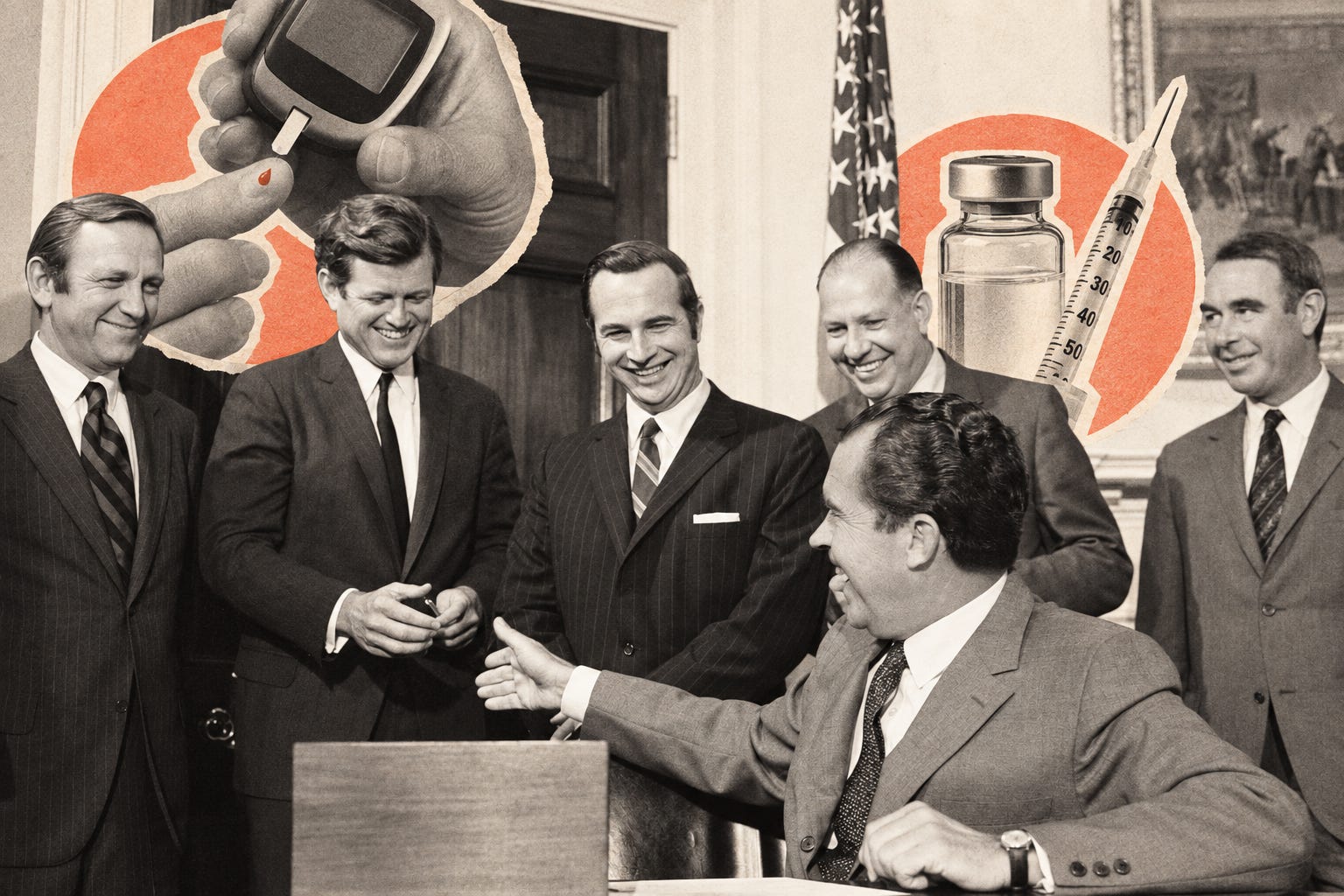
The words “Medicare for All” may not immediately bring to mind President Richard Nixon, but perhaps they should. Unlike any of the contemporary luminaries staking their names on expanding Medicare access, Nixon and the 92nd Congress actually did something about it.
In 1972, Nixon signed into law the renal disease entitlement program, which provided Medicare coverage to nearly all patients with end-stage renal disease (the most severe form of kidney disease), regardless of age. While I understand why many may be reluctant to follow in Tricky Dick’s footsteps, it turns out this is an ideal model for expanding Medicare and stabilizing U.S. health insurance more generally.
Disease-specific coverage targets precious social-safety-net dollars precisely at the most expensive patients and can even lower their per-patient costs thanks to Medicare’s bargaining power. Plus, by removing particularly expensive patients from the commercial insurance pool, it stabilizes costs for everyone else along the way.
“Medicare for All” advocates should take note. While Sen. Bernie Sanders became nearly synonymous with the phrase thanks to his extraordinarily generous version of the proposal during the 2016 presidential primary, other politicians trying to get in good with the left have increasingly used the slogan to signal more limited expansions.
Abdul El-Sayed, the Democratic candidate for U.S. Senate in Michigan, has labeled his health care proposal “Medicare for All,” even though it would not actually provide Medicare to all.1 Slow Boring and The Argument columnist Matt Yglesias argued that this could create a permission structure for other candidates to push for more measured policies under the same label.
Medicare for All fans can certainly view policies such as a buy-in or a lower eligibility age as the opening salvo in a process that will ultimately insure everyone. But these proposals should interest those who see a role for commercial insurance as well. Both would end up putting more expensive patients on Medicare, which would take the burden off commercial insurance. With lower claims costs, commercial insurers could lower premiums for the majority of Americans.
So why target a specific organ or disease instead of lowering eligibility or offering a buy-in? The main reason is that the latter options use imperfect proxies to identify expensive patients, otherwise known as sick people. Yes, 55- to 64-year-olds have worse health, on average, than younger people, but expanding the program by lowering the eligibility age would sweep in lots of people in good health as well. Yes, a Medicare buy-in would likely be most sought by those with health challenges, but any healthy person can also buy in.
Now, giving people health care coverage is hardly the worst thing you can do to them. But a healthy patient — someone who pays premiums without using many health care resources — is someone insurance companies need to keep their books in order. And in a world of scarcity like ours, we want our in-demand federal dollars going where they’re most needed.
That’s why disease entitlement, such as Medicare’s kidney coverage, is such a good option. It is a perfect proxy for sickness. By definition, there are no healthy patients with end-stage renal disease.
So, if we’re looking for other options to expand Medicare, I think we would be much better off continuing with the approach we started in 1972: expanding it one disease at a time.
Designing such a policy necessarily means choosing which chronic disease we should cover next. The Centers for Disease Control and Prevention has identified nine of the costliest chronic health conditions, and a quick look at total health care spending attributable to each of those diseases gives us three obvious candidates.
Cardiovascular disease and cancer appear nearly tied as the most expensive chronic diseases, followed more distantly by diabetes. But if we look back at our success story, kidney entitlement, we can see why diabetes is the clear front-runner.
Why diabetes?
End-stage renal disease had three main features that made it a good starting point for Medicare expansion: