

“You don’t ask a fish how to fish; you ask a fisherman,” is the manosphere’s most important sales pitch.
It is the logic that underpins Myron Gaines’ notorious Fresh&Fit podcast, where he takes pleasure in revealing “hard truths” about female mating behavior. Or the YouTube channel of Stirling Cooper, who claims to be an expert on what women “subconsciously” want in bed. Or the clips of Andrew Tate, currently facing charges of rape and human trafficking, smugly explaining to viewers what it is that “girls really want.”
These men have built their careers on the idea that women are unreliable sources of information about their own desires. The implication of even the most benign manosphere content is that for men to be romantically successful, they must doubt women’s stated preferences. Modern women may say they want agency and equal partnership, but deep down, they all want the same thing: a dominant alpha male.
This suspicious view of women explains a broad spectrum of behavior, from the merely manipulative — like not giving your girlfriend too many compliments, lest it decrease your sexual market value — to the wholesale embrace of incel ideology that can culminate in murderous violence, as when a Toronto teenager stabbed a woman with a sword christened “THOT slayer” in 2023. And while manipulation and murder are very different impulses, both can be justified by the belief that women are, by nature, slippery fish who will play you if you don’t play them first.
Four centuries before podcasts and 4chan and red-pilling, Shakespeare recognized that this kind of paranoid misogyny does not actually serve the interests of men.
A play about a man murdering his wife on suspicion of infidelity, Othello is Shakespeare’s most intimate tragedy — a psychological portrait that lays bare the futile endgame of contemporary dating advice for men. The manosphere tells men they must collude to trick women into liking them. But the story of Othello reminds us that this is a tragically counterproductive approach to the opposite sex.
The companionship and love that the lonely men of the manosphere yearn for cannot exist if men believe that women are fish to be caught rather than human beings to be understood and respected.
Men who lie to other men about women
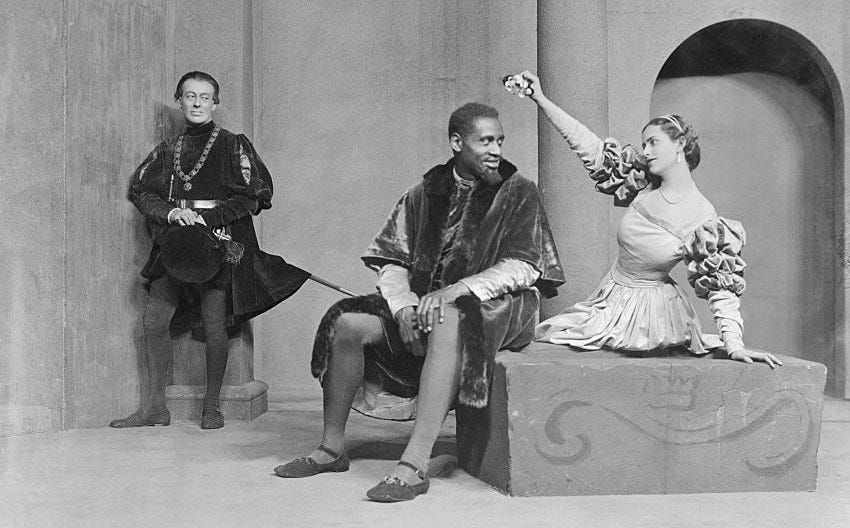
Othello, which the Shakespeare Theatre Company recently brought to Washington, D.C., in a production starring The Wire’s Wendell Pierce, begins as a love story.
Set during the Ottoman-Venetian War of the late 16th century, the play opens on the wedding night of Othello, a Black military commander, and Desdemona, the white daughter of a prominent senator. Many are scandalized by their interracial marriage, including Desdemona’s father, but they elope anyway, so passionate is their love. When Othello is deployed abroad, the thought of being apart is so unbearable that Desdemona joins him.
It is here, in a military fortress on Cyprus, that things begin to sour. There is no Andrew Tate, but there is Iago: an officer in Othello’s platoon who seeks to destroy his commander by turning him against Desdemona.
The motives behind Iago’s diabolical scheme aren’t entirely clear. But whether he is driven by racial animosity, sexual jealousy, career resentment, or megalomania, he proves to be a devastatingly effective manipulator.
Within days, he has managed to convince Othello not only that Desdemona is having an affair with the amiable lieutenant, Cassio, but also that he, Iago, is Othello’s loyal friend — the only one willing to tell him the painful truth about how the world really is. All the while, a bewildered Desdemona can’t understand what has happened to her husband, who has suddenly transformed into a cold and distant stranger: “For by this light of heaven, I know not how I lost him!”
Finally, in the play’s concluding act, Othello confronts Desdemona directly. When she insists that she is innocent, that she has only ever loved Othello, her words fall on deaf ears. His mind is already made up, and so he smothers her — even as she cries out: “A guiltless death I die!” Minutes later, realizing what he has done and that he has fallen into Iago’s trap, Othello takes his own life.
What makes the play so gut-wrenching is that it follows a narrative arc that, once set in motion, feels almost inevitable. While there is a long history of critical speculation1 about why Iago does what he does, Othello’s character is no mystery. His psychological trajectory from infatuation to violence is as legible to an audience in the 21st century as it was in the 17th.
Iago stokes an entirely universal anxiety — the person I love does not love me back — with misogynistic contempt: Desdemona, he tells Othello, is lustful and disobedient by nature. Just look at her past! She married Othello against her family’s wishes, and everyone knows a woman willing to betray her father will most certainly betray her husband.
Before Iago can make a murderer out of Othello, he must first persuade him that Desdemona is not who he thinks she is. It is only when you stop seeing someone as your wife, your friend, your fellow human being, and see instead only their most vilified caricature, that misery can curdle into the sort of paranoia whose logical endpoint is a homicidal rage.