

Imagine you’re trying to learn CPR. You’ve never heard of the technique before and have no idea what it entails. The instructor opens by saying, “Here’s a dummy. Go ahead and try to do CPR on it!” Then they invite you to talk to the person seated next to you about doing CPR. Then they give you half an hour of open exploration time to try out CPR. They circulate the room, asking questions like “Why do we do CPR?” or “What are you trying?”
They are careful not to give away the answer by telling you how to do it.
This is what’s called an inquiry-based approach. And while no one would ever consider teaching CPR that way, its adherents argue that it’s the perfect way to teach math.
Determining the best way to teach children is at the crux of the second season of education reporter Emily Hanford’s Sold a Story podcast, which is airing now. It’s a bigger topic than the one she tackled in her first season (the science of reading instruction).
Inquiry — the “think for yourself about how this might work” approach — is a hit with many education theorists. But research has found that the best-performing method, by far, is one called Direct Instruction: a scripted instructional program in which the teacher breaks down new material and has students repeat it until mastery.
Consider how you actually learn CPR: The instructor explains how to do it, asking quick questions to make sure you internalized what was just said. Then the instructor demonstrates it. Then the students attempt it and the instructor tells them whether they’re doing it right or wrong.
That’s direct instruction. We know that direct instruction works extremely well to get poor children reading and doing math at grade level. But, Sold a Story argues, we’ve repeatedly chosen what feels good over what gets results, including refusing to admit it when our comprehensive studies show direct instruction as the strongest method.
Education schools often instead promote inquiry-based approaches, which mostly don’t work as well.
In the 1960s, the U.S. government commissioned a large-scale study called Project Follow Through to see which educational approach produced sustained gains for students. The results were clear-cut: Direct instruction worked extremely well, much better than any of the other programs studied. In fact, most of the innovative programs had negative effects on student achievement (relative to a baseline of normal classroom instruction).
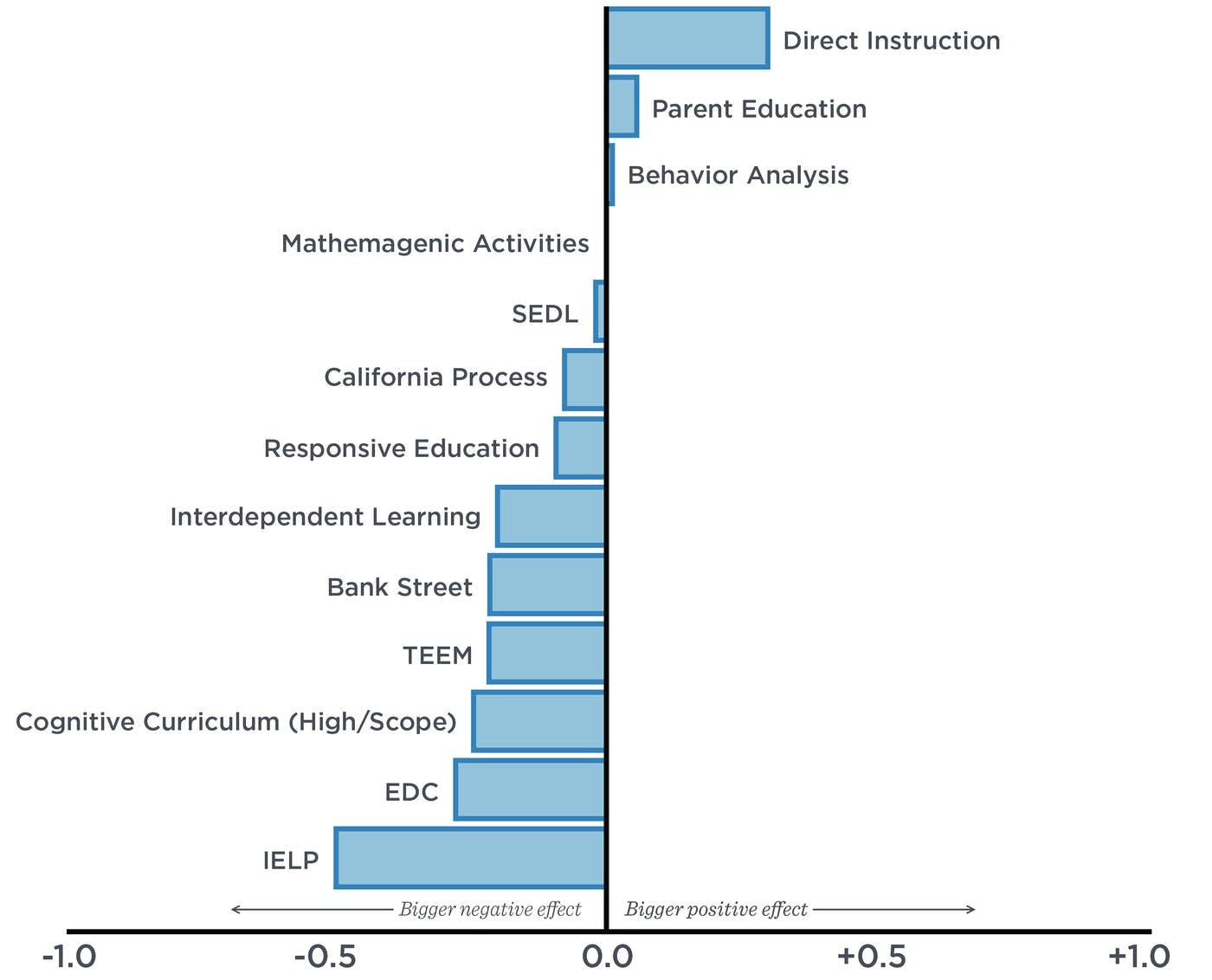
Looking at these results, the government that commissioned the study decided, basically, to pretend it had never seen them. The results buried the facts, and the federal government ultimately decided to highlight individual high-performing schools from each approach rather than be honest that one approach was head and shoulders above the rest.
The podcast meticulously documents how direct instruction’s opponents, who disliked it because it seemed too robotic, persuaded the government to ignore its own evidence. It’s accurate, damning, and compelling.
But, as in season 1, Hanford brings the fire on faddish, non-evidence-based approaches and then is quite fuzzy on the institutional and implementation decisions we would need to make in order to do better. Season 2 is fun and satisfying to listen to — if you agree with her that we’ve neglected the science of pedagogy at great cost to our students.
But even if everyone working in education listened to it and took it seriously, I can’t help but anticipate the result would be of limited utility. Passing a law mandating direct instruction would probably do about as much as passing laws mandating phonics has done — which is to say, not very much. Many states may have changed their phonics laws in response to Sold a Story season 1, but not all have seen actual gains.