Is Generation Z screwed? With unemployment barely over 4%, even asking that question might elicit eye rolls in some quarters. But on this week’s episode of The Argument podcast, Jerusalem Demsas and Matt Yglesias were joined by economics commentator Kylan Scanlon, who is uniquely sympathetic to the plight of the young. Paid subscribers can watch or listen to the episode ad free or read the transcript. Free subscribers can watch the episode on YouTube or listen at their podcast provider of choice.
Subscribe: Apple Podcasts | Spotify | YouTube | Overcast | Pocket Casts
If you’ve seen Moneyball (or read the book), you’re probably familiar with the concept of Wins Above Replacement (WAR). In baseball, WAR tells you how much value a player adds to their team by quantifying how many “wins” the player contributes over a generic replacement-level player at the same position.
As part of our work at Split Ticket, we’ve spent years calculating WAR for political candidates. Today, we’re proud to introduce our WAR model — exclusively here at The Argument — for the 2026 midterm elections.
Here’s how we calculate each score: For every single contested two-party race, our model compares the final result to the expected result of a matchup between a generic Democrat and generic Republican in the same district. The difference between the actual result and the generic baseline tells you whether the Republican or the Democrat in the race was stronger — and by how much.
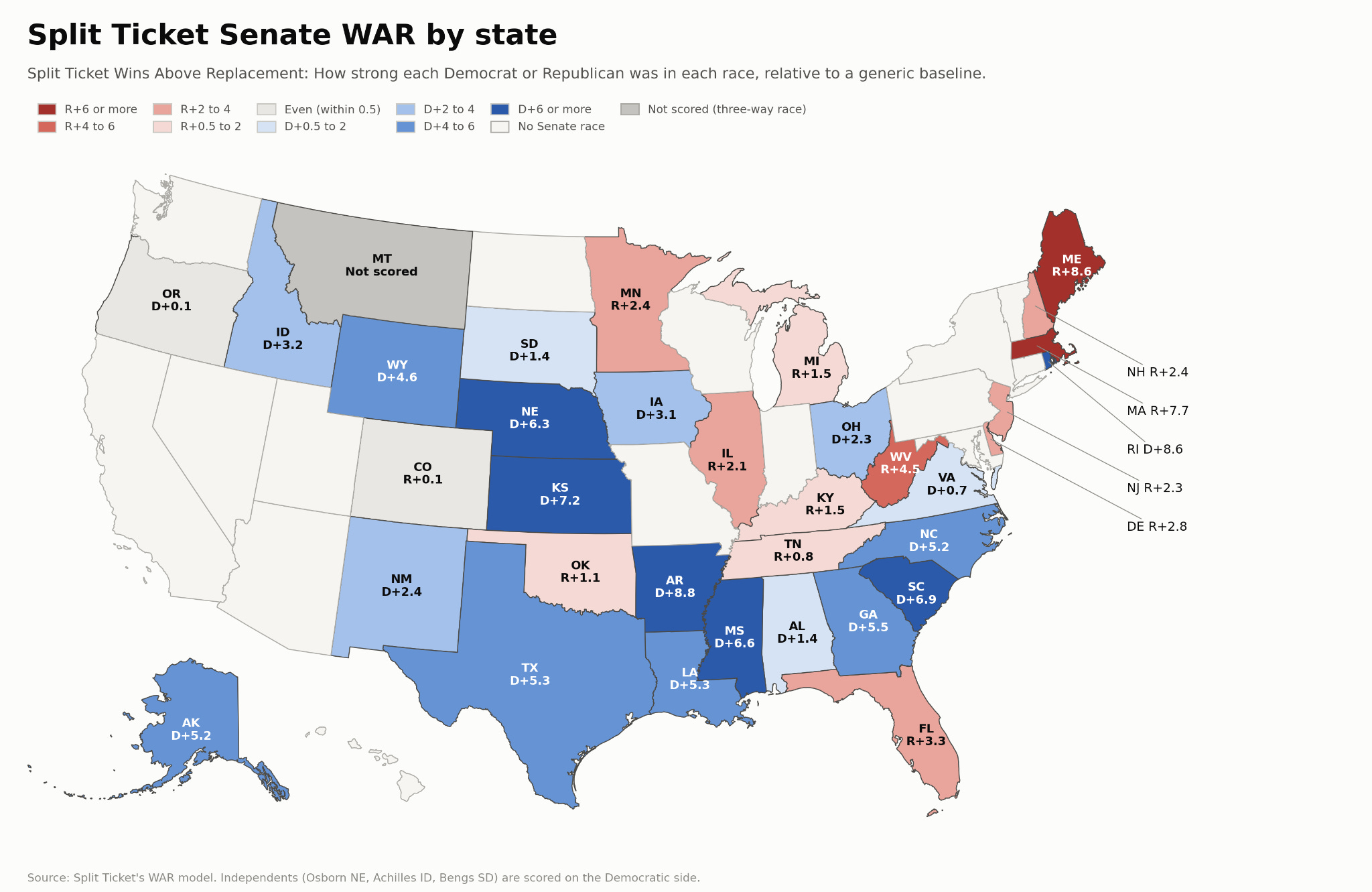
For instance, let’s consider Mississippi’s U.S. Senate race, in which Democrat Scott Colom narrowly prevailed over incumbent Republican Cindy Hyde-Smith. Because baseline voting patterns in Mississippi are so Republican to begin with, a “generic” matchup between an incumbent Republican and a Democratic challenger probably would have produced something like a 6-point Republican win — even in a blue wave year like 2026.
Instead, Colom won by roughly 1 point. Thus, the WAR for that race is D+6.6 — meaning, in our estimation, that Colom did 6.6 points better against Hyde-Smith than you would expect a standard Democrat to do against a standard Republican incumbent.
A model like this is incredibly hard to make, especially in a midterm year. Many basic analyses simply compare 2026 results to 2024 presidential margins. But a Democrat outperforming Kamala Harris by 30 points in Houston isn’t nearly as impressive as the very same 30-point overperformance in rural Mississippi would be.1 That’s because you have to take into account factors like the demographics of the seat, incumbency and outside party support, and the statewide environment.
This is the most complex and comprehensive modeling exercise we’ve done yet. Let’s dive into the findings.
Democrats really overperformed in the Senate