

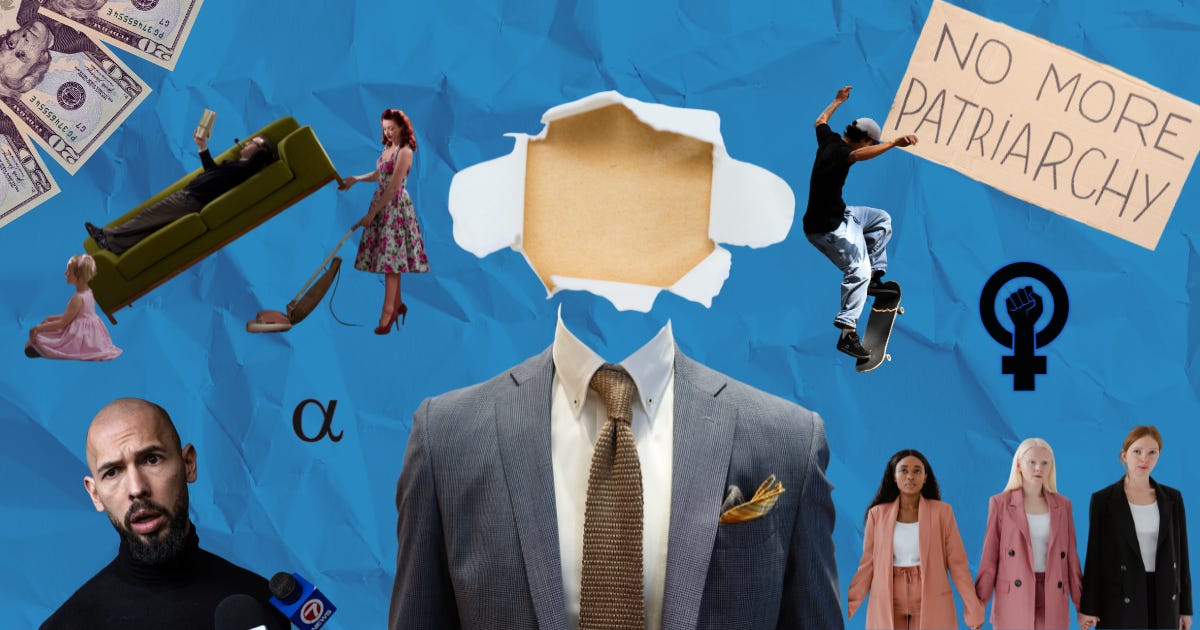
Donald Trump’s 15-point gain with young male voters in 2024 triggered a crisis of confidence among liberals: Maybe Gen Z men just weren’t that into them?
This phenomenon became a fixture of political commentary at the time. “What’s the Matter with Young Male Voters?” asked The New Yorker; Politico speculated about “Trump’s push to win over the ‘bro’ vote,” and in the Financial Times, Chief Data Reporter John Burn-Murdoch laid out a grim prognosis for a “global gender divide.”
It seemed that a new, humbling reality of modern politics had been revealed. Anyone trying to win over the American public would now have to account for the fact that men simply did not support the gender-equal world that liberals had built. This looked to be particularly true of the chronically online Gen Z male, resentful of women’s progress and nostalgic for a bygone era when men could be men.
Data taken from The Argument’s national survey of 3,003 registered voters, fielded between Feb. 4 to 10, 2026, told a more optimistic story. In response to every question we asked about changing gender norms, younger men were more progressive than Gen X or boomer men. Just like with women, men under the age of 45 tended to hold more liberal views than older men.
And contrary to the narrative that young American men and women are uniquely polarized on social issues, our data suggested that Gen Z remains more aligned relative to other age groups.
Aggregated across all of our polls conducted since August 2025 — totaling over 13,000 responses — the difference between female and male conservative identification was comparatively small among the youngest generation. This makes sense given that rates of conservative identification were relatively low for younger voters overall in our survey — men and women alike. Catalist polling from 2024 confirmed this trend, finding that young men gave Harris the highest support share among all male voters.
This pattern aligns with Gallup’s telephone survey data from back in 2024. Even as the narrative that young men were shifting right took hold in the media, Gallup reported that the “gender gap” in ideology was actually driven by increasingly liberal young women, not increasingly conservative young men.
Gen Z men are not “the problem”
Based on our February poll, the most noteworthy gap in ideology fell along generational, not gendered, lines. 48% of 18- to 29-year-olds strongly disagreed with the statement that “society would benefit from a return to traditional gender roles,” almost 20 percentage points more than other cohorts.
Even when we remove women from the sample, 52% of men under 45 strongly or somewhat disagreed with returning to traditional gender roles, compared to 43% of older men.
Narrowing that population down further to only the men who voted for Trump, the youngest male cohort, 18 to 29, was again the least likely to support the statement, with 36% of Gen Z male Trump voters at least somewhat disagreeing.
Of course, what precisely respondents mean by “traditional gender roles” is hard to say. The term could plausibly refer to anything from women not occupying leadership positions to men wearing nail polish. Our polling points to the latter: discomfort with gender nonconforming behavior, not views about women’s economic roles, driving support of gender roles.
Only around 18% of both male and female respondents agreed with the statement that “Nowadays, women in America are taking jobs that should go to men. 75% of women and 72% of men at least somewhat disagreed.
This suggests that although many Americans see value in traditional gender norms — a finding backed by a recent 19th News-SurveyMonkey poll — it does not follow that an equally large share view women’s economic gains as zero-sum.
Gender norms are popular. Misogyny isn’t.
Given pervasive pessimism about men’s latent sexism, pointing out that explicitly misogynistic attitudes are not, in fact, widely held by the general male public seems like an increasingly important point of clarification.
In December, Ross Douthat argued that the radicalization of young conservative men mainly had to do with labor market grievances — with, in his words, “feeling like a door has been slammed in your face or closed before you ever reach it.”
Douthat is undoubtedly correct that there are some men who truly feel this way. But as we survey the political landscape and strategize about how to persuade voters to reject democratic backsliding, we should be able to hold two thoughts in our minds at once. Gen Z is not just the generation of Nick Fuentes and looksmaxxing. Younger men are also more open to therapy, more likely to identify as LGBTQ, and more likely to spend time with their kids than previous generations.
From this ideological fray, a middle-ground position seems to emerge. While overt opposition to women’s economic gains was a fringe position in the sample, preferring gender conformity was relatively popular, even among younger voters. When we asked respondents how they felt about men looking and acting like men, and women looking and acting like women, over half at least somewhat agreed that this was better.
As disappointing as some of us might find the American public’s preference for gender conformity, this should not be conflated with a wholesale return to strict gender roles. Liberals should not capitulate to a vocal minority of sexist young men whose views are better represented in the current White House than they are among their voting peers. Patriarchal restoration is not, yet, the majority politics of the day.
Correction: An earlier version of the “Broad agreement that women are not taking jobs” graph in this article had incorrect question wording. The graph has been updated.
Recommended Reading:

The trans rights backlash is real

New polling from The Argument shows that the country is turning its back on trans people.
While I like the analysis, I unfortunately have to point out that 18-45 is a really wide age range - that includes middle aged dads and radicalized 20 year olds in their first year of college
I think what's broadly going on is two things -
1.) The most likely reality is 20-year old men in 2026 are slightly less 'woke' than 20 year olds in 2021 but still far more 'woke' than 20 year olds in 2006 or 2001. But at the same time, young women are just getting woker.
2.) A chunk of the loudest most seemingly right-wing men on places like Twitch, Youtube comments, Twitter, whatever are literally teenage boys who are all dumb, full of testosterone, and saying dumb things they either really don't believe or will largely stop believing the moment they get a girlfriend or go off to college and regularly interact with women on a semi-regular basis in-person.
I say all this as a former teenage boy who while I was always a mild-mannered political dork saw a lot of my fellow teenage boys calm down in a variety of ways and this was in the early 2000s, let alone today.