

Charges of hypocrisy are more compelling than they should be.
There’s something strangely persuasive about proving that someone hasn’t lived up to their own stated standards, that they have thrown stones through the walls of their glass house. Logically, this shouldn’t matter that much in evaluating someone’s argument. If someone who tells you not to cheat on your wife ends up cheating on their wife, that really shouldn’t affect whether you think their advice was true to begin with.
But enough complaining. The abundance movement has been charged with hypocrisy for forming interest groups. Prominent voices within the abundance movement—like The Argument columnist Matthew Yglesias and New York Times columnist Ezra Klein—have both criticized the influence of interest groups within the Democratic Party.
“Mainstream progressive advocacy groups…threaten [Biden] and other Democrats with bad press unless they hew to progressive orthodoxy,” argued Yglesias.
“[The Democratic Party] is learning how not to listen so much to its funders and interest groups,” remarked Klein approvingly.
These criticisms have frustrated many activists and voices among the progressive left, who note, correctly, that Abundance groups have sprung up all over the place.
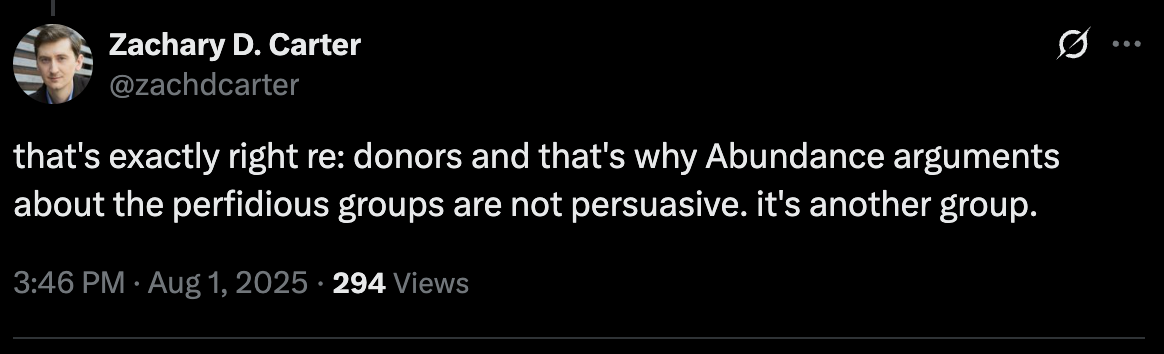
Zach Carter, a columnist at Slate and author of the John Maynard Keynes biography The Price of Peace, argued last year that “Abundance arguments about the perfidious groups are not persuasive. It’s another group.”
Earlier this week, Amanda Litman, president of Run for Something, responded to news that Cheri Bustos, former chair of the Democratic Congressional Campaign Committee, was forming a new abundance group called Next American Era with frustration:
“The ~Groups for me, not for thee~ mindset of a certain subset of our party makes me so so tired,” she tweeted. A sentiment which was then reposted by the president of Refugees International and the executive director of Groundwork, to name a few.
This debate is not really about abundance, but rather it’s a microcosm of a broader debate roiling the left-of-center: Should the Democratic Party moderate in order to win elections?
As a result, I worry that the fundamental democratic critique is being missed. While the critique of the groups has most recently been levied as part of this intra-left dispute over electoral strategy, for decades political scientists, economists, and activists have raised the alarm over a growing democratic crisis.
The crisis is that contemporary advocacy organizations exert political influence on the basis of representational claims they haven’t earned. These groups lack democratic membership structures that could give them the authority to speak for their asserted constituencies, nor do they maintain the empirical rigor that would justify following their policy prescriptions.
This dual failure is structurally corrosive to democratic politics and is in part responsible for the rise of populist sentiment. And the media, elected officials, as well as the groups themselves are all responsible.