


To virtually anyone watching the 2024 election, one of the biggest shocks of the cycle was the way young and Hispanic voters zoomed toward Donald Trump.
Two years later, it’s difficult to find signs of the president retaining any of that once-mythical strength.
Through aggregating and analyzing the surveys we’ve done at The Argument, we have been able to reconstruct a spectacularly detailed picture of both the American electorate at large and the likely electorate of 2026. This trove of data allows us to see Trump’s approval and voting intent for each subgroup. And it tells us that Democrats are making titanic gains among the groups they initially lost ground with in 2024, as young and Hispanic voters abandon Trump at dizzying speeds.
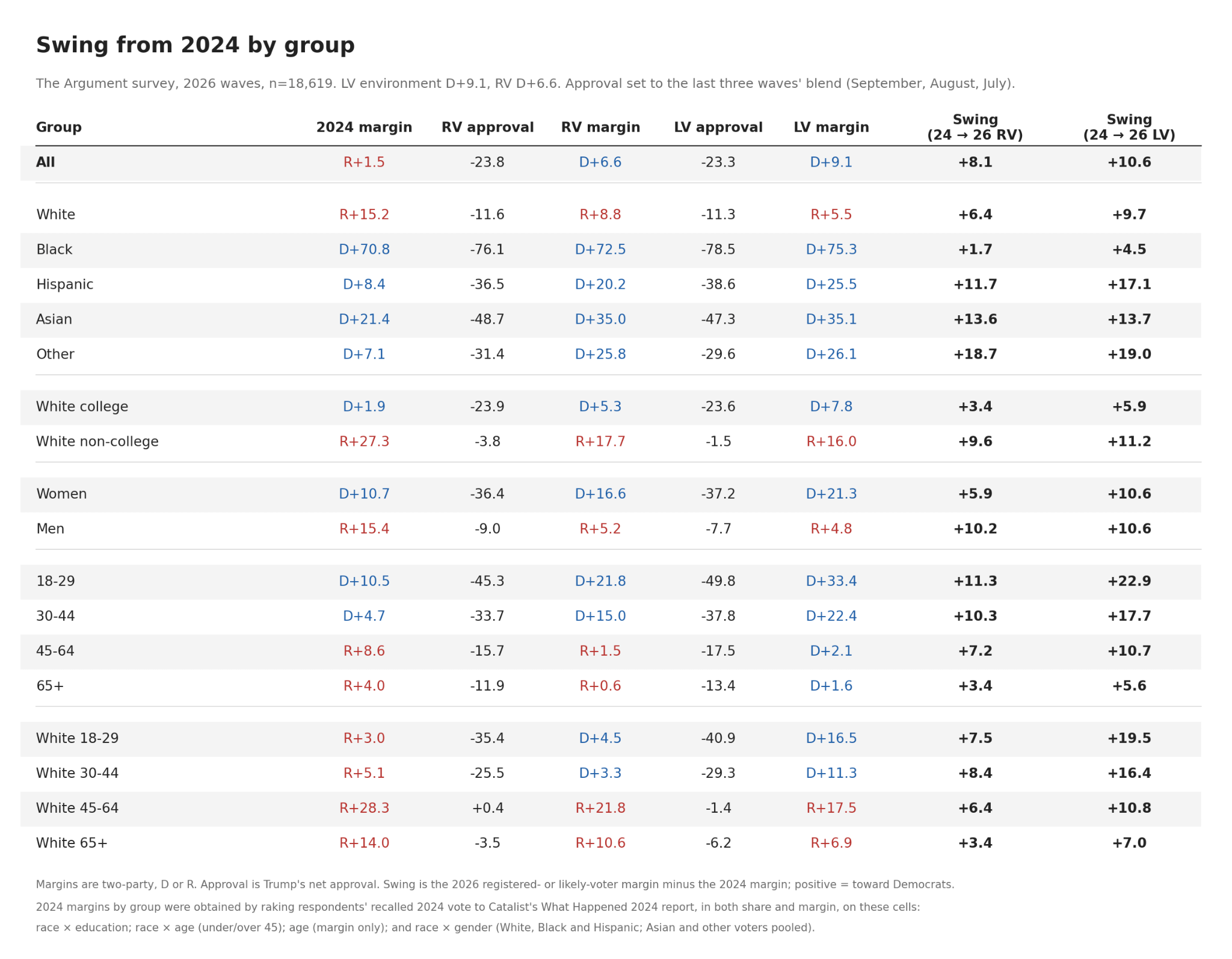
Whether because of disillusionment over his foreign policy, anger over his immigration agenda, or disappointment over the way he has handled the cost-of-living crisis, Trump’s approval has cratered spectacularly. His net approval with Hispanic voters sits at -37 with registered voters, and at -39 with likely voters. Meanwhile, the picture is even uglier with young voters, as his approval sits at a shocking -45 with registered voters and -50 with likely ones.
Two things are happening as a result. First, a lot of voters are simply switching sides. Among all registered voters between 2024 and 2026, Democrats have gained over 11 percentage points of margin with Hispanics and young voters alike, which exceeds the leftward national swing by a few points.
But our polling also found something else: a lot of the conservative voters who remain unwilling to vote for Democrats are also so angry at Trump that they have no intention of showing up in 2026. We see this in the delta between the likely voter electorate and the registered-voter electorate. Even though registered voters are a less Democratic sample, Trump’s approval is the same in both groups. That means the registered voters who are unlikely to vote are disproportionately Republican-leaning voters who disapprove of Trump.1 This takes the swings projected for the midterm from notable to colossal.
When we compared the margins of the 2024 election to those of the likely 2026 electorate, Democrats picked up 17 percentage points in net margin with Hispanics, as well as 23 points with voters under the age of 30.
In the case of Hispanics, these projected 2026 margins are on par with Joe Biden’s 2020 numbers.2 Meanwhile, with young voters, you’d have to go back to either the 2018 blue wave or Barack Obama’s 2008 landslide for the last time Democrats saw numbers this high.
It would be a mistake to look at this and think that the Democratic problems of 2024 are all solved. Voters who sit out the 2026 midterms may return for the 2028 presidential election. And among all registered voters — not just the ones likely to vote this November — the shift toward Democrats is considerably smaller, even though Trump is similarly unpopular in both groups. That suggests a substantial and disproportionate chunk of the voters who have abandoned the president remain unwilling to vote for Democrats.
In particular, when it comes to the full electorate of registered voters, the margin by which people disapprove of Trump is much larger than Democrats’ lead over Republicans. That gap is especially large with many subgroups, including young and white noncollege voters, suggesting again that dissatisfaction with Trump doesn’t necessarily translate into votes for Democrats.
That’s the sort of thing that calls into question just how durable either side’s electoral position really is. It means that these voters remain up for grabs in the next election despite how intensely they’ve soured on the president, giving both sides glimmers of hope in 2028. After all, while it’s clear that most voters now dislike Trump, it’s not yet so clear that they would vote for Rep. Alexandria Ocasio-Cortez, California Gov. Gavin Newsom, or Kamala Harris over Secretary of State Marco Rubio or Vice President JD Vance in 2028.
When I see the chart we’ve assembled above, I see a myriad of potential outcomes.
In one, Democrats could sweep 2028 in the same way that they dominated 2008. Disillusioned white working-class voters, Hispanics, and young voters could rocket to the left over disappointment with the outgoing Republican president’s handling of foreign wars, cost of living, and healthcare.
In another, a tight election could result in a narrow Republican win, with just enough voters holding their nose for a different kind of Republican candidate against an unappealing Democrat.
Those are two wildly different outcomes, but in many ways, the uncertainty is the point. Though the story of 2026 may be largely written by now, the story of 2028 certainly isn’t.
But this is still a very different type of discussion than the one we were having in 2024. Axios‘ youth-vote analysis declared, “A big chunk of the future electorate is MAGA red” and claimed “lasting power” for MAGA. Data scientist David Shor, speaking on The Ezra Klein Show, described young people as “potentially the most conservative generation that we’ve experienced maybe in 50 to 60 years.” Few predicted that the right-wing youth revolution of 2024 was potentially just a blip on the radar.
Meanwhile, endless pages of ink were spilled on the loss of Democratic standing with Hispanics. Discussing Republican gains in heavily Hispanic communities, pollster Patrick Ruffini argued that “the FDR coalition is being dismantled piece by piece and being reassembled in Donald Trump’s GOP.”

The change we’re seeing doesn’t make those autopsies any less correct or valuable, but it does remind us that the certainty can sometimes just be an artifact of a lack of data. With two years between elections, each race is analyzed and scrutinized endlessly with a fine-toothed comb in the hopes of avoiding or predicting the next surprise.
But at the end of the day, the choices that parties make really do matter. And had Trump made some different ones, we probably wouldn’t be having this conversation today.
METHODOLOGY
To assemble these estimates, we combined data from all of the surveys performed by The Argument over the course of 2026. First, a likely voter screen was created for each survey. The likely voter screen takes every respondent’s demographic and voting history and calculates a probability that they will vote in 2026. It then aligns this with probabilistic turnout scores from self-expressed vote likelihood and rakes this to the likely 2026 electorate, calculated via historical demographic turnout data from a Catalist voter file sample, in order to estimate respondents’ likelihood of voting.
Then, the pooled survey file is fitted among 2024 voters to have demographic shares and Verasight panel-profiled votes match the margins in Catalist’s 2024 What Happened report on the following factors: race by age, race by education, and race by gender (for white, Black, and Hispanic voters). It is also weighted to match the report’s margins for age and to match the actual, certified election results by region. This allows us to anchor our own 2026 estimates by ensuring that the 2024 vote margins of our demographics align with actual, validated external measures. Every registered voter is also weighted to the Catalist voter file sample’s benchmarks on white/nonwhite by modeled party.
Respondent likely voter weights are then rescaled by the amount they shifted by during the recalled margin rake, and the likely electorate is then restratified across demographics to align with the initial likely electorate screen.
Recommended reading:
Four things I changed my mind on after a year of polling

Issue polling is dominated by interest groups. We wanted to do something different.
The unraveling of Trump's 2024 coalition

There’s good reason to believe that 2026 may be the best year for Democrats since 2018. But no two waves are the same.
It’s especially notable that Trump’s approval is better among the likely electorate than the full electorate of registered voters for noncollege whites.
It should be noted, though, that these are still well short of the margins that Barack Obama and Hillary Clinton put up.
It seems to me that drawing any particularly strong conclusion about one party and "shifts Left/Right" is probably a self-deceiving way to frame: rather the Parties moving radically Left/Right back and forth may be more party shifting than population shifting. While Political Obsessives express incredulity at the surprise of many a Trump voter of how Trump 2 has turned out, expecting more a rerun of T1 (which I honestly myself thought was highest likelihood given how lazy he is).
Schor's observation is not necessarily wrong (it might be of course), but it may equally be "more conservative youth does not equal support to rabid Trumpian MAGA" [or put another way, turning slightly culturally right in reaction to Woke did not convert most people to frothy right-Woke-MAGA]