

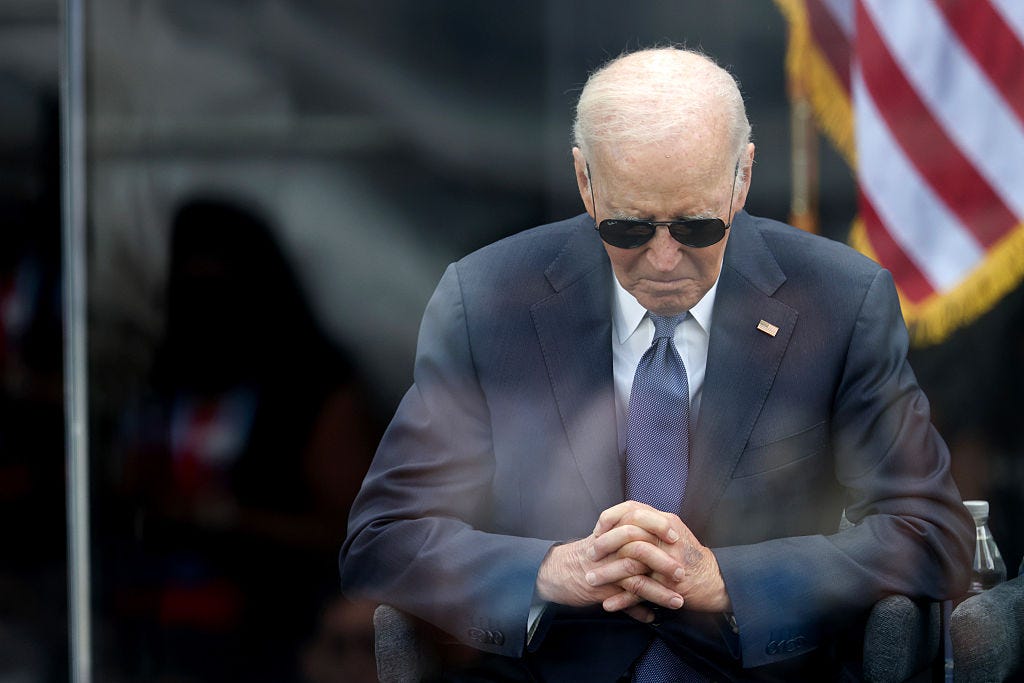
The Bidens are in the news again, and they are busy desperately trying to salvage their legacy while lashing out at those they deem disloyal.
This time, the former president is featured in New York Magazine as he struggles to raise funds for his presidential library, while Jill is busy promoting her new memoir, View from the East Wing. Hunter joined Candace Owens’ podcast and is all over Twitter writing AI-generated election analysis while correcting a user for creating an AI-generated image of him smoking a meth pipe instead of a crack pipe. And the broader Biden cinematic universe is still clamoring to tell its story, including recent books from Kamala Harris and Karine Jean-Pierre.
So, since Matt and I can’t seem to escape Sleepy Joe, we decided to rank the worst parts of his presidency and see what can be learned from it. Here are my rankings, which differ from Matt’s in a few key ways:
1. It’s the economy
I am a woman of the people, so my number one problem with Sleepy Joe was his failure to adequately tackle inflation — which was downstream from his apparent contempt for the people who actually understand economics. Much of the administration was a revolt against economists, wonks, and the white-paper style of governance that defined the Obama years.
Tariffs, energy, housing… all areas he could have taken more of an interest in. But, as is a theme in my beef with Biden, he didn’t seem all that interested in major parts of economic and domestic policy.
Additionally, people with private-sector experience were treated as inherently suspect. I understand not wanting the SEC run by hedge fund managers, but Biden took it further. He leaned on Warrenite bureaucrats who seemed hostile to the idea of letting private-sector people in at all.
None of this was helped by the fact that Biden was barely engaged with his own domestic agenda. He wasn’t the one in the room hashing out the details of the Inflation Reduction Act or playing hardball with Joe Manchin. It’s the kind of disinterest you’d expect from a president too old and self-absorbed to get bogged down in the minutiae of actually governing.
And when he did engage, even amid record inflation, it was to stay loyal to the labor and green groups whose agendas often pushed prices higher.
2. Running again
Joe Biden’s administration actively concealed his decline from the American public, and that is why Donald Trump, a man anathema to liberalism, is president. Remember when it took a movie star donor who had no elected responsibility to the public to reveal that something was seriously wrong with the sitting president running for reelection?
Worse still, Biden got his allies to tie themselves in knots and embarrass themselves on cable news as they tried to convince voters that he was still up to the job — all because he couldn’t recognize (or acknowledge) that he was not fit to run again.
3. Israel
You can’t talk about Biden’s downfall without getting into a heated argument about Israel. Matt is more defensive of Biden here, claiming he successfully worked to prevent the very war with Iran that Trump and Netanyahu have since carried out. I think that Biden was far too permissive of Israel’s destructive actions in Gaza and the West Bank.
Plenty on the far left have sadly turned a blind eye to the terrorism of Hamas, but Democrats have been too lenient when it comes to Israel’s treatment of Palestinians for decades, and Biden’s decision to bear hug Netanyahu was a moral and strategic error.
4. Immigration
The Biden administration avoided taking charge of immigration resettlement and ceded authority to Texas Gov. Greg Abbott. Biden was not that personally interested in any major macroeconomic issue, which clearly affected his administration’s ability to attack the border security problem effectively.
5. Kamala
Full disclosure: I worked for Kamala Harris in South Carolina in 2019, and I left politics shortly afterward. So I come to this with some history.
In 2020, we were at a moment when people badly wanted to elevate a nonwhite candidate, and especially a Black woman, to higher office. When you look around the halls of power and notice they’re dominated by the same few groups, the impulse to correct that is the right one.
But deciding that the solution is to find any Black woman at all to elevate is obviously stupid. It’s insulting to Black women, and to Black people in general, to suggest that the way you serve a community with real concerns about inflation, schools, and crime is to hand power to someone who simply happens to share some of their characteristics.
The Democratic base didn’t want Kamala at the top of the ticket in 2020, and there should have been an open primary in 2024 to find out whether that had changed. Instead, she was handed the nomination in a coronation, and we never got to test it.
Matt points out that this identity-based philosophy was integral to the Biden administration. From his Supreme Court pick to cabinet secretaries to Merrick Garland as U.S. attorney general, Biden was seemingly obsessed with optics rather than putting together a formidable administration.
We get into all of it on this week’s episode.
Watch or listen wherever you get your podcasts.
*In a couple of weeks, we’ll be reviewing Jane Jacobs’ The Death and Life of Great American Cities, so grab a copy and read along!
The Argument. Libbing out.
(Illustration by The Argument, photo by Justin Sullivan/Staff via Getty)
The transcript will be after the paywall in this post for paying subscribers.
WATCH THE EPISODE HERE (YouTube)
New episodes post every Thursday.
For an ad-free version and full transcript, subscribe at TheArgumentMag.com.
Subscribe: Apple Podcasts | Spotify | YouTube | Overcast | Pocket Casts
Corrections:
Around 19:00, Matt says that the Biden White House leaked to Politico that it pushed for Karine Jean-Pierre to take a job at EMILY’s List and leave her job as press secretary, but it was The New York Post that broke this story
Around 21:00, Jerusalem says that in Trump’s second term, “there’s a gay cabinet member for the first time,” referring to Scott Bessent. That distinction actually goes to either Richard Grenell, Trump’s acting director of national intelligence appointed in 2020, or Pete Buttigieg, Biden’s transportation secretary, depending on whether you consider Senate confirmation a relevant qualifier.
Around 25:00, Matt says that Biden “immediately fires his campaign manager after winning the primary.” The leadership shake-up actually happened mid-primary, while Bernie Sanders was still in the race.
Show notes:
Ben Terris article about Bidens getting back in public eye: New York Magazine article
“The Ones Who Walk Away from Omelas,” short story by Ursula K. Le Guin referenced by Matt. The story features a utopian society whose happiness and prosperity are contingent upon the suffering of a single innocent child. Goodreads page, Full story
George Clooney op-ed sounding the alarm on Biden being too old to be the 2024 Democratic nominee: The New York Times article
Jay Kelly, film starring George Clooney about a famous actor’s relationship with his manager: IMDb page, Netflix streaming
Ezra Klein February 2024 audio essay calling for Democrats to find a nominee other than Biden: The New York Times article
Podcasts Matt referenced in which he argued against choosing Kamala Harris as Biden’s running mate: The Weeds episode, The Weeds episode
“Karine Jean-Pierre is not a #Girlboss,” article by Jerusalem criticizing Jean-Pierre’s selection and job performance: The Argument article
Reporting indicating the Biden administration avoided taking action on migrant resettling because it didn’t want to “own the issue”: CBS News article
“America needs clearer goals on migration,” article by Matt criticizing the Biden administration’s lack of strategy on migrants: Slow Boring article
Research indicating that the American Rescue Plan and the Coronavirus Aid, Relief, and Economic Security Act) together raised inflation by about 3 percentage points by the end of 2021: Federal Reserve Bank of San Francisco letter
Biden executive order to create a government-wide antitrust crackdown: White House fact sheet
Peer Review: “Bachelors Without Bachelor’s: Gender Gaps in Education and Declining Marriage Rates,” by Clara Chambers, Benjamin Goldman, and Joseph Winkelmann: NBER working paper
“The New Divide in American Marriage,” Jerusalem’s podcast episode interviewing Benjamin Goldman about the paper: The Atlantic podcast
“Yelling at ambitious young women won’t boost marriage,” article by Matt arguing the decline in marriage rates is not being led by highly educated women: Slow Boring article
“Boy moms and Nazi POWs: How ‘The Feminine Mystique’ changed feminism,” podcast episode about Betty Friedan’s The Feminine Mystique: The Argument podcast
Love After Lockup, reality show referenced by Jerusalem about couples that begin with one partner in prison: IMDb page
The Death and Life of Great American Cities, famous book about urban planning by Jane Jacobs that will be the subject of an upcoming episode: Goodreads page, Amazon page