

Welcome to The Weekly Scroll!
The Weekly Scroll is a once-a-week roundup of the funniest, most interesting, and strangest stories from around the social internet.
The internet is not just a strange, hyperselected web of people hiding from reality; in many ways, the internet is reality. What happens online shapes real life just as real life shapes what happens online.
Every week, I sift through social media so you don’t have to, collecting the most notable trends, memes, and online dramas in one place. Think of it as a guided tour through the more insane parts of the web, with commentary about what it all means.
If you enjoy internet nonsense but don’t have the time to doomscroll for hours every day, you’re in the right place.
This week, we’re talking about conspiracies in the Lindsay Clancy murder trial, surprising piracy trends, Reddit’s disappearance from ChatGPT results, and whether Bama Rush is dead.
Why do young women think Lindsay Clancy is innocent?
There’s no real mystery about who killed Lindsay Clancy’s children.
In January 2023, while struggling with severe postpartum mental illness, Clancy strangled all three of her children while her husband was out running errands. She then attempted to kill herself by jumping out of a second-story window, which left her paralyzed from the waist down. Crucially, Clancy herself does not dispute this story. She has confessed.
Clancy, who is currently standing trial for murder, is instead disputing whether she was responsible. Her defense rests on an insanity plea — that she was suffering from postpartum psychosis and had repeatedly asked for help in the weeks before killing her children — and the trial is to resolve whether her mental state was so altered that she can’t be held criminally responsible.
But, bizarrely, some corners of social media are investigating a different angle to the case — the possibility that Clancy has been framed and didn’t kill her children at all.
As the trial has unfolded, conspiracy theories have flourished among women on TikTok suggesting that Clancy is innocent, that perhaps she was set up and her husband or other shadowy forces are to blame. “Can someone who’s actually watching the case explain to me why you think Lindsay Clancy is guilty?” asks one TikTok with more than 120,000 likes. “He killed the kids … he threw her out the window,” says another. Some accounts accuse the husband of suspicious behavior because he has “dead eyes” or isn’t emotional enough during the trial, or perhaps just because he’s a Gemini.
Again, I want to emphasize that literally everyone agrees that Clancy killed her children, including Clancy, her entire family, and her legal defense team.
Part of what’s going on is that this has become less about the facts of the case and more a debate over whether women are given enough support after birth. Lots of women have struggled with postpartum mental health challenges. Lots of mothers have felt overwhelmed or abandoned by systems that didn’t take care of them when they needed it. And if you believe that Clancy’s actions were the result of postpartum psychosis, it’s not difficult to empathize with a young mother who broke under the strain.
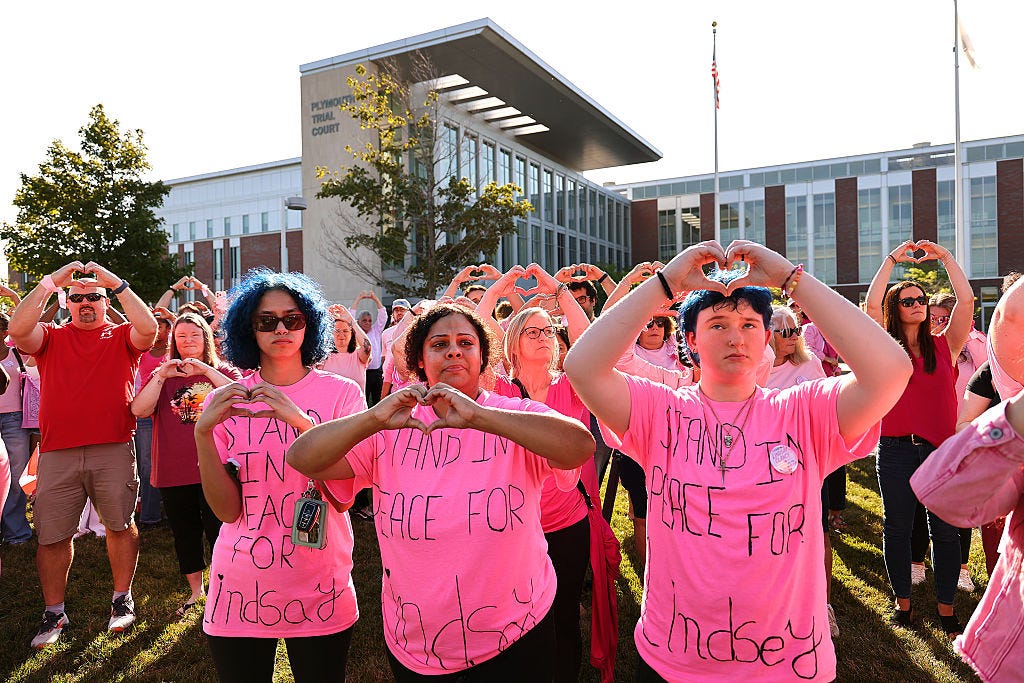
That’s part of why hundreds of pink-clad women rallied outside the courthouse to support her this week, and it’s why a GoFundMe to support her parents has raised more than 1 million dollars.
People struggle with believing that someone is both sympathetic and wrong. Tragic figures can be guilty ones, too, but on the internet, empathy becomes entangled with absolution. So the person you empathize with must be factually innocent.
This instinct is prevalent both on and offline, but given how difficult it can be to communicate nuance online, social media discourse, in particular, privileges morally clean stories. Social media is a fantastic vector for conspiracy theories, and true crime podcasts have convinced a generation of women that there’s always a stunning twist in criminal cases, a solution to be found if only you can put the evidence together in the right way. That’s why so many of the pro-Lindsay TikToks are obsessed with compiling evidence for a case where none of the facts are in dispute.
I often think of conspiracy theories as originating from a moral commitment, not from factual uncertainty. Conspiracies can be a form of value expression. Serial was about whether the criminal justice system was unfair to brown men. The O.J. Simpson case was a proxy for police racism.