

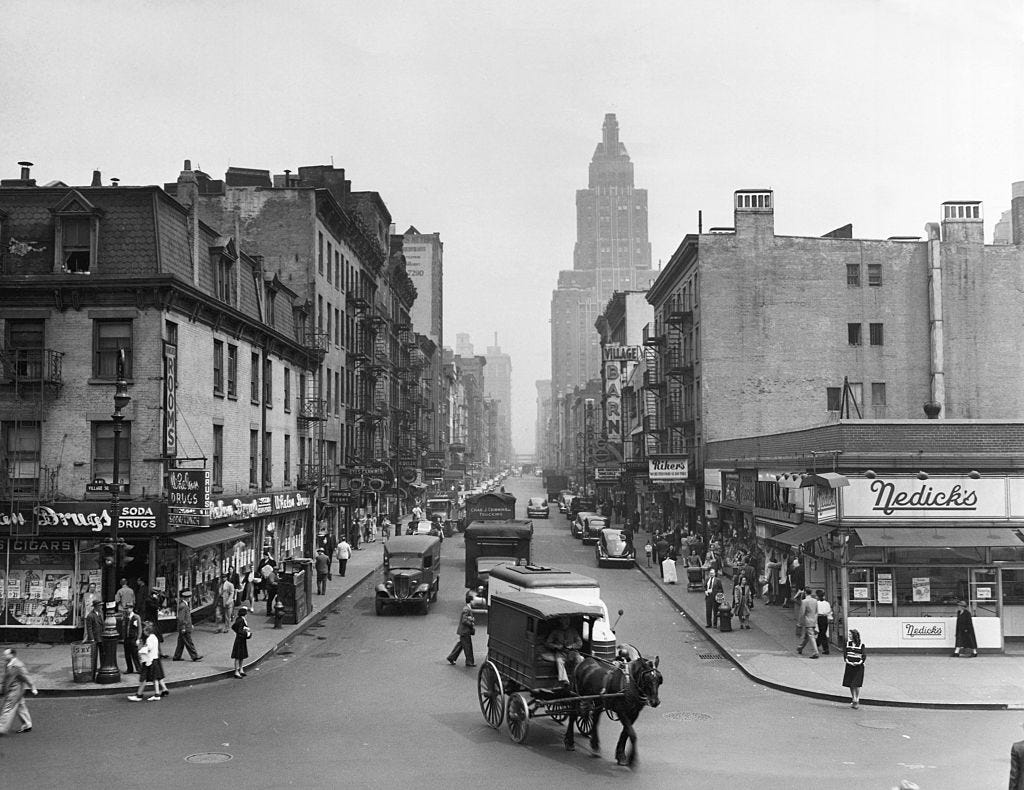
There are a lot of bad vibes about cities: They’re crime-ridden, full of degenerates, dirty, crowded, and ugly. Real America is rural, or, maybe, suburban.
When politicians talk about America, they tend to locate authentic national identity outside of its urban environments. Thomas Jefferson gave us an early version of this rhetorical move, arguing that the “mobs of great cities add just so much to the support of pure government, as sores do to the strength of the human body” in an essay where he explained why Americans should prefer farming to manufacturing. But he was just the first.
At a fundraiser in North Carolina in 2008, Sarah Palin asserted that “the best of America is in these small towns that we get to visit, and in these wonderful little pockets of what I call the real America.” And, of course, Donald Trump has supplied the contemporary version of this, painting inner cities as “disgusting, rat and rodent infested” messes and casting himself as the defender of the Suburban Lifestyle Dream. A dream that needs to be protected from the horrors of new housing and crime.
As a hardcore defender of cities (aesthetically and dispositionally), I really loved Jane Jacobs’ The Death and Life of Great American Cities the first time I read it in my early 20s. Economics had taught me that cities were brilliant engines of economic innovation and opportunity; Jacobs gave me a fellow urbanist’s love letter to her favorite neighborhoods and helped put into words what made certain neighborhoods lovely to look at.
Rereading it now, much of what Jacobs wrote still rings true. Some of it, like her insistence on small city blocks, is pretty weak. But her other prescriptions hold up well:
Dense concentrations of buildings and people let a neighborhood sustain real variety, from the bodega to the fancy restaurant to the hipster record store.
Border vacuums, the dead zones that form beside highways, should be avoided.
Above all, mixed primary uses help keep a street alive at every hour.
That last one I think about all the time. Walk through a neighborhood built around a single use, like a school, and in the evening it feels dead, because nobody’s there at night. Jacobs wanted homes and shops and offices sitting together, so that someone always has a reason to be on the street.
That makes an area feel more alive, and safer too. It’s what she called “eyes on the street.” She argued that foot traffic and visibility deter crime, since people are less likely to break the law when others are around.
She was also right about the problem of central planning. Jacobs understood, perhaps better than anyone at the time, that you cannot sit in an office and perfectly predict and arrange the lives of millions of people. This Hayekian criticism deserves its flowers.
Her biggest flaw was shared by many of her contemporaries — she thought more local control could solve the information and coordination problem of central planning. Jacobs concluded that the city planners should devolve power down to the local level, where residents supposedly have the knowledge that planners lack.
That policy is almost singularly responsible for the housing shortage we’re now living in. The neighborhood veto she championed as a defense against demolition became the tool by which existing residents block everything new. She won the war against top-down destruction so completely that her victory is, in its own way, just as damaging.
Near the end of her life, Jacobs reportedly lamented that the Greenwich Village home she bought for just $7,000 would be unaffordable to her now. That complaint should have prompted more self-reflection than it likely did.
The book has other blind spots too. Jacobs appears almost completely uninterested in the fact that a city is an economic engine. People and firms crowd into the same place because proximity makes them more productive, spawns innovation, and creates the jobs that draw the next wave of residents. That is why cities exist, and she wrote a roughly 450-page book that barely touches it.
To be fair, she was writing at a time when cities were seen as slums and New York’s economic value was falling, not rising. Her whole project was to make people fall back in love with cities, and a dry argument about economics was never going to do that. But the omission still shapes what’s wrong with the book, because once you stop seeing a city as an engine, you lose sight of what it’s really for.


(Darling is referencing an infamous niche tweet by transit wonk Nilo Cobau.)
My co-host, Matt Yglesias, is much harder on the book than I am. His sharpest critique is that Jacobs is doing the very thing she accuses the planners of. Le Corbusier looked at a city and decided superblocks with dozens of towers were the answer. Jacobs looked around and claimed everything should be like her charming stretch of Hudson Street. Both would rather impose the picture in their heads than let markets figure it out.
Ultimately, what makes a neighborhood great is the people, not the buildings. It’s nice to walk around Greenwich Village or Paris and feel transported back in time, but freezing a city in place also means stagnation and exclusion. Cities are dynamic things, and they need to be able to change in order to survive and thrive.
Jacobs was right that you can’t plan life into a place from the top down. She was wrong that you protect that life by handing a permanent veto to whoever already lives there. After all, look at Greenwich Village today.
Matt and I get into all of it on this week’s episode. Watch or listen wherever you get your podcasts.
The Argument. Libbing out.
(Illustration by The Argument, image by Frank Lennon/Contributor via Getty)
The transcript will be after the paywall in this post for paying subscribers.
WATCH THE EPISODE ON YOUTUBE HERE
New episodes post every Thursday.
For an ad-free version and full transcript, subscribe at TheArgumentMag.com.
Subscribe: Apple Podcasts | Spotify | YouTube | Overcast | Pocket Casts
Show notes:
The Death and Life of Great American Cities, book by Jane Jacobs that forms the central topic of this episode: Goodreads page, Amazon page
Explanation of the Tanakh, the Hebrew Bible that brings together the five books of the Torah, the Nevi’im (Prophets), and the Ketuvim (Writings): My Jewish Learning article
Silent Spring, famous book by Rachel Carson about pesticides that is often credited with launching the environmental movement and served as the topic for a previous episode of The Argument: Goodreads page, Amazon page
“How NIMBYs hijacked the climate movement,” previous podcast episode about Silent Spring: The Argument podcast episode
There Goes the Gayborhood, book by Amin Ghaziani about how historically gay neighborhoods have changed and evolved over time: Goodreads page, Amazon page
“Operationalizing Jane Jacobs’s Urban Design Theory: Empirical Verification from the Great City of Seoul, Korea,” study by Hyungun Sung, Sugie Lee, and SangHyun Cheon testing Jacobs’ conclusions against evidence from Seoul: Journal of Planning Education and Research article, University of Chicago summary
The Power Broker: Robert Moses and the Fall of New York, famous book by Robert Caro about the profound ways Moses shaped New York City: Goodreads page, Amazon page
Archived collection of Robert Moses articles written for The Atlantic: The Atlantic page
“How Sociotropic Aesthetic Judgments Drive Opposition to Housing Development,” article by David Broockman, Christopher Elmendorf, and Joshua Kalla tracking the rationale for people’s support (or lack thereof) for apartment buildings: Center for Open Science preprint
Polling that shows 55% of Americans prefer living in a community where “houses are larger and farther apart, but schools, stores, and restaurants are several miles away,” while 44% prefer one where “houses are smaller and closer to each other, but schools, stores and restaurants are within walking distance”: Pew Research Center poll
Stuck, book by Yoni Applebaum about how the desire to maintain neighborhood character has stymied progress: Goodreads page, Amazon page, The Atlantic excerpt
“Cities are not about fun. They’re places where people go to do serious things like study, and make vaccines, and negotiate contracts. The fun that they create is merely a positive externality, and we shouldn’t ever forget that or we’ll mix up what actually makes them great,” infamous tweet by Nilo Cobau, now deleted but republished by Matt Darling: Tweet
Peer review: “Keys to Upward Mobility: Typewriter Adoption and Women’s Economic Outcomes,” by Myera Rashid: Northwestern Institute for Policy Research article
Study here
The Feminine Mystique, famous book by Betty Friedan encouraging women to join the labor force, which served as the central topic for a previous podcast episode: Goodreads page, Amazon page
“Boy moms and Nazi POWs: How ‘The Feminine Mystique’ changed feminism,” podcast episode about The Feminine Mystique: The Argument podcast episode
“Effect of Online Dating on Assortative Mating: Evidence from South Korea,” article by Soohyung Lee showing that online dating has decreased geographic and occupational sorting while increasing educational sorting: Journal of Applied Econometrics article