

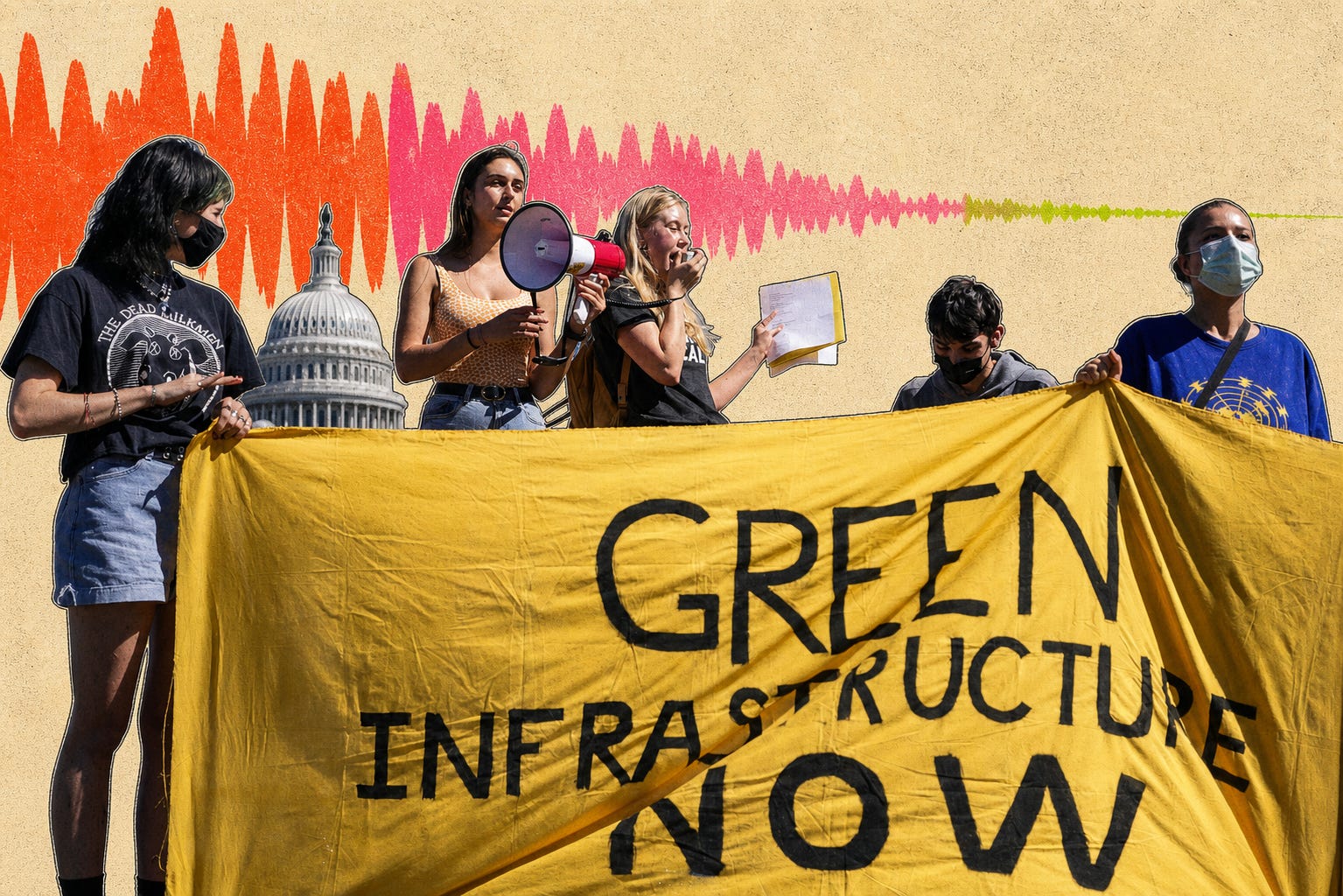
The OG climate deniers were crank scientists who attributed climate change entirely to natural variability (or sunspots) instead of humanity’s greenhouse gas emissions. Their dubious work was cited at the highest levels of government, including by the Bush administration’s Council on Environmental Quality and, perhaps most notoriously, by the late U.S. Sen. James Inhofe, who suggested in 2003 that global warming was “the greatest hoax ever perpetrated on the American people.”
That outright rejection of scientific consensus has largely lost in the court of public opinion: Recent surveys show strong majorities of Americans accepting the reality of climate change. With such denial in retreat, today’s climate activists have a new pejorative specifically for the Democratic elected officials and analysts who are conspicuously less outspoken on climate change during the second Trump era: climate hushing.
These so-called hushers are “meekly shying away from righteous and winnable fights against evildoers,” according to Democratic Sen. Sheldon Whitehouse. Party moderates are the canonical hushers, at times directly urging Democrats “don’t say climate change,” as Searchlight Institute did last year. But the ranks of the hushers appear to grow larger by the day: The Washington Post recently reported that the word “climate” has vanished almost entirely from public statements by Sen. Ed Markey, a longtime Green New Deal champion who just prevailed in a tense primary election against a more moderate challenger.
Democrats’ descent into infighting is most often taken as a sign of retreat for the causes of decarbonization and climate resilience. But that need not be the case.
Indeed, there are reasons to think that climate hushing will promote more ambitious and durable climate action than what came before. Unlocking the next wave of U.S. clean energy will require a return to the bipartisan compromise politics that have historically driven the country’s decarbonization. Maximalist climate activism can only harm these efforts.
In an era when voters are laser-focused on cost-of-living concerns and emerging challenges like artificial intelligence, climate hushing may well be the thing that saves the climate.
The long road of denial
After climate advocates waged a fairly straightforward campaign against climate denial during the Bush presidency, the concept underwent a kind of semantic inflation during the Obama years. A “climate denier” became anyone who opposed any plank of the climate movement’s policy agenda. In 2015, the activist Bill McKibben accused President Obama of “climate denial of the status quo sort” for refusing to block oil drilling in the arctic.
This appeared to be part of McKibben’s attempts to punish the Obama administration for prioritizing health care over climate change. “He talked very little about climate,” McKibben wrote bitterly in 2009, “and in the process left the door open for climate deniers to have a field day.”
“It will be painfully easy to tell if President Obama is going to take a serious stab at doing something about climate change in his second term,” McKibben wrote after Obama’s reelection in 2012. “The purest, starkest test he faces will be the proposed Keystone XL pipeline.”
But the expanding definition of denial didn’t stop at pipeline protests. In 2015, historian Naomi Oreskes criticized pro-nuclear climate scientists, calling their support for zero-carbon nuclear power “a new, strange form of denial … one that says that renewable sources can’t meet our energy needs.”
My organization, the Breakthrough Institute, was once lumped in with a “kinder, gentler” climate denial for the crime of arguing that policymakers were overestimating energy efficiency measures’ ability to mitigate carbon emissions.
And so, new battle lines were drawn, between the climate activists who argued that a “climate emergency” demanded a brute-force transition from fossil fuels to 100% renewable energy (defined more or less exclusively as wind, solar, and batteries) and the climate pragmatists who argued comprehensive climate action was dependent on a broader portfolio of clean energy technologies and infrastructure — including nuclear power as well as carbon capture and removal, hydrogen fuels, crops genetically engineered to be climate-resilient, and more.
By conflating public acceptance of mainstream climate science with a much narrower and contested vision of climate policy, climate activists convinced themselves that public opinion supported even the most expensive and sweeping regulatory interventions into the economy and energy system.
As it happened, the activists would win on the rhetoric, while the pragmatists prevailed on the policy.
