


Judgment comes from marrying intuition, experience, and logic. Judgment is what helps you determine whether a piece of fruit will be ripe before you bite into it, what to say to a friend when their dog dies, and whether a man with a Nazi tattoo who cheats on his wife and makes offensive comments on anonymous accounts is likely to have other skeletons in his closet.
Yesterday, Politico published damning new rape allegations against Graham Platner, the Democratic nominee for Senate in Maine. The allegations are corroborated with messages that were sent before Platner rose to prominence and from a source who had a documented relationship with the candidate’s accuser. Pundits and politicians who had previously stood by Platner through earlier scandals began to rescind their support, sensing that this might be the final straw.

I think this entire story has to do with bad judgment: Platner’s, yes, but also that of his defenders and anyone else who equivocated their way to this moment.
Let’s review the record:
On Oct. 16, 2025, deleted Reddit posts authored by Platner surfaced, including comments on a post about underwear designed to prevent sexual assault in which he wrote: “Holy fuck, how about people just take some responsibility for themselves and not get so fucked up they wind up having sex with someone they don’t mean to? Men and women, you make a choice to consume enough of a substance to lose your self control. So if you don’t want to be in a comprising [sic] situation, act like an adult for fucks sake.”
These comments led his political director, Genevieve McDonald, to resign.
Then, on Oct. 20, 2025, Platner went on Pod Save America and divulged that he has a tattoo on his chest that looks like a Totenkopf — the symbol of Hitler’s SS units. He claimed he didn’t know what it was, but his former political director disputes this.
Then, in May, The Wall Street Journal revealed that Platner had been sexting with women during his then-relatively new marriage.
Days later in June, The New York Times profiled several women who reported that Platner had repeatedly engaged in demeaning behavior toward women. The piece included an allegation of physical assault in which Platner reportedly twisted the woman’s “arm behind her back, shoved her into a bedroom and held the door closed from the other side so she couldn’t get out, telling her to remain there until she was ‘calm.’”
In nearly all circumstances, it’s good to think the best of people, but picking 1 of the 100 people to work in the U.S. Senate is one of the few exceptions that demands a different standard. The standard for a friend, colleague, or sibling may be “Can I imagine a sympathetic explanation for this behavior?” but the standard for the person making consequential policy decisions for 340 million people is whether the available evidence suggests the habits of mind we should want near power.
Judgment is the discipline of noticing when a pattern has become impossible to ignore. Getting a Nazi tattoo doesn’t make someone a rapist, nor does cheating on your wife prove you’re a Reddit troll. But judgment is the practice of finding the signal in the noise and knowing that bad acts are not randomly distributed; they are correlated. And time and again, Platner has proven himself to be a bad person who you shouldn’t trust with power.
Why Platner weathered so many storms
Redemption stories are Teflon. Platner didn’t present himself as a golden boy, but rather as a reformed soldier — someone once tormented by the horrors of war but who had become, finally, a good man.
Scandals ruin golden boys because they contradict the brand, but scandals merely reify the myth of the reformed sinner. They provide his supporters with a ready-made tool to weaponize in the face of any detractor: “Don’t you believe in redemption?” As such, the myth became nearly unfalsifiable.
Compare Graham Platner with Cal Cunningham, the 2020 Democratic candidate for Senate in North Carolina, who was caught cheating on his wife at the 11th hour and summarily lost his race to Thom Tillis. Mere weeks before the general election, Cunningham’s carefully manicured image as an honest and devoted family man collapsed.
But even for Platner, any honest broker would have realized that the timeline for redemption never really made sense. Platner is now 41, got his Nazi tattoo at age 22 or 23, wrote that rape comment at 28 or 29, allegedly assaulted his girlfriend between ages 28 and 31, made a series of other regrettable posts into his 30s, allegedly committed violent sexual assault at age 37, and was exchanging sexually explicit texts at age 40.
These weren’t youthful indiscretions, this is a pattern of behavior: what we sometimes call bad character.
You could have seen this coming
People sometimes treat moral failures as separable from errors of cognition. This is wrong. Moral failures sprout directly from bad practical reasoning.
There are two ways this happens: First, some people struggle to even distinguish right from wrong (for instance, believing that it’s fine to cheat on your wife). Second, even when people know what is right, they sometimes give themselves permission to act differently (yes, it’s wrong to lie to your wife about sexting with other women because the truth would be too costly to cop to).
Many forms of these ideas have been bandied about by various philosophers but perhaps the most famous of these was written by Immanuel Kant, which “sets out the principles of moral conduct based on his philosophical account of rational agency, and then on that basis defines virtue as a kind of strength and resolve to act on those principles despite temptations to the contrary.”
Essentially, people should use reason to figure out what’s right and wrong and good character is merely the will to act on those rationally derived truths. Morally defective people are not necessarily stupid; they could be very clever. But their defects lie in errors of reasoning, like failing to truly internalize that other human beings are people of equal moral worth or concocting elaborate rationalizations.
Some intellectual defects are relatively isolated, like when you misread a word and say it wrong out loud for the first time. That tells me basically nothing about you or how you might govern or treat other people.
But other defects can have far-reaching consequences. For instance, having a low opinion of women is not an error that sits harmlessly in some dusty back-shelf in your brain, it is wrongly categorizing half the human race as deficient based on faulty logic.
This type of error has consequences that leak into jokes, relationships, professional conduct, political judgment, and yes, anonymous Reddit posts. These are the sorts of errors one should expect to bear other poisoned fruit. That is, when the jerk with a Nazi tattoo who cheats on his wife is accused of physically assaulting another woman, it’s not actually all that surprising.
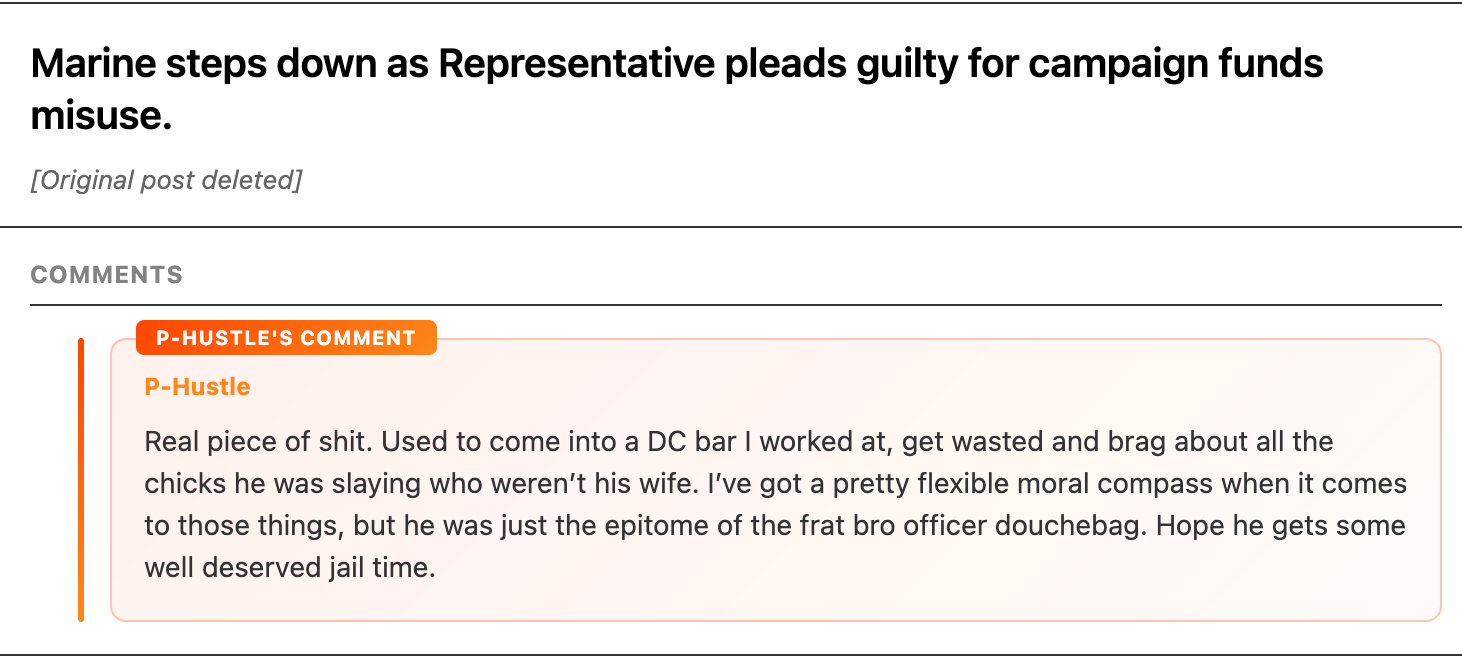
I really hate the term “sex scandal” because it implies the problem with cheating or sexual assault or sleeping with an intern is largely about the fact that sex was had.
But cheating is not just sexual misconduct, it’s also a profound lie; a lie to the person you pledged your life to in front of your friends, family, the state, and God. Cheating tells this person: I am entitled to make your choices less informed than mine.
And this isn’t the only way Platner signaled his comfort with lying. Here is all the evidence that Platner likely knew his tattoo was a Nazi symbol well before he ran for office, despite repeatedly insisting that he only realized this on the campaign:
A former acquaintance and a former partner both recalled Platner referring to his tattoo as “my Totenkopf” years before he became a candidate for office.
A second person told CNN that they remembered this former acquaintance describing Platner’s tattoo years before as a Nazi design.
Reporting revealed an incriminating text exchange “discussing Platner’s Nazi-like tattoo” from several months before Platner publicly revealed the tattoo.
Platner’s former political director said he had been aware of the tattoo’s meaning for years.
A 2019 Reddit post indicated Platner’s familiarity with the Totenkopf symbol.
Platner’s defenders intellectual defects
The problem, of course, is that Platner’s defenders have done some bad practical reasoning. They have decided that the world is sorted cleanly into friends and enemies, which means evaluating claims is a matter of figuring out which team you’re on, not whether the argument has merit. That’s why every time people raised concerns with Platner’s behavior, it was shot down as an attack on a friend by an obvious enemy.
The woman claiming physical abuse? Well, she’s a Republican.
The people upset about the Totenkopf? Obvious AIPAC stooges.


People who object to cheating? Democratic HR ladies and smoothgroins.
There are many problems with this way of thinking. First and foremost, the only way to know if someone is an enemy or friend is if you continuously evaluate the things they say and do. Second, sometimes even your enemies can make good points.
Everyone, including Platner, seems to understand this when the compromised candidate belongs to the other side.
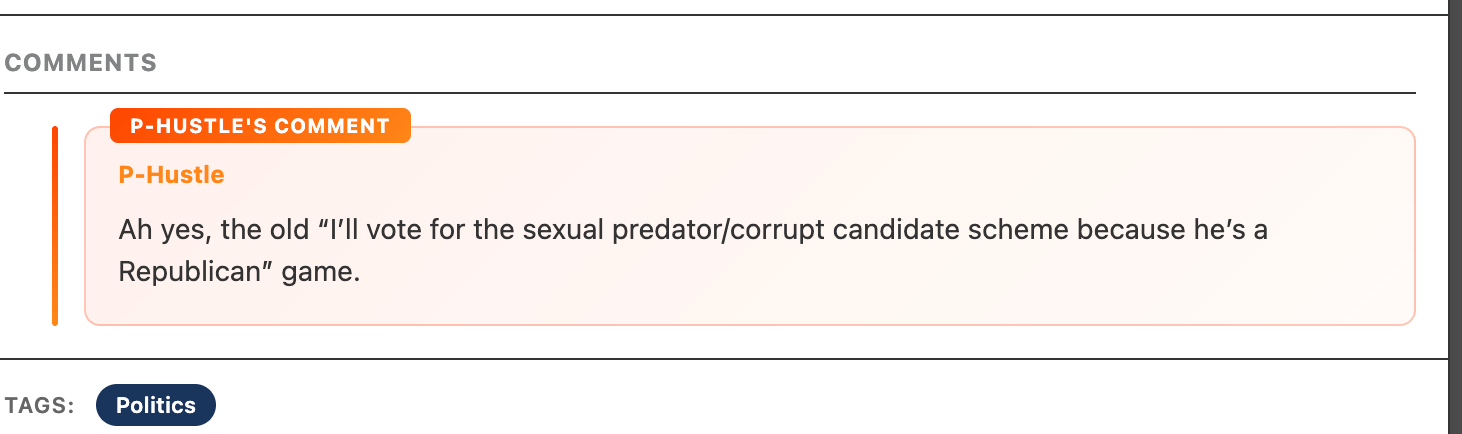
This is how bad judgment accumulates. It calls itself loyalty, forgiveness, realism, nuance, an anti-establishment revolt, or refusing to play by the enemy’s rules. All of those things can be virtues, but sometimes they’re just rationalizations.
Platner himself is likely finished in Democratic politics, but the habits of mind that put him a hair’s breadth from power are what really need to be defeated. That will only happen if people stop cordoning off virtue into the realm reserved for religious leaders and annoying moms.
Virtue is not a decorative, prissy quality that hinders you from being savvy. No, virtue is what comes from reasoning well and having the will to follow through on that reasoning. There will be other Graham Platners, other people who seem like they are on your team but for some pesky red flags. The point of good judgment and all that annoying virtue is that it prevents you from making the mistake of trusting them.
What really got me was the repeated assertion that while you or I might not like his behavior, working class people like a guy who is a little rough around the edges. Where does this belief that working class people have lower moral standards come from? Why should we assume this is the case?
A month or so ago, I thought I would hold my nose and vote for Platner if I lived in Maine. That was a mistake. Using immoral means to achieve a moral end (a check on MAGA).
I feel the same way about a candidate who refuses to acknowledge Israel's right to exist as a Jewish state. That is an antisemitic and immoral position. A sinister position different than criticism of the Israeli govt. and wanting to use US aid and arm sales as a way of influencing behavior.