

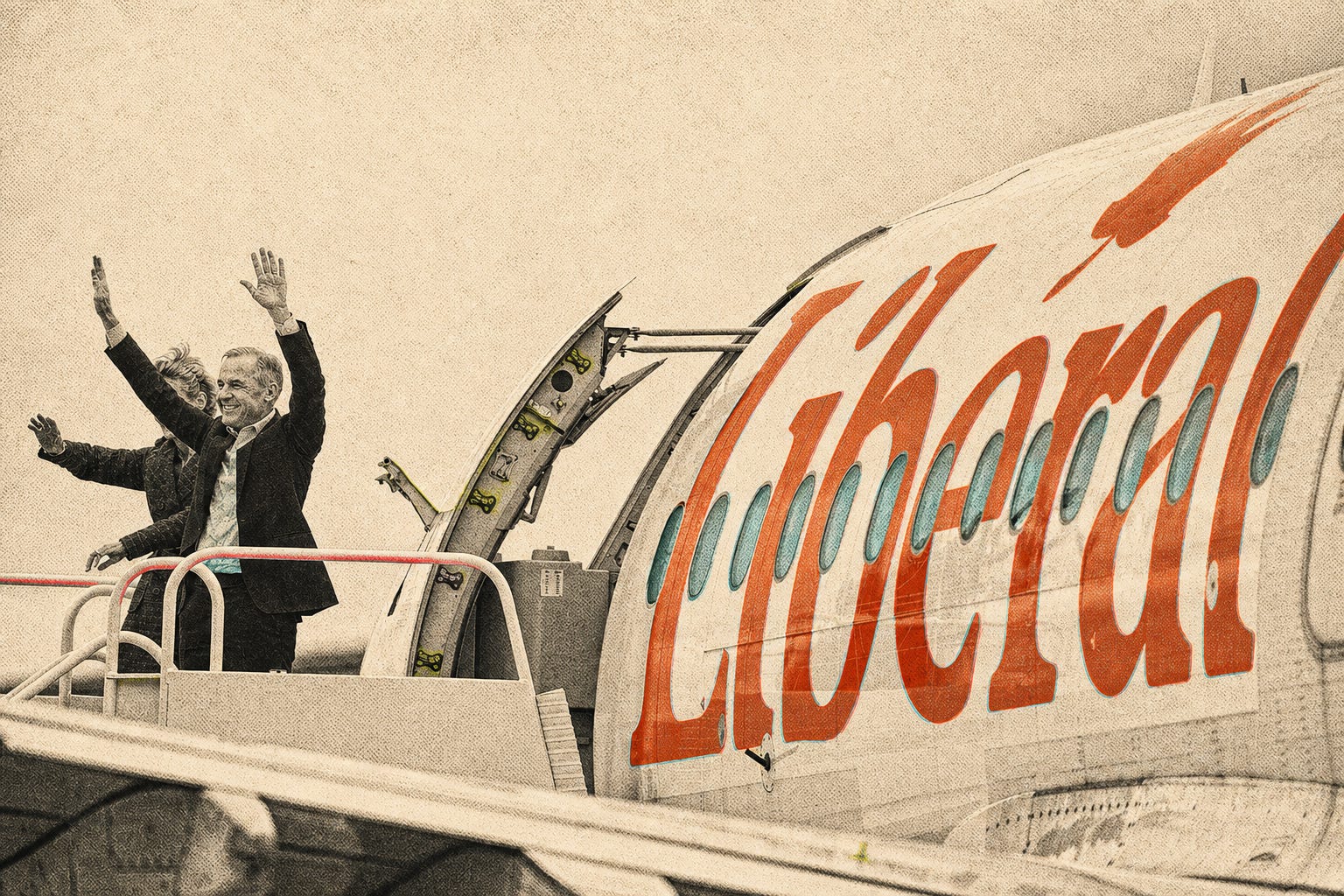
Canadian Prime Minister Mark Carney is not just the head of his country’s Liberal Party, but something of an icon of liberalism globally. At a bleak moment for center-left parties worldwide, he won his election, and has remained popular as he feuds with an increasingly indefensible American president.
So it’s remarkable to hear a prominent voice on the American left describe the Canadian leader as a “dangerous autocrat” who is not just worse but “far worse than Trump.”
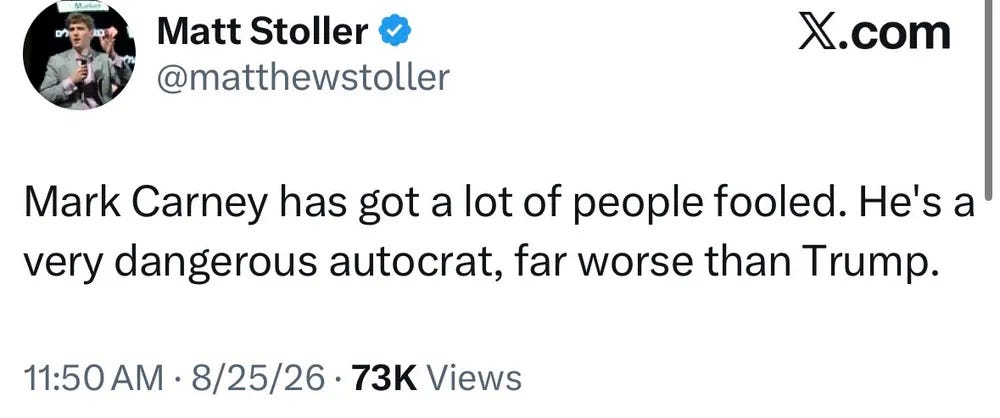
This was not a one-off outburst. Matt Stoller, research director at the American Economic Liberties Project, has previously called Carney a “dangerous authoritarian.”
Why? Well, this latest outburst was because Carney is “a former Brookfield and Goldman guy” who apparently favors airport privatization.
To take Stoller’s argument at face value: No, Carney is not far worse than Trump; he’s far better. Trump’s view is that Canada is weaker and smaller than the United States, and that while a rupture in the commercial relationship is bad for people on both sides of the border it will be worse for Canada so it should act like a supplicant and kowtow to his demands. This is not the most salient aspect of Trump’s malgovernment, but it is probably the clearest expression of his authoritarian heart — he’s a man who’s fundamentally more comfortable treating North Korea’s dictator as a peer than the elected leader of a fellow democracy.
Carney, on the other hand, has stood up for the rights of smaller nations and for economic sanity. Americans outside the MAGA camp ought to be signaling loud and clear that we will end this trade war after we break Trump’s monopoly on political power.
The good news is that very few people of any ideological persuasion agree with Stoller about Carney. The bad news is that Stoller is not just an influential figure on the populist wing of Democratic Party economic policy, he’s in many ways just a guy who’s imprudent enough to follow the post-liberal left’s logic to its natural conclusion.
The tweet matters less as an assessment of Carney than as a glimpse of a larger ideological inversion on the populist and post-liberal left. A movement that speaks in the language of “open markets” and “economic liberty” has come to treat every deviation from absolutely perfect competition as a warrant for central planning. As a result, its adherents regard traditional market liberals as enemies more profound than a corrupt authoritarian who is currently wielding state power. Many on the left claim to view politics as a remorseless twilight struggle against an ill-defined force known as “corporate power,” and Stoller has the courage of these convictions: Carney is a more alarming authoritarian than Trump precisely because he respects liberal limits on the state, and Trump does not.
The post-liberal left’s position on aviation, a sector in which competition is always imperfect and government is always involved, makes this ideological inversion unusually easy to see.
Aviation as a microcosm
The notion that airport privatization is a more egregious threat to democracy than January 6 is a reminder that the larger post-liberal economic camp to which Stoller belongs is full of strange ideas about air travel.
For four decades, the federal government’s Civil Aeronautics Board (CAB) regulated U.S. airfares and directly controlled which routes airlines could fly. Because the CAB wanted to subsidize certain markets with weak demand, this meant raising prices for long-haul flights to compensate. “Concerned that such practices caused inefficiencies and inhibited the growth of air transportation, the Congress deregulated the industry,” explains a 1996 GAO report. Airlines were allowed to set their own prices and pick what routes they wanted to travel. This resulted in cheaper airfare but fewer nonstop destinations and smaller planes in places with weak demand.
The idea that disbanding the CAB turned U.S. air travel into a miserable hellscape is an article of faith on the post-liberal left. Ganesh Sitaraman, director of the Vanderbilt Policy Accelerator for Political Economy and Regulation, published a 2023 book titled Why Flying is Miserable (the book is long, but the answer is airline deregulation) and followed up in 2026 by proclaiming that Spirit Airlines’ bankruptcy proved that competition in aviation has failed and we need to return to comprehensive regulation of the industry.
This whole narrative makes absolutely no sense.