

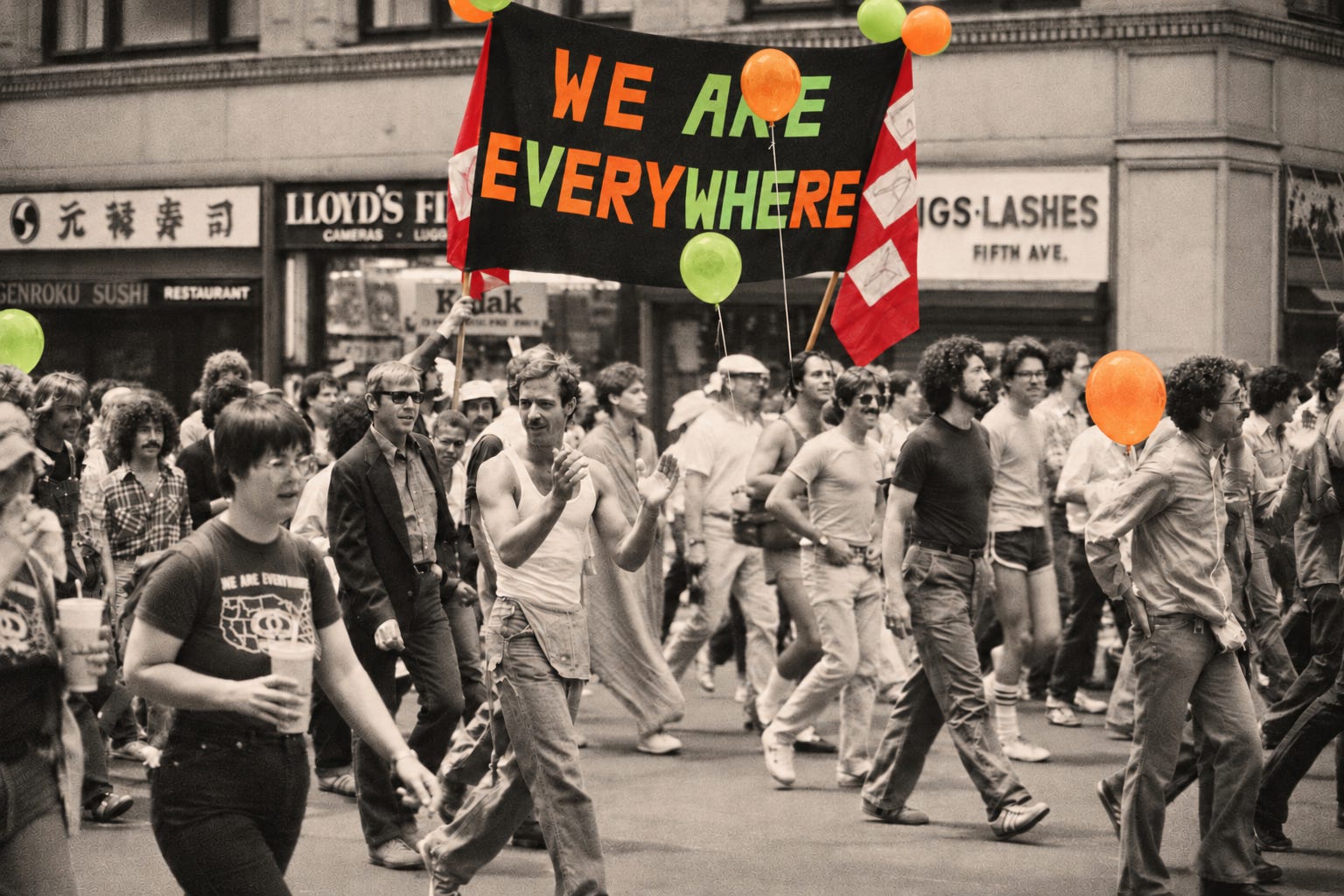
As of 2024, nearly 1 in 4 Americans aged 18 to 27 identified as LGBTQ+ — a rise from just 1 in 16 millennials a decade earlier.
It is no mystery what has driven this increase: Bisexuality is far and away the identity category that has grown the most in the last 10 years. Members of Gen Z are around twice as likely as millennials to identify with the bisexual label — and around six times as likely as Gen X.1
What accounts for the bisexual boom?
On the right, it’s common to claim that Gen Z is just faking it. They don’t actually experience same-sex attraction at higher rates than earlier generations; they just think belonging to a marginalized identity sounds cool and bisexuality is the easiest one to claim. (There’s a version of this same explanation floating around in queer and progressive spaces as well, encapsulated in the observation that a lot of bi women seem to only date men.)
The intuitive liberal response is to insist that sexual orientation is not a choice. The reason rates of LGBTQ+ identification are so high among young people is that earlier generations are repressed and closeted. Increased acceptance has allowed an underlying, immutable truth to reveal itself. Boomers would be bisexual too, if only they libbed out!
Both the conservative position and its liberal rejoinder assume that attraction is relatively fixed: that there is a “true” rate of non-straightness that holds across generations and was only undershot by past surveys due to social stigma.
But while the proportion of gays and lesbians has remained relatively stable for decades, bisexual numbers are undeniably in flux, driven largely by young women. In the General Social Survey, the gay and lesbian share of the population stayed flat from 2008 (1.6%) to 2018 (1.7%) while the bisexual share climbed from 1.1% to 3.3%.
Imagine a woman who is attracted to lots of men she meets but only occasionally other women. Fifty years ago, that woman would happily have called herself straight, dated and married a man, and called it a day. Today, she might call herself bisexual and be interested in pursuing a relationship with a woman. Neither version is necessarily suppressing her desires or misrepresenting them.
To insist that some natural rate of bisexuality is only now revealing itself would be to miss an opportunity to make a more radical case for accepting same-sex desire: that as gender norms change, more options will present themselves when it comes to sex, dating, and family, and people should be free to consider these with a relative degree of agency.
In other words, maybe there are a substantial number of young people jumping on the bisexual bandwagon who otherwise would have made do with heterosexuality — and maybe, contra the right, it is perfectly fine to do so.
The bisexual wager
Sexuality is complicated because it involves both external behavior and internal experience, and the two don’t always align. Who you have had sex with in the past doesn’t necessarily have any bearing on who you would like to have sex with in the future. As an identity category, sexuality exists always somewhat in the realm of possibility.
Research suggests that the possibilities for internal experience are particularly expansive when it comes to female sexuality. Women have repeatedly been found to have more capacity for same-sex attraction than men, even those women who identify as straight. In studies that measure responses to erotic stimuli, women are generally more likely to get aroused by images of both sexes.