

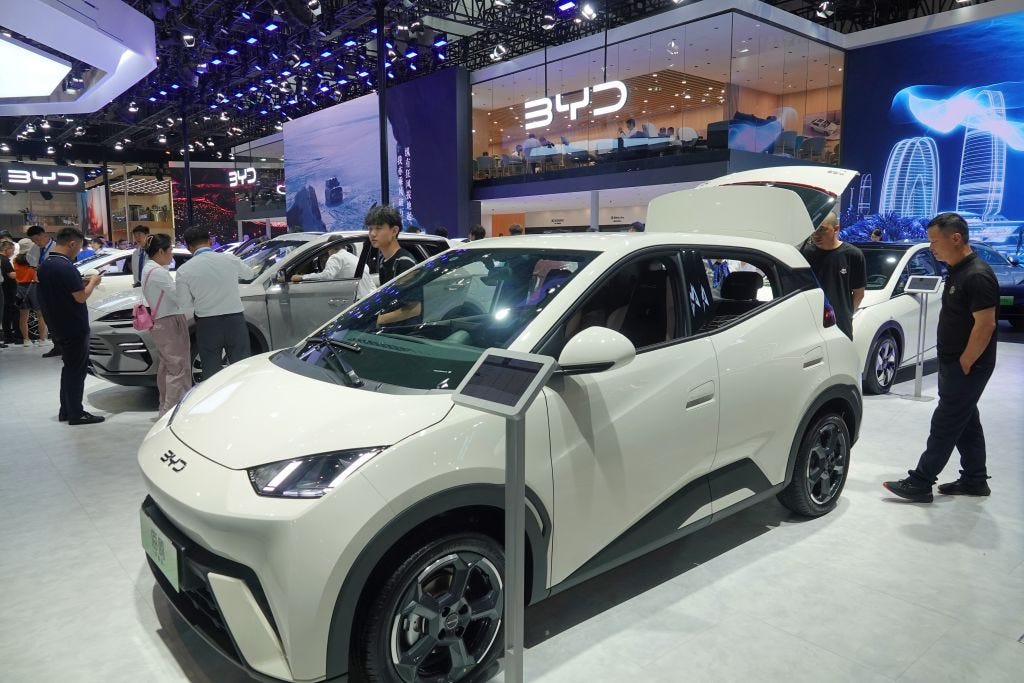
“We wanted flying cars, instead we got 140 characters,” used to be the gripe about how technological progress moved away from advancements in the physical world to “advancements” in the digital world.
But now we sort of do have flying, well, jumping cars. And more than that, we have cars that are unbelievably technologically advanced. The problem is they’re made in China, and both Republicans and Democrats have decided to collude so that I can’t buy them.
And worse than not being able to buy cool electric jumping cars that can add 250 miles of charge in five minutes flat, I’m also barred from buying cheap advanced cars.
A new car now costs nearly $50,000 on average. I could buy five new Chinese EVs for that price, though I’d settle for just one.
It’s rare for one of my private purchasing decisions to be the subject of so much political and policy discourse, but that’s tariffs for you: Everything from wedding dresses to coffee and televisions has been affected by taxes on foreign imports.
To be fair, I recognize that there are valid concerns about America’s (and our allies’) dwindling capacity to build batteries. But… blocking consumers from buying EVs doesn’t magically produce a domestic battery industry.
The protectionist case was supposed to be about buying time for American manufacturers to catch up. That hasn’t happened. Ford and SK announced an $11.4 billion battery joint venture, took a $9.6 billion government loan, and then dissolved the whole thing when EV demand fell short of projections. These companies are not making the decades-long capital commitments that would make them competitive with China’s BYD.
My co-host, Matt Yglesias, doesn’t care much about my personal car troubles (he has a plug-in hybrid) and is more sympathetic to tariffs on Chinese EVs. He points to Apple’s shift toward manufacturing in India as a positive example. He also brings up President Reagan’s restrictions on Japanese car imports, which didn’t do much for the Big Three but did successfully pressure Japanese automakers to open factories in the U.S.
Transportation is the second-largest household expense in America. Blocking cheaper, often better technology from entering the market imposes real costs on real people, disproportionately on the working-class people politicians in both parties claim to be fighting for.
The frustrating thing is that a more targeted approach is available. Subsidies, tax breaks, and friendshoring can build the domestic battery industry we need. The Inflation Reduction Act’s 45X production tax credits1 — which rewarded companies for actually manufacturing batteries rather than just announcing factory deals — are closer to the right idea. We could also remove environmental blockers and mine rare earths domestically or encourage mining in friendly nations. And you can still let me buy a cheap, cool car!
After all, the best industrial policy has always focused on export discipline — that is, the idea that the infant industries you’re nursing should be forced to compete against existing giants. Otherwise, you could spend decades forcing Americans to pay high prices to help domestic manufacturers make a bad product.
We get into all of it — the failure of Trump’s tariff regime, what serious industrial policy might actually look like, and how the climate activists are once again missing the mark — on this week’s episode of The Argument.
Watch or listen wherever you get your podcasts.
The Argument. Libbing out.
(Illustration by The Argument, photo by ANDREW CABALLERO-REYNOLDS via Getty)
The transcript will be after the paywall in this post for paying subscribers.
New episodes post every Thursday.
For an ad-free version and full transcript, subscribe at TheArgumentMag.com.
Subscribe: Apple Podcasts | Spotify | YouTube | Overcast | Pocket Casts
Time stamps:
0:00-The BYD car that can jump over potholes
4:07-Climate activists miss the mark
11:46-Setting the stage for war with China
20:13-Protecting nonunion electric vehicles
27:50-Let Jerusalem buy a cheap Chinese EV
35:13-Matt Yglesias’ trade solutions
41:20-Comparing today to 1980s Japan auto policy
46:10-Peer review: The effects of school phone bans
Corrections:
Around 03:25, Jerusalem says we have a 130% tariff rate against China. This was the rate at one point, before the Trump administration lowered it to 10% in November 2025.
Around 12:21, Matt says Graham Allison titled his book The Thucydides Trap. This was actually the name of an earlier essay by Allison. His book was titled Destined For War: Can America and China Escape Thucydides’s Trap?
Around 18:17, Jerusalem says BYD has a battery that can charge to 90% in five minutes. Their claim is actually that it can add 400 km of range with five minutes of charging. EV Powered reports it can charge from 10% to 70% in five minutes.
Around 36:25, Jerusalem says, “I don’t think it’s great that 90% of the world’s rare earths that go into lithium-ion batteries are coming from China.” Around 90% of rare earth mineral refining does come from China, but these materials are typically used in the motors of EVs, not the lithium-ion batteries.
Around 42:24, Matt ambiguously says “they” bought Rockefeller Center in New York after he was discussing Sony. It was actually Mitsubishi that bought Rockefeller Center.
Show notes:
Full video of BYD’s $230,000 Yangwang U9 jumping over pot holes and road spikes; clip shown near beginning of episode: YouTube video
Coverage of solar subsidies transferring costs to apartment dwellers: CalMatters article
David Roberts expressing support for allowing Americans to buy Chinese EVs: Bluesky post, The Breakthrough Institute article
Noah Smith expressing support for allowing Americans to buy Chinese EVs: Noahpinion article
Coverage of Biden maintaining, and in some cases increasing, Trump’s first-term tariffs against China: NPR article, Reason article
Coverage of Biden and Harris campaigning against Trump tariffs: NBC News article, Newsweek article
Coverage of European tariffs (ranging from 7.8% to 35%) against Chinese products, which are meant to counteract China’s own subsidies: European Commission page, S&P Global article, Luxembourg Times article
Coverage of second-term Trump tariffs against China peaking at 145%: The New York Times article, CNN article
Coverage of Sen. Sheldon Whitehouse’s social media thread encouraging Democrats to talk about climate change, one of the party’s less-popular issues, in the midterms: Twitter thread, E&E News article, Politico article
Coverage of Congress overturning California’s attempt to phase out internal combustion cars. Frontline Democrats in the House voted with Republicans, but senators, including Gary Peters from Michigan, were whipped into voting against it: CalMatters article, E&E News article
Coverage of Biden administration’s thinking about banning the sale of Chinese EVs to support U.S. automobile and battery manufacturing: NPR article, The Wall Street Journal article
Coverage of trade war with China threatening supply of lithium-ion batteries: CSIS analysis, TariffTax article
On the Principles of Political Economy and Taxation, book by David Ricardo about comparative advantage using an example of England trading cloth for Portugal’s wine: Goodreads page, Amazon page
Economic Interdependence and War, book by Dale Copeland arguing that open trade supports peaceful relations by nurturing an expectation of future trade: Princeton University Press page
The Sparrow, novel by Mary Doria Russell about a Jesuit priest making first contact with aliens: Goodreads page, Amazon page
The American Prospect editors expressing interest in the U.S. China Security and Economic Review Commission: The American Prospect article, The American Prospect article
The Thucydides Trap, essay by Graham Allison arguing that preparations for war between the U.S. and China could become a self-fulfilling prophecy: The Atlantic essay, follow-up book
Coverage of WWI-era naval posturing between Germany and Britain leading to war: World History Encyclopedia article
Coverage of Chinese government suppressing protest movement in Hong Kong and the city’s “one country, two systems” status quo: Council of Foreign Relations article, Carnegie Endowment for International Peace article
Coverage of Chinese government’s repression of Uyghurs in Xinjiang: Council of Foreign Relations article, Human Rights Watch article
Coverage of UAE government fomenting war and repression in Sudan: The Washington Post article
Details of 45X program, part of the Inflation Reduction Act that provided a specific credit rate to manufacturers of critical energy production components: IRS page, Congress.gov article
Coverage of BYD’s “Super e-Platform” battery that charges to 70% in five minutes, enabling around 250 miles of range: Inside EVs article, EV Powered article, Electric Motor Engineering article
Coverage of decrease in manufacturing jobs under Trump administration’s tariff regime: Center for American Progress article, Cato Institute article
Coverage of bifurcated U.S. automobile industry between UAW factories in Michigan and foreign factories in the South: CBS News article, Jacobin article
Coverage of Trump administration’s change of heart on battery development: Axios article, CSIS article
Coverage of BYD’s transformation from a battery company into a car company: CNBC article, BYD company intro
Study detailing why Chinese EVs are able to be sold at low prices: Rhodium Group report, CNBC article
Coverage showing that Chinese state subsidies account for just 5% of BYD’s per-vehicle cost advantage over Tesla: Rhodium Group report, EVXL article
Coverage of $11.4-billion joint venture in 2021 between Ford and SK, and its subsequent $9.6 billion loan from the Department of Energy, which was dissolved because of lack of EV demand: Utility Dive article, Carscoops article
Coverage of Reagan-era experience of curtailing Japanese car sales: NPR article, City Journal article, The New York Times archived article
Coverage of U.S. EV share peaking at 10.6% in Q3 2025 before falling to 5.8% the following quarter: Kelley Blue Book article, Cox Automotive article
Coverage of China branding plug-in hybrids as “New Energy Vehicles: The Oxford Institute for Energy Studies article, DieselNet article, Green Car Reports article
Coverage of Geely, a Chinese company, buying Volvo from Ford in 2010: Reuters article, Volvo release
Coverage of Apple shifting manufacturing away from China to India: Reuters article, CNET article, Time article
Coverage of 91% of the world’s rare earth mineral refining coming from China: IEA article, The New York Times article
Coverage of Trump exempting components of data centers from tariffs: White House proclamation, Facilities Dive article, GHY article
Coverage of Trump allowing Nvidia to export its chips to China: Time article, Lawfare article
Coverage of Walter Mondale’s comments about Japanese takeovers of U.S. assets, in which he said “What do we want our kids to do? Sweep up around Japanese computers?” The New York Times archived article, Stanford University Press book
Coverage of Japanese companies reinvesting profits into U.S. assets, such as Sony buying Columbia Pictures Entertainment and Mitsubishi buying Rockefeller Center: The New York Times archived opinion article, Los Angeles Times article, The New York Times archived article, Los Angeles Times article
Rising Sun, 1992 book (and adapted into a 1993 film) depicting the volatility of Japanese-U.S. business relations in the 1980s: Goodreads page, Amazon page, IMDb page
David Autor articles about Chinese imports depleting U.S. manufacturing: American Economic Review article, Annual Review of Economics article
Economist Adam Ozimek arguing that $40,000 is too much to spend on a new car: tweet, tweet
Coverage of the median cost of a new car exceeding $50,000 for the first time in September 2025: Kelley Blue Book release
Peer Review: “The Effects of School Phone Bans: National Evidence from Lockable Pouches,” paper by Hunt Allcott, E. Jason Baron, Thomas Dee, Angela L. Duckworth, Matthew Gentzkow, and Brian Jacob: NBER working paper
Coverage portraying the Allcott et al. paper as being a disappointing result for the phone ban industry: The Washington Post article, The New York Times article
Coverage of Yondr pouches: Yondr “How it works” page, The Valley Breeze article
Coverage of students figuring out how to open Yondr pouches: The New York Times article