

A frustrating fact about the politics of crime is that everyone freaks out when crime goes up, but the reaction when crime goes down is much more muted. In related news, we’re about to have the lowest homicide year since the 19th century.
It’s remarkable, given how dire things looked in 2020, and a far cry from Trump’s 2022 declaration that “the blood-soaked streets of our once great cities are cesspools of violent crimes.”
It’s not just that crime has fallen from pandemic-era highs; it’s that it’s lower than the pre-2020 crime spike trajectory would suggest. That raises the question: What happened?
My view is that this is all downstream of two things: one obvious, one less so. The obvious one is that COVID-19 had a bunch of criminogenic factors, like:
shifting police deployment and activity to limit COVID exposure.
cutting potentially violent young people off from school and work while concentrating them in close proximity with people they have disputes with.
The less obvious explanation is the Great Cop Vibe Shift. Despite all the mayors and governors touting their various (and varied) crime-fighting policies, largely what happened is that we live in a country where the willingness of police to arrest criminals, track down leads, and issue traffic violations plays an incredibly significant role in crime trends.
Police forces across the country essentially went on an informal work-to-rule strike — not actually walking off the job, but just doing the bare minimum — to protest the disrespect they were receiving from the politicians and citizens they’re supposed to serve. In San Francisco, police officers mostly just stopped doing any citations when the pandemic hit (reasonable) and then did barely any until roughly January 2024.
No matter how you feel about the police, the fact that they can and do retreat from their duties in such a manner reveals a catastrophic failure of democratic accountability. Whether you think the 2020 protests and anti-police attitudes were justified or not, police officers should be under the control of democratically elected officials. In practice, they are not.
Years ago, I wrote about the Ferguson effect — the phenomenon whereby protests against police reduce officer morale and therefore effort (thus yielding higher crime), which is often used to berate advocates for protesting. While I think this development carries lessons for anti-police advocates, it’s rarely wielded in favor of reforming police unions and increasing mayoral control of police policy and practices in general.
On today’s episode of The Argument, I discuss this all with my co-host Matt Yglesias, who, true to form, has a more pessimistic view of police reform advocates.
Yet, the ultimate version of reform would mean addressing the problem with police unions. Currently, we have a system where, not only do these unions bargain on wages and benefits, they also shield cops who have no business remaining on the force. It’s bad enough when teachers’ unions do this; it’s worse when the employee gets to carry a gun to work. University of Michigan law professor Nicholas Bagley and former senior White House official Robert Gordon both argued for merit-based reforms to public unions.
We talk about that and much more on this week’s episode of The Argument.
Watch or listen wherever you get your podcasts.
The Argument. Libbing out.
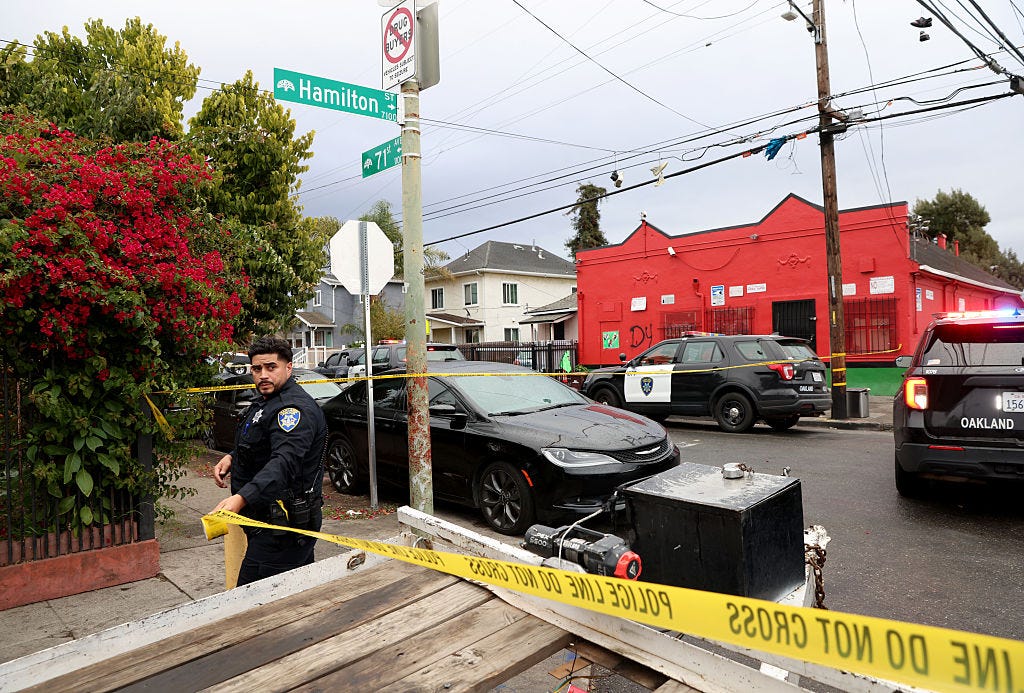
(Illustration by The Argument, image by Ira L. Black via Getty)
The transcript will be after the paywall in this post for paying subscribers.
New episodes post every Thursday.
For an ad-free version and full transcript, subscribe at TheArgumentMag.com.
Corrections:
Around 21:00, Matt describes a situation in which a D.C. cop was “chasing a kid on a bicycle” when the kid was hit by a car. Matt says he thinks the kid had a gun. However, in the case of Karon Hylton-Brown, the 20-year-old was riding a moped, not a bike, and there is no evidence he had a gun.
Around 35:00, Matt says the Fraternal Order of Police endorsed the Democratic candidate for president from 1996 to 2008. While the organization did endorse Bill Clinton in 1996, it endorsed George W. Bush in both 2000 and 2004, as well as John McCain in 2008. Instead, the National Association of Police Organizations endorsed Al Gore, John Kerry, and Barack Obama.
Around 49:00, Matt says all Landmark Theatres locations sell alcohol. Most do, but not all.
Show notes:
Council on Criminal Justice 2025 annual report: Council on Criminal Justice report
John Roman Substack article discussing the report: External Processing article
Coverage of bipartisan criminal justice reform efforts involving conservatives such as the Koch brothers: The Washington Post article
Coverage of James Comey blaming a “Ferguson effect” for increased crime: The New York Times article
Richard Rosenfeld’s June 2015 study that took a skeptical lens to the Ferguson effect: The Sentencing Project policy brief
Richard Rosenfeld’s June 2016 study that reversed his skeptical conclusions, determining more research was needed: National Institute of Justice paper
“Policing the Police: The Impact of ‘Pattern-or-Practice’ Investigations on Crime,” paper by Tanaya Devi and Roland Fryer showing that when the Department of Justice undertakes investigations into police departments, it leads to a statistically significant reduction in homicides and total crime — as long as the investigation was not preceded by a “viral” incident. If it was, then this leads to an increase in crime: NBER working paper
“Who Protests, What Do They Protest, and Why?” paper by Erica Chenoweth, Barton Hamilton, Hedwig Lee, Nicholas Papageorge, Stephen Roll, and Matthew Zahn showing the demographics of those who protested in 2020 were more representative of the U.S. public than the demographics of those who voted in 2020. John Hopkins study
Coverage of Mitt Romney participating in a George Floyd protest in 2020 “to make sure people understand that black lives matter”: CNN article
Coverage of 30 states, plus D.C., passing statewide legislative policing reforms in the wake of 2020 police killings: Brennan Center for Justice article
Data on Denmark’s COVID-era crime decline: Macrotrends metrics
Data on the U.K.’s COVID-era crime decline: U.K. Office for National Statistics release
Data on Spain’s COVID-era crime decline: Macrotrends metrics
Data on Italy’s COVID-era crime decline: Macrotrends metrics
Data on the U.S. COVID-era crime increase: Council on Criminal Justice report
Data on Germany’s COVID-era crime increase: Macrotrends metrics
Data on Portugal’s COVID-era crime increase: Macrotrends metrics
Coverage of Daniel Lurie being elected mayor of San Francisco to fight crime in the wake of COVID’s crime wave: The Washington Post article
Coverage of recall of San Francisco District Attorney Chesa Boudin and replacement by pro-law enforcement Brooke Jenkins: Politico article
Coverage of Secure D.C. Act, which made changes to D.C. police restraint policies, which was introduced by Councilmember Brooke Pinto and signed by Mayor Muriel Bowser: DCist article
Coverage of D.C. police chase and death of 20-year-old Karon Hylton-Brown, for which Officer Terence Sutton was convicted by a jury before being pardoned by President Trump and reinstated: U.S. Attorney’s Office release, DCist article, NBC Washington article, The Washington Post article
Analysis of “work-to-rule” slowdowns being particularly common in the airline industry: GAO analysis
Research indicating collective bargaining and union rules for police officers have negative impact on cities: Center for Labor & A Just Economy report, American Economic Journal: Economic Policy article
Coverage of then-Gov. Scott Walker limiting collective bargaining in Wisconsin, but exempting cops and firefighters to make the politics easier: The New Yorker article, Wisconsin Examiner article
Coverage of police officers mainly living in distant exurbs or “cop neighborhoods,” rather than in the communities they police: WBAL-TV 11 article, USA Today article
Coverage of D.C. being unable to fill police academy classes, despite putting money into new hiring: The Washington Post article
“Police State,” song by Agnostic Front described by Matt: YouTube video
Image shown on screen during Agnostic Front song: Wikimedia Commons page
Coverage of Rodney King murder and subsequent demonstrations: USC article
Coverage of Fraternal Order of Police presidential endorsements: The New York Times article, CNN article, The Oklahoman article, The New York Times article, NBC News article, Roll Call article
Coverage of most soldiers identifying as Republicans or Republican-leaning: Gallup polling
Coverage of non-college-educated voters becoming more Republican in recent cycles: Pew Research Center polling, Manhattan Institute article
Coverage of “Defund the Police” lacking majority support, with most truly wanting reform: Gallup polling
Coverage of 2020 Jacob Blake killing in Kenosha, Wisconsin: DOJ archived release, EBSCO article
“Does Movie Violence Increase Violent Crime?” 2008 paper by Gordon Dahl and Stefano DellaVigna showing short-term crime decreases following the release of violent movies that young men enjoy: NBER working paper
Coverage of more movie theaters selling alcohol: KBAK article, Mission Local article, New Jersey Digest article
“Effects of violent media content: Evidence from the rise of the UFC,” 2022 paper by Jason Lindo, Isaac Swenson, and Glen Waddell showing that early exposure to the TV show The Ultimate Fighter significantly reduced crime: Journal of Health Economics article
Coverage of paper showing that dealing with childcare during the pandemic worsened parents’ mental health: NBER working paper, The Atlantic article
Coverage of evidence indicating that parents had comparatively better mental health outcomes during the pandemic: Demography article
