

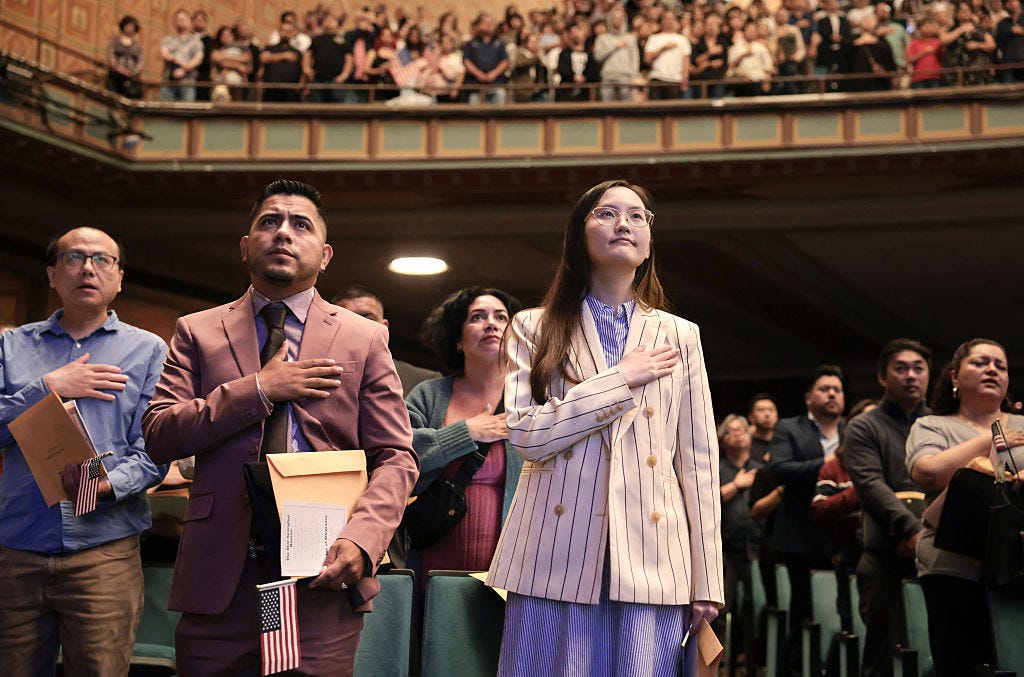
I was born in Addis Ababa, Ethiopia, but when I travel around the world, I don’t have to tell people I’m an American.
It’s not just that I “pass” as American, it’s that I am American. Like millions before me, I went through an assimilation process that included public K-12 schools, cross-cultural friendships, and workplace norms and expectations.
Assimilation has become more controversial. It implies that to become an American, you have to change yourself. It’s also difficult to promote assimilating into a culture you think is fundamentally rotten.
“Assimilation has fallen into disrepute,” begins a 1997 academic article in The International Migration Review. And the left in particular, which is the strongest pro-immigration constituency in America, has had to reconcile its pro-immigration views with arguments that America is, at its core, structurally bigoted, built for the purpose of preserving slavery, and imbued with institutions that are oppositional to social progress.
From 2016 to 2020, the share of Democrats saying that it’s important to share American customs and traditions fell from 79% to 59%.1 Anecdotally, the melting pot metaphor has been abandoned in favor of “salad bowl,” “mosaic,” and “kaleidoscope.”
In 1991, New Deal liberal Arthur M. Schlesinger Jr. warned that new ideas were taking root that rejected America as a nation of individuals from all nations melting into a new nationality. Rather, these ideas recast America as a nation of groups that “threatens to become a counter-revolution against the original theory of America as ‘one people’, a common culture, a single nation.”
The result is pieces like this recent one by The Washington Post columnist Shadi Hamid, who argued that “Muslims shouldn’t have to assimilate to belong.”
Hamid was responding to a bigoted tweet from Rep. Andy Ogles, who wrote that Muslims don’t belong in American society and that pluralism is a lie.

Of course, Muslims do belong, and pluralism is self-evidently all around us.
But promoting assimilation is both necessary for a healthy pro-immigration politics and good on its own terms. Being an American is great, people who come here largely think so, and we should help them achieve the ideal of American identity (just as they help us).
In 2014, just 39% of immigrants agreed that “there are some things about America today that make me feel ashamed,” versus 69% of native-born Americans. Immigrants and their children also express more trust in all three branches of government than native-born Americans.
Anti-assimilation advocates tend to ignore that immigrants largely self-select for liking America. Many grew up on our books, movies, and music, and they arrived wanting to fit in.
They may keep their faith and remain culturally or socially distinctive in some ways, but most people don’t want a stranger clocking them on the street as different. Many immigrants report having an easier time assimilating here than in more homogenous countries. America lets you fade into the background and do your own thing.
And immigrants are often clear-eyed about what the alternatives presented by other countries actually are: The U.S. ranks first globally in the share of foreign-born adults who say their local area is a good place for immigrants to live (96%).
We’ve been doing a great job of assimilating for over 100 years. In Streets of Gold, economists Leah Boustan and Ran Abramitzky went through millions of census records and found that the children of immigrants climb the income ladder today at roughly the same rate as those who entered through Ellis Island at the turn of the last century, with Mexican immigrants among the fastest assimilators. It’s just not common for a kid to arrive here not knowing any English and still have that issue by the time they reach adulthood. Nearly 98% of immigrants who arrive before age 5 know English.
Hamid closed his column by arguing that America was founded on the idea that citizens never have to converge on foundational questions. I think this is partly true. You’ll find wildly different visions of the good life in this country.
But there are better and worse ideas that we should try to select for and inculcate in both native-born and foreign-born Americans. I don’t want a wave of authoritarian-minded newcomers trying to install a dictatorship. The real question of assimilation has little to do with what you eat or how you pray. It’s really about whether you can get on board with liberal democracy and basic equality.
People imagine that assimilation has to be a sort of violent process that seeks to strip people of their cultural garments, religion, and language. But most assimilation comes through second-generation kids telling their parents not to microwave fish in the company kitchen.
The best definition of assimilation that I’ve seen comes from 1921: “a process of interpenetration and fusion in which persons and groups acquire the memories, sentiments, and attitudes of other persons or groups, and, by sharing their experience and history, are incorporated with them in a common cultural life.”
At some level, it probably seems a bit condescending to teach someone how to be a “good American,” but I think most people would actually appreciate knowing the rules. A pluralistic, diverse country benefits from more explicit rules about common standards of behavior because everyone is coming from a different standpoint about what is reasonable.
Before my first solo trip to Germany, my dad warned me not to take long showers. I reluctantly took a quick one, and the next morning, my host thanked me for not being like those wasteful Americans. I was glad my father cared enough to tell me. I didn’t want to come off as rude or ignorant.
My co-host Matt Yglesias agrees on the merits of assimilation and wants to push it further: He thinks progressives treat ethnic conflict as a uniquely American problem, although in reality, it’s simply an unfortunate feature of the human condition. They have let America become defined by its worst chapters, and, in that process, are ceding the ideas of patriotism to the right — a problem I’ve written about previously.
But the progressive story is an American one. It’s the abolitionists, the suffragists, and the civil rights movement. When liberals invite immigrants into this country, we’re not inviting them into a world of slavery and exclusion. We’re inviting them into the part that fought it.
Matt and I get into all of it on this week’s episode.
Watch or listen wherever you get your podcasts.
*In a couple of weeks, we’ll be reviewing Jane Jacobs’ The Death and Life of Great American Cities, so grab a copy and read along!
The Argument. Libbing out.
(Illustration by The Argument, image by William Warby via Wikimedia Commons)
The transcript will be after the paywall in this post for paying subscribers.
WATCH THE EPISODE HERE (YouTube)
New episodes post every Thursday.
For an ad-free version and full transcript, subscribe at TheArgumentMag.com.
Subscribe: Apple Podcasts | Spotify | YouTube | Overcast | Pocket Casts
Corrections:
Around 20:30, Jerusalem says that a greater proportion of Black people ride bikes than white people. However, Black people have the lowest rates of commuting by bike. Some evidence suggests that Black Americans are overrepresented in using rideshare services and, notably, low-income Americans are the most likely to commute by bike.
Show notes:
“Muslims shouldn’t have to assimilate to belong,” opinion article by Shadi Hamid that inspired this episode: Washington Post opinion article
Rep. Andrew Ogles tweet that inspired Hamid’s article: Tweet
Definitions of melting pot and salad bowl read by Matt: Black and Green Atlantic article
Suddenly Amish, reality TV show about non-Amish people adapting into Amish life referenced by Jerusalem: IMDb page
Witness, film directed by Peter Weir about a detective hiding out in Amish country, referenced by Matt: IMDb page
“Do Immigrants’ Partisan Preferences Influence Americans’ Support for Immigration?,” article by Daniel McDowell and David Steinberg referenced by Jerusalem: Journal of Experimental Political Science article
Streets of Gold, book by Ran Abramitzky and Leah Boustan examining immigrant assimilation in different groups and at different time periods, referenced by Jerusalem: Goodreads page, Amazon page
“The Integration of Immigrants into American Society,” 2015 report about immigrants’ success integrating into American society referenced by Jerusalem: National Academies of Sciences, Engineering, and Medicine report
“Why are Conservatives Winning?” article by Alice Evans about Muslim immigrant women’s economic inactivity, referenced by Matt: The Great Gender Divergence article
“American Pride Slips to New Low,” polling showing that the percentage of U.S. adults who were extremely or very proud to be an American fell from 85% in 2013 to 58% in 2025: Gallup poll
Peer Review: “Is the iPhone Birth Control? Causal Evidence from AT&T’s 2007–2011 Carrier Monopoly” white paper by Caitlin K. Myers and Ezekiel Hooper about the correlation between fertility rate decline and smartphone availability. NBER working paper
“The answer to bad tech is better tech,” article by Jerusalem about her experience with a dumb phone in 2025: The Argument article
The Death and Life of Great American Cities, famous book about urban planning by Jane Jacobs that will be the subject of an upcoming episode: Goodreads page, Amazon page