

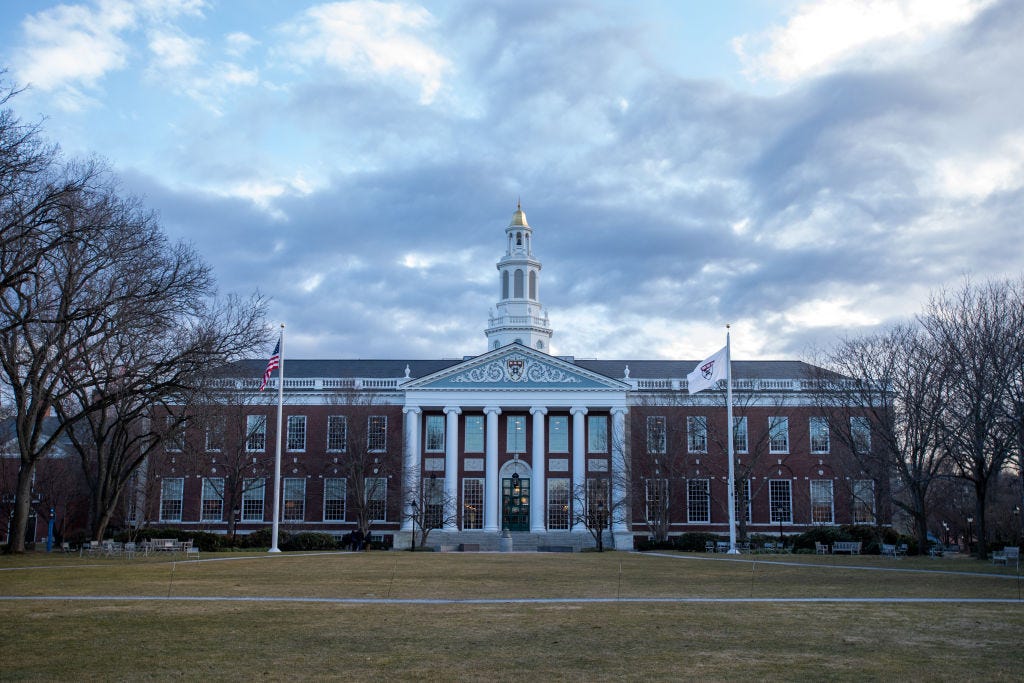
When Harvard Business School researcher Francesca Gino was fired from her tenured job over research misconduct, she promised to take the fight to court: She sued Harvard and the researchers who outed her for defamation and (in Harvard’s case) for failing to follow its process to investigate her.
That didn’t go particularly well.
Gino’s downfall has been one of the most scintillating pieces of academic drama in recent years. Gino was a star behavioral scientist at Harvard Business School whose work often focused on honesty and ethics. She often found strikingly large effect sizes for fairly minor interventions that, in many cases, did not replicate.
For example, in one study, she checked whether signing a “statement of integrity” at the top of the page or at the bottom changed the odds that participants would cheat in an exercise where they were paid based on how many puzzles they reported solving. The effect sizes claimed in this paper are staggering: “Signing at the top vs. the bottom lowered the share of people over-reporting their math puzzle performance from 79% to 37% (p = .0013), and lowered the average amount of over-reporting from 3.94 puzzles to 0.77 puzzles (p < .00001),” Data Colada wrote.
Big if true, as they say. But it wasn’t true.
The team of external researchers at Data Colada looked at the raw data in Excel and noticed that six participants had been moved to the wrong group: Three big cheaters were incorrectly moved to the “signed at bottom” group and three honest people were moved to the “signed at top” group. Not the typical p-hacking, then, but intentional data manipulation — and Gino was reportedly the only one of the paper authors involved in data collection and analysis.
Harvard, as part of its investigation, found the data file that was emailed to Gino by a research assistant and observed that it was quite different from the one Gino sent to her coauthors days later. Gino had added three participants (who seem to have been legitimate participants who really existed) and changed a bunch of cells (including the swaps that the Data Colada team found, as well as some other changes).
Let’s look at the timeline:
In fall 2021, three behavioral scientists on the Data Colada team flagged anomalies in four of Gino’s Harvard Business School papers (including the aforementioned honesty pledge paper). Harvard investigated with an outside firm and produced a nearly 1,300-page report concluding that she “committed research misconduct intentionally, knowingly, or recklessly.”
The fallout was massive. Gino lost her tenured job, four of her papers were retracted, and she has become an object of derision. But where any other scholar might slink away in embarrassment, Gino decided to double down. Her defamation claims, which the judge called “weak indeed,” were thrown out, but the litigation over the firing process is still proceeding.
Harvard filed a counterclaim against her, and in the course of litigation, Harvard’s original report that led to her firing came out. It contained some remarkably damning details, and more details have come out in the course of the litigation that are, if true, even more damning.
The single most incriminating detail is that investigators found an early data file on Gino’s computer whose numbers didn’t match what she had published. Mid-investigation, that file vanished, and a new one was in its place with the same name but different numbers that matched the published version. Whoever swapped it tampered with the file’s hidden date stamp to make it look over 10 years old.
Harvard wants to be allowed to investigate who deleted the original file, replaced it with a different file, and backdated the replacement.
I’m not a court of law, but I have a theory of who did it: probably the same person who did all of the other research fraud.
But AI told me I was right!
Gino has taken her case to the court of public opinion. By her side has been prominent legal scholar Lawrence Lessig, who clerked for Justice Antonin Scalia and has since developed a recurring habit of taking up contrarian cases that tend to backfire. For instance, he defended an MIT administrator’s decision to keep anonymous a contribution from Jeffrey Epstein1 and then sued The New York Times for “clickbait defamation” when it headlined a piece: “A Harvard Professor Doubles Down: If You Take Epstein’s Money, Do It in Secret.”
Over the last year, Gino and Lessig put together a long podcast making the case for her innocence. Lessig is a talented guy, and his long and meticulous case sounds quite convincing.
The problem is that it leaves out most of the actual evidence against Gino.