

Welcome to The Weekly Scroll!
The Weekly Scroll is a once-a-week roundup of the most interesting, strangest, and funniest stories from around the social internet.
This week, we’re talking about whether or not Russian bots disappeared from the internet, a surprising win from a crypto site, the flame war between Chinese and Brazilian leftists, and more.
Did blowing up Russian data centers make the internet good again?
Earlier this month, Ukraine conducted strikes to take out major data centers owned by Russian technology giant Yandex. Almost immediately, social media users started noticing a difference in their feeds.
“Ever since Ukraine bombed that bot farm, internet’s been a lot more peaceful…” proclaimed influencer dannyphantom.exe on TikTok. Other users noted that, after the strikes, online engagement for Elon Musk and other right-wing influencers plummeted, mentions of the name “Fauci” declined along with health-related disinformation, nationalist European influencer accounts appeared to malfunction, and subreddits focused on European politics got less activity.
While deeply online sickos were the first to notice, news sites began to pick up on this trend as well. “Kyiv destroys Russian data centers, pro-Trump and pro-AfD [Alternative for Germany] bot activity collapses on social media,” proclaimed Le Parisien (translated from French). A gleeful Futurism headline declared “Elon Musk’s Twitter Engagement Shrivels After Destruction of Russian Data Centers.” Even Ukrainian President Volodymyr Zelenskyy had a theory about the effect of his military strikes: “It suddenly became a little easier to breathe on many social-media platforms… because there were fewer bots.”
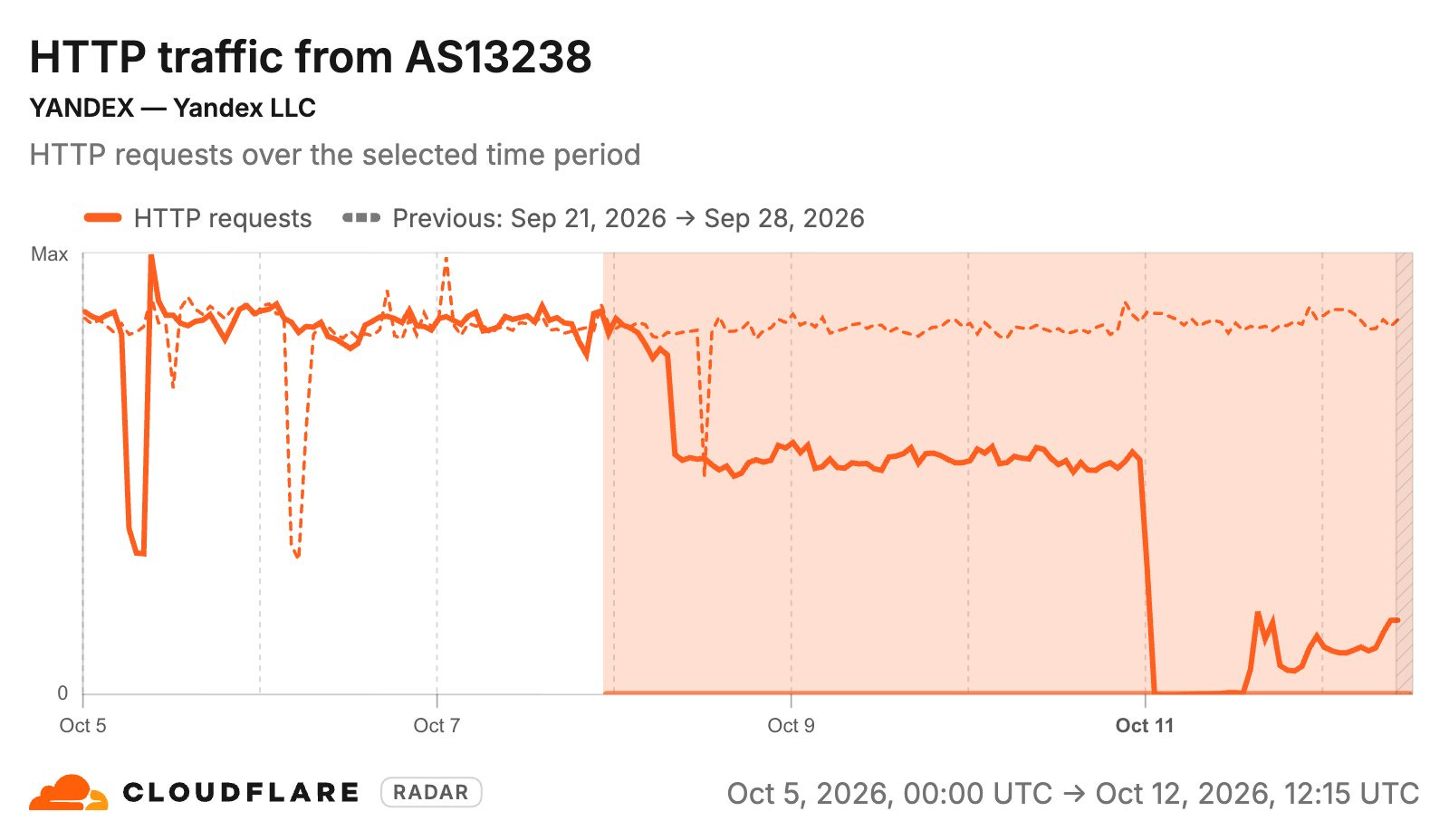
Zelenskyy wasn’t just speculating; Cloudflare data did seem to support the idea that Russian bot activity had fallen off a cliff:
This would be an incredible story about how Ukraine’s military success cleaned up our social media platforms. The only problem is that it’s probably not true.
The Cloudflare data is legitimate, but it’s measuring “bots” in the mundane sense of web crawlers and automated tools — meaning a large part of the traffic it’s measuring is not accounts with names like PatriotEagleUSA, exhorting Texas Oblast to secede from the U.S. to take advantage of its warm-water ports. Instead, the real impact is that Russian banking and food delivery apps crashed because their internal systems went down.
Most of the evidence that there was a specific drop in social media bot activity is flimsy. A viral claim that the right-wing German political party AfD saw a decline in activity seems to be pure misinformation with no credible source. And many of the statistics about engagement are misleading.
One analysis showed that a reported 54% drop in traffic to the /r/irishpolitics subreddit is technically accurate — but if you adjust the examined 12-hour time period by a few hours, it instead turns into a rise of up to 109%. That indicates the traffic swings might just be random noise. There were observable traffic declines in Russian-specific social media like the “Ask A Russian” subreddit and Russian Telegram channels, but even those were fairly limited.
Cloudflare itself says that malicious Russian bots simply migrated to other hosting providers. Disinformation trackers say that they see no discernible changes in the networks they’re observing. Valdemar Osted from Common Consultancy, a firm that tracks social media conversations, also saw no real disruptions other than “day-to-day noise.”
It’s hard to prove a negative, and the situation is still evolving, but for now it seems safe to say that the data center strikes didn’t actually have any real effect on social media bot activity.
So why did people think that it did?