

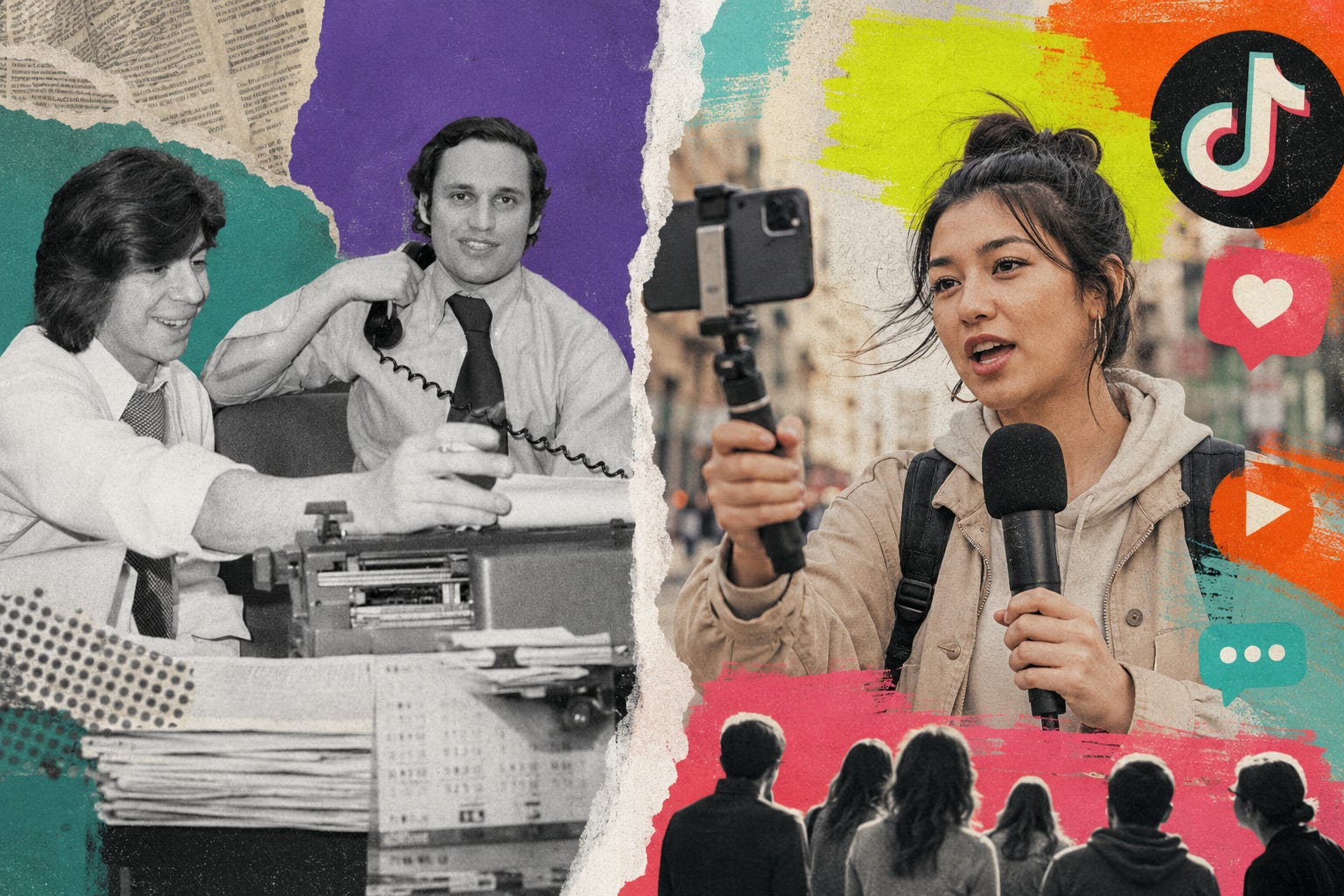
I was recently delighted to discover that my fellow Americans do not consider me an elite.
In The Argument’s recent poll of registered voters, fielded nationally between July 20 and 26, 2026, we asked respondents who they considered elite.
Of all the groups we listed, journalists were tied as the least selected group at just 9%.
As someone entering middle age and therefore excessively concerned with what young people think of my kind, I eagerly checked the breakdown of the results by age and discovered that just 7% of the youths (18- to 29-year-olds) consider journalists to be elites.
Young people actually have a more favorable view of journalists than any other age cohort. With 57% of 18- to 29-year-olds viewing us positively, my colleagues are more popular than Democrats, Republicans, billionaires, and Alexandria Ocasio-Cortez. (We do, somewhat vexingly, remain less popular than college professors.)
It’s hard to see young people’s attitudes as especially informed since, according to them, they simply do not read or watch the news very much — at least not without the mediation of social media.
Regular consumption of traditional news sources — by which I mean newspapers, news websites, and television — declines dramatically as you climb down the age ladder. Those under the age of 30 are less than half as likely to get regular news from TV as the general population and 8 percentage points less likely to read newspapers and news websites regularly.
Of all the traditional formats, newspapers and websites are the most used by 18- to 29-year-olds — but with just 33% of this group perusing these sources regularly, they are still distinctly unpopular parts of their news diet, on par with Elon Musk’s X. Compare that with TikTok, podcasts/YouTube, and Instagram, where 42% to 53% of young people say they get their news.
Even Facebook is slightly more popular than traditional news sources, although at 36%, the youngest subgroup’s rate of regular Facebook usage is about the same as that for our age 65 and over respondents, with whom Facebook is the most popular social media news source by far.
Young people probably don’t see themselves as opting out of news consumption: Only 4% selected “none of the above” when we asked for their news sources, in line with the general population.
And, just like older voters, the 18-to-29 cohort has opinions on bias and partisanship in journalism — albeit distinct ones. While nearly half of our respondents overall think that journalists have a liberal bias, only 40% of those under 30 feel the same. This shift is primarily accounted for by a larger proportion of 18- to 29-year-olds saying that journalists are “neither more liberal nor more conservative” than any other age group.
There are a couple reasons this may be the case.
Our 18- to 29-year-old respondents were 15 percentage points more liberal than our sample overall, so they may be less likely to see liberal bias than a more conservative overall population.
Younger respondents, who consume primarily algorithmic media, may be working off an implicit redefinition of what a journalist actually is. After all, is a gonzo YouTuber named Reckless Ben who’s obsessed with catching an alleged Lego thief a liberal or a conservative? I can’t even venture a guess.
But as to whether or not the traditional national media are “fair and unbiased,” all age groups are split roughly 50/50. That said, there is a dramatic drop-off from the 18% of those 65 or over who believe the news can be trusted “most or all of the time” to the merely 8% of those under 45 who believe the same.
This is directionally consistent with 2025 results from Gallup, which found a 15-point gap in trust in mass media between 18- to 29-year-olds and those 65 and over — a gap that has widened dramatically since the 2001 to 2003 period when the two were at parity.
In some ways, this all confirms what we already know: We are entering a world where information delivery is increasingly fragmented and traditional gatekeeping institutions have diminished trust and influence. This has created formidable challenges for the news business and will continue to do so.
But, to the extent our survey results offer any solace, it seems like America’s young adults are approaching the field with a slightly more open mind than older Americans. And they are not particularly buying the “liberal media” narrative that the right has been pushing to discredit the profession since before they were born.
Recommended reading:

The real reason behind Minnesota's Somali fraud scandal

The easiest way to steal from government programs is the same everywhere, and it has nothing to do with immigration.
Fascinatingly, I think you'd get a very different answer if you asked people if they thought members of "the media" are elite.
My reaction is that "journalists" are underpaid, scrappy, truthseekers, working hard to hold powerful people and institutions to account for their transgressions against society. Think ProPublica, your local paper, etc.
Whereas "the media" are a bunch of overpaid Fox-and-MSNBC elitist, disingenuous hacks whose primary job is to stir up anxious infotainment addicts by constantly identifying (and exaggerating) new and urgent threats to society and the world.
Obviously, both groups are journalists. But my perception of each label differs wildly.
I keep thinking that these surveys also need to ask whether elite is a negative term, a favorable term, or a neutral one.