

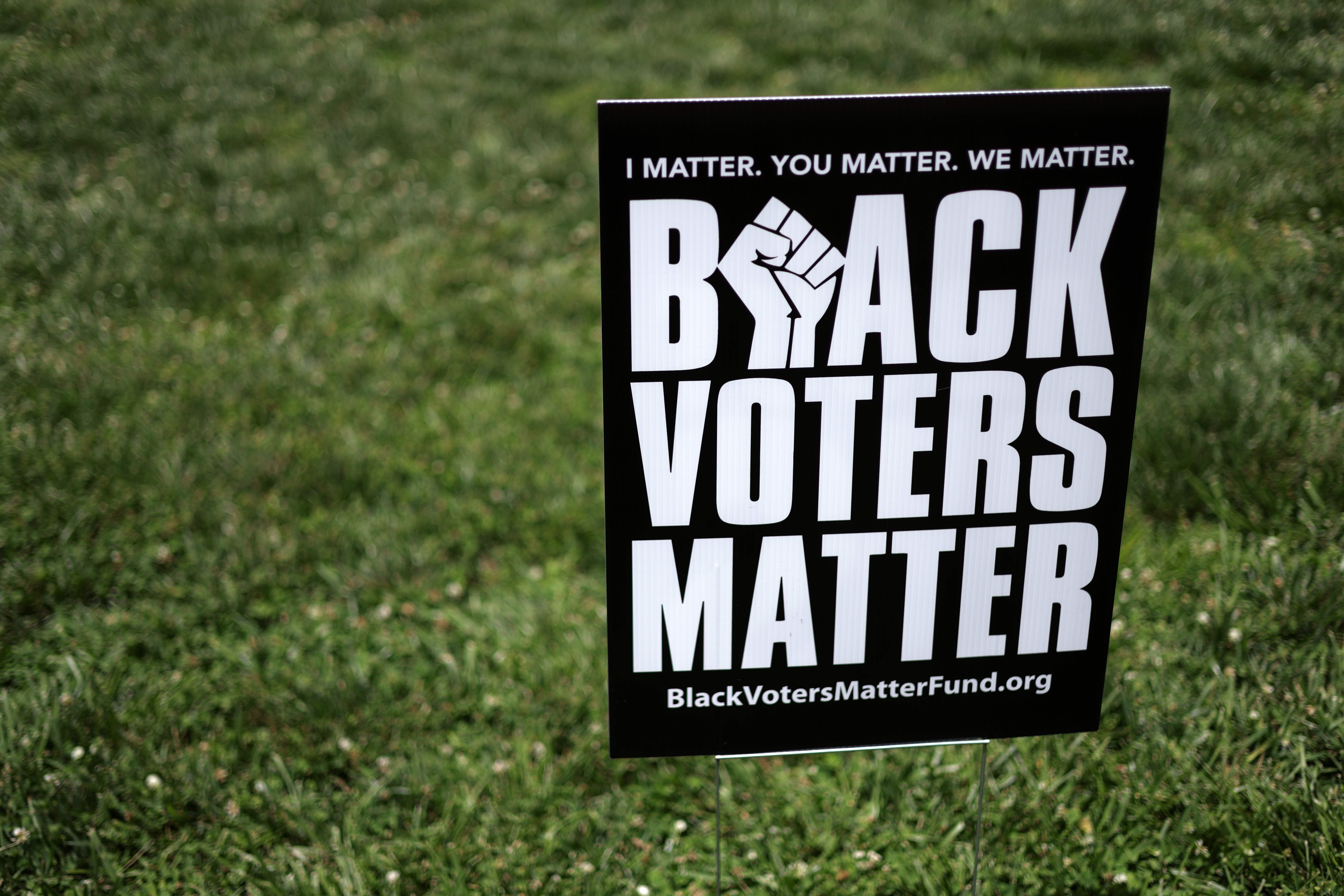
There’s an interesting tension within the Democratic Party’s coalition: To win national majorities, Democrats depend on nonwhite voters, many of whom have pretty conservative views but vote for Democrats anyway.
In The Argument’s aggregated national polling data, just 6% of white conservatives planned to support the Democratic candidate for Congress this fall. But 15% of Hispanic conservatives and a remarkable 61% of Black conservatives planned to vote blue in the midterms.
The statistic among Black voters is particularly interesting because they are widely considered the backbone of the Democratic Party. Of all racial groups in America, Black voters are by far the most likely to identify as and vote for Democrats. Yet just 34% of them call themselves liberals.
What explains this phenomenon? Do Black voters have a different conception of what ideological labels like “liberal” and “conservative” mean?
Our polling data shows that Black voters aren’t just applying a different label to themselves. On a range of issues, particularly those relating to gender and sexual orientation, Black voters have much more conservative preferences than other Democratic voters. The exceptions are issues connected to race, like policing and affirmative action, where they’re notably more liberal.
For the older generation of Black voters, two things keep them voting for Democrats, despite their policy disagreements: First, peer pressure. Second, what political scientists call “ideological innocence,” which is the fact that many voters neither think about their views in an ideologically consistent way nor do they have stable views on policy at all. That’s why it’s easy to come across a voter who both self-identifies as a conservative and wants the government to do big things like Social Security and Medicare.
But both of these forces are weakening, which helps explain why Democrats are bleeding support among younger Black voters — especially young Black men.
Black voters really are more conservative than most Democrats
Based on Catalist data, 85% of Black voters backed Kamala Harris in 2024. But looking at self-reported ideology, Black voters are only a hair more liberal than the general population and much less liberal than Harris 2024 voters on both economic and social issues.
In The Argument’s aggregated survey data from August 2025 through March 2026, just under two-thirds of Harris 2024 voters called themselves liberal on social issues, compared to just 38% of Black voters. On economic issues, 55% of Harris voters called themselves liberal, while just 35% of Black voters did.
Black voters were 12 percentage points less likely than voters overall to agree that same-sex marriages should have the same legal protections as traditional marriages, and a whopping 33 points less likely than Harris 2024 voters.
Compared to Harris 2024 voters, Black voters were also much more likely to agree that it’s better “when men look and act like men, and women look and act like women,” to support a return to traditional gender roles, and to say that being transgender is morally wrong.
It’s not just these broad values questions either. In our poll’s questions about transgender policy, Black voters were generally aligned with the median voter, which is to say they were much more conservative than Harris voters.
That’s not to say that Black voters are just more conservative than their party across the board, though. On racial issues, they’re much more liberal.
Black voters are much more liberal on race
These days, the conventional wisdom is that “Defund the Police” is and was: (a) a dumb idea, (b) unpopular, and (c) something that Black people didn’t actually want.
Defund was indeed dumb and unpopular, but it’s actually not true that Black people were opposed to it. For example, here’s a Morning Consult/Pollitico poll from June of 2020. Half of Black respondents supported the slogan “defund the police,” and 61% supported the general idea of redirecting police funding.
Another good example is race-based affirmative action in college admissions. In a Pew survey from 2023, just a third of all U.S. adults approved of the practice — but a plurality of Black voters did.
Here’s a Gallup poll from after the Students for Fair Admissions v. Harvard case was decided. While 68% of voters said the decision was mostly a good thing, Black voters were evenly split; half of Black respondents thought the ruling would negatively impact higher education, and 52% thought it would make things harder for Black applicants.
Peer pressure or ideological innocence?
So what’s going on here? How is it that large majorities of Black voters identify as conservative or moderate while also voting for the liberal party?
One strand of literature argues that Black voters are overwhelmingly Democrats, despite many of them holding conservative views, for group-interest reasons. A 2022 paper by Julian J. Wamble, Chryl N. Laird, Corrine M. McConnaughy, and Ismail K. White argued that “black Democratic partisanship is upheld, in part, through black Americans’ use of social sanctions (both positive and negative) to encourage compliance with a group norm of Democratic Party support.”
They found that Black voters were more likely to identify as Democrats — and more likely to donate to Obama — when faced with a Black interviewer.
In a 2024 paper, the Stanford political scientist Hakeem Jefferson took a different tack, arguing that “the terms ‘liberal’ and ‘conservative’ are unfamiliar to many Black Americans,” causing respondents who are “unfamiliar with these terms [to] misapply them and choose ideological labels that fail to align with their partisan preferences.”
Jefferson examined American National Election Studies data and created an index of familiarity with the terms “liberal” and “conservative” based on whether survey respondents correctly identified the Republicans (and Republican presidential nominees) as more conservative than the Democrats.
Among Black people who scored lowest on familiarity (those who were least able to identify the Republican Party or Donald Trump as conservatives), self-identifying as conservative had either no relationship with partisanship or a negative relationship with it.
That is, among low-familiarity Black respondents, calling yourself “conservative” tells us essentially nothing about your partisanship.
Blexit is real for the younger generation
Since 2012, Democrats have lost three to four points of support among Black voters each presidential cycle. But that decline is especially large among Black voters under 30, particularly among young Black men. Among Black men aged 18 to 29, Harris got just 75% of the vote, compared to 94% for Obama in 2012.
Here’s how I think you can square the arguments in the two political science papers I cited above:
Historically, it is true that Black voters overwhelmingly vote Democratic — including Black voters with more conservative views — because the Democratic Party was seen as the party of civil rights. Voting blue was a way of practicing in-group solidarity.
That solidarity was enforced by institutions like the Black church and the memory of the civil rights movement, which helped keep the most conservative Black voters in the Democratic coalition.
But today, that’s changing. The civil rights movement is less salient now, partly because some of the battles it fought are now considered settled issues, and partly because younger Black voters simply weren’t alive for it. Racism is by no means over, but it has abated significantly.
Institutions like the Black church are also weakening, as a growing share of young people of all races become religiously unaffiliated. And voters now have more information than ever before about what each party’s positions are.
The net effect is that young Black people are increasingly ideologically polarized, which means that Black conservatives are beginning to leave the Democratic Party.
I don’t expect this trend to be a straight line. As my colleague Lakshya Jain noted in a recent piece, polling shows that Democrats are gaining the most ground with noncollege and minority voters ahead of the midterms. And I do expect to see a large “bounce back” for Democrats in 2026 with Black and Hispanic voters that shifted away from the party in 2024. But it’s unlikely to be a return to 2012 levels of Democratic support, and over the longer run — that is, the next few decades — I expect to see Democratic support among conservative nonwhites continue to erode.
More polling:
The Trump voters telling pollsters they never voted for him

There is a curious polling phenomenon where a nontrivial share of respondents falsely claim to have voted for the winner of the last election. Whether they’re lying, misremembering, or rewriting history, “winner’s recall” is common enough th…
The unraveling of Trump's 2024 coalition

Donald Trump’s populist appeal broke the Democratic Party last year. It cost them their base and their message, and it shattered their confidence, as the nonwhite voters Democrats had claimed to champion for years comprehensively turned on them.
This is a great piece - but one quibble I have is that while it was true that Black voters supported police defunding in 2020, that position was not stable. Pew saw this change significantly only one year later- the percentage preferring reduced funding dropped from 42% to 23%, which was a much larger drop in that position than any other racial group. https://www.pewresearch.org/short-reads/2021/10/26/growing-share-of-americans-say-they-want-more-spending-on-police-in-their-area/
My slight pushback on this would be that 2008-2016 were actually outlier times for black support so comparing it to then is somewhat overstating the problem.
Like, yes, Harris only getting 75% of the black vote looks bad compared to 2012 or 2016, but if you look at the Roper numbers on 2004 - Kerry got 88%. Considering A-A women always support Democrats at higher numbers, if we say A-A women were at 90% and men were at 85%, then a 10-point drop is still a worry, but it's less of a disaster than looking at 2016 when Obama was still POTUS.
I also think in general, there's an overreaction to the moderation of the black vote - by everything I've seen, yes, African-American voters are closer to the median voter on things like LGBT rights, abortion, etc., but they also care less about those issues and may actually vote more 'liberal' in a primary because of their left-leaning views compared to the population on race, policing, or gun control.