

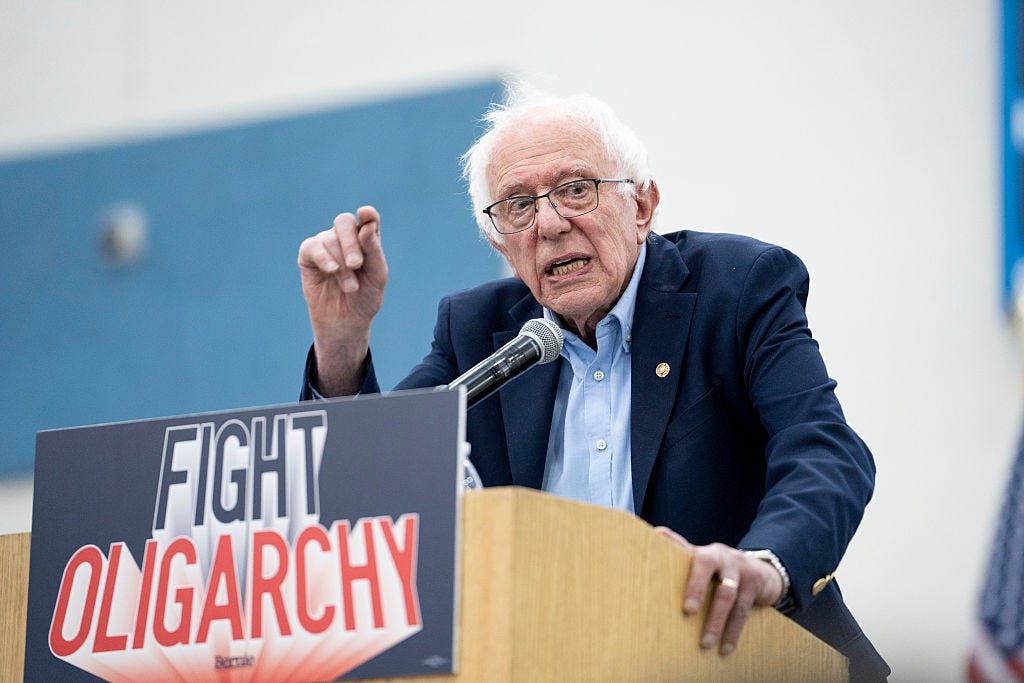
The notion that there is a handful of wealthy, powerful people who are secretly pulling the strings is seductive. It appeals to people’s sense that extreme inequality is unjust, while also offering a simpler explanation for political failure than one involving the incentives and interactions of dozens of competing groups and institutions.
But that doesn’t mean it’s right.
On today’s episode of The Argument, my co-host Matt Yglesias argues that “I don’t think the oligarchy is real.” At a literal level, this statement is straightforwardly correct. There is no unified billionaire class that decides elections and gets its way whenever it throws money around. And while power is distributed unequally, billionaires are merely one set of actors with an unequal share of political power.
However, I accept that word meanings and usage naturally change over time so I think the energy behind Sen. Bernie Sanders and Rep. Alexandria Ocasio-Cortez’ Fighting Oligarchy tour is worth taking seriously. As a political journalist, I’ve watched very wealthy people receive a kind of access to elected officials that ordinary citizens cannot get. While none of this proves quid pro quo, it still violates an important democratic ideal: Not just, one person, one vote, but the promise that citizens have equal standing.
And money buys more than meetings. It buys the ability to shape the discourse. Wealthy donors fund think tanks, advocacy groups, research, lobbying, and media. Usually, they are not purchasing beliefs, rather they are amplifying the voices of people who they like. Take Elon Musk’s purchase of Twitter. In doing so, he has altered the information environment in which politicians and journalists operate, shifting the window of what is reasonable farther right by removing moderation rules that marginalized bigoted views.
Defining a problem accurately is the first step to actually addressing it. Is the issue that politicians literally do whatever billionaires want even when it comes in conflict with voter preferences? Well, that’s clearly not the case.
Wealthy people lose all the time! Self-funded candidates flame out (see: Billionaire Tom Steyer in California), better funded candidates lose elections (see: Hillary Clinton in 2016), lobbying campaigns fail(see: Big Pharma’s campaign against Medicare drug-price negotiation)… Voters have agency, and small-d democratic preferences, particularly on salient issues, have a large effect. But a theory that treats every billionaire victory as proof while ignoring every billionaire defeat is a theory that can never be falsified.
And when I consider the structure of power in American politics, it often cleaves along lines that have nothing to do with being a billionaire. Homeowners dominate land use politics, professional associations capture licensing rules, industry representatives shape low-salience regulations on their issues because few other people care enough to engage. All of this can produce profoundly unequal outcomes without being the work of a coherent oligarchic class.
It is morally revolting to see a homeless person sleeping outside a $10 million house but a wealth tax doesn’t build a homeless shelter. The relevant questions for addressing homelessness are practical: How do we build more shelters at cost? Where should they go? How do we deal with the small number of homeless individuals who refuse offers of aid? Higher taxes may help fund some of those answers, but punishing winners is not actually the same thing as helping the losers.
Matt is far more down on oligarchy messaging than I. Listen to us get into all of it on this week’s episode.
Watch or listen wherever you get your podcasts.
The Argument. Libbing out.
The transcript will be after the paywall in this post for paying subscribers.
WATCH THE EPISODE ON YOUTUBE HERE
New episodes post every Thursday.
For an ad-free version and full transcript, subscribe at TheArgumentMag.com.
Corrections:
Around 0:05:00, Jerusalem says Josh Kalla and David Broockman’s research shows that donors are “five times as likely to get a senior staffer and, like, three times as likely to get face time with the candidate,” compared to simply a constituent. The 2015 study showed donors are three to four times as likely to get access to a senior staffer and four times as likely to get facetime with a member of Congress.
Around 0:21:30, Matt observed that Eric Jones had been “trailing outside the top two in another Bay Area race.” This was true for weeks, but Jones eventually made it into the top two and advanced to the general election.
Show notes:
Website for the Fighting Oligarchy tour: Bernie Sanders website
Sen. Amy Klobuchar tweet criticizing policies to help the “broligarchy”: Tweet
“Campaign Contributions Facilitate Access to Congressional Officials: A Randomized Field Experiment,” article by Joshua Kalla and David Broockman, referenced by Jerusalem, about to what extent donors get better access to candidates: American Journal of Political Science article
Polling asking “Would you say the government is pretty much run by a few big interests looking out for themselves or that it is run for the benefit of all the people?” that shows a large majority responding “few big interests”: ANES survey
OpenSecrets campaign finance data referenced by Jerusalem: OpenSecrets article
“The Business of American Democracy: Citizens United, Independent Spending, and Elections,” article by Tilman Klumpp, Hugo Mialon, and Michael A. Williams comparing the effects of Citizens United on states that did and did not have strong union support: SSRN page
The Homevoter Hypothesis: How Home Values Influence Local Government Taxation, School Finance, and Land-Use Policies, book by William Fischel arguing that people vote to exclude apartment buildings from their communities in order to drive up their home values: Goodreads page, Amazon page
Neighborhood Defenders: Participatory Politics and America’s Housing Crisis, book by Katherine Levine Einstein, David Glick, and Maxwell Palmer about participatory democracy’s role in defeating housing projects: Goodreads page, Amazon page
“Testing Theories of American Politics: Elites, Interest Groups, and Average Citizens,” article by Martin Gilens and Benjamin Page arguing the U.S. is an oligarchy: Perspectives on Politics article
Lobbying and Policy Change: Who Wins, Who Loses, and Why, book by Frank Baumgartner, Jeffrey Berry, Marie Hojnacki, David Kimball, and Beth Leech studying the effects of lobbyists’ work: Goodreads page, Amazon page
Capital in the 21st Century, economics book by Thomas Piketty, referenced by Matt: Goodreads page, Amazon page
Abundance, influential book by Ezra Klein and Derek Thompson that you have probably read if you subscribe to this magazine: Goodreads page, Amazon page
“The Doom Loop of Oligarchy,” article by Ezra Klein in reaction to Piketty’s Capital. Vox archives
Peer review: “Is Immigration Good for Health? The Effect of Immigration on Older Adult Mortality in the United States,” article by David C. Grabowski, Jonathan Gruber, and Brian E. McGarry: NBER working paper
“We may miss the sweatshops,” article by Matt about how AI’s labor potential weakens the economic case for immigration: The Argument article
“Where the rubber meets the road: Emerging environmental impacts of tire wear particles and their chemical cocktails,” study by Paul Mayer, Kelly Moran, and others, referenced by Matt, about air particulates caused by dissolving car tires: Science of the Total Environment article
“Should we end asylum?” podcast episode where Matt and Jerusalem debated asylum policy: The Argument podcast
“A.I. progress is giving me writer’s block,” article by Matt about how AI uncertainty makes it difficult to think through effective policy solutions: Slow Boring article
One Billion Americans: The Case for Thinking Bigger, book by Matt arguing that Americans’ path to prosperity lies in increasing the size of our population: Goodreads page, Amazon page
It’s good political messaging heading into a midterm where you want emphasize the cronyism and corruption of the party in power. You are obviously overthinking a slogan to the point that nearly all political messages would fall apart under the level of scrutiny.
In Wisconsin, for the last filing period, $6.5 million out of $7.4 million contributed to the Wisconsin Republican Party came from 3 people (two of whom were named Uihlein).