

Artificial intelligence, if you believe the hype, promises to accelerate economic growth, solve most medical problems, and lead us to a world of material abundance. The downside is the mechanism by which AI will produce this utopia is through disruptive change to labor markets and people’s ability to earn a living by working.
This poses a daunting set of political questions that will likely reshape modern politics much as the Industrial Revolution reordered the politics of its time. But in an abstract sense, the distributive questions have pretty straightforward answers.
We already have the basic technology of taxation and the social safety net, and these tools are already widely used in the United States and other affluent democracies. Their use, however, is limited by genuine resource scarcity.
Aging populations have placed significant burdens on systems that were designed in a period of shorter life expectancy, fewer health care services, and higher birth rates. Voters and politicians alike worry, with some reason, that both higher taxes and more generous social assistance tend to discourage work, which could retard economic growth and ultimately make the welfare state less sustainable.
Automation, on the merits, should serve to alleviate those concerns.
To the extent that human labor becomes less economically valuable, it would be less necessary to worry about creating economic incentives to engage in it. To the extent that productivity soars due to automation, there is less need to be stingy with benefits because there is more material surplus to go around.
I worry a lot about the question of whether the United States will, in fact, make sensible and humane policy choices in the face of these changes, but I think it is relatively clear what the sensible choices are. And if the basic institutions of American democracy survive the current era at all, the nature of democratic electoral competition provides strong incentives for elected officials to make sound decisions and ensure that whatever AI-induced prosperity materializes is broadly shared.
But what about the global poor?
The answers here are a lot less clear to me, and it seems plausible that the normal course of democratic politics will lead to borderline catastrophic results for the residents of countries that are currently far from the economic frontier.
There is little precedent for large-scale, sustained transfers from rich countries to poor countries, and while there have been tremendous economic growth success stories that have dramatically reduced inequality on the global scale, these successes have tended to depend on trade flows that only make sense on the premise that cheap labor can be made valuable to customers in the rich world.
If automation genuinely devalues human labor, then the main ladder by which poor countries become richer would collapse at the exact same time that the main national interest rationale for immigration evaporates. Poor countries could still benefit from rich world technological innovations, but they could also face bleak futures as natural resource exporters with extremely narrow economic bases and minimal prospects for broad development.
The ladder of industrialization
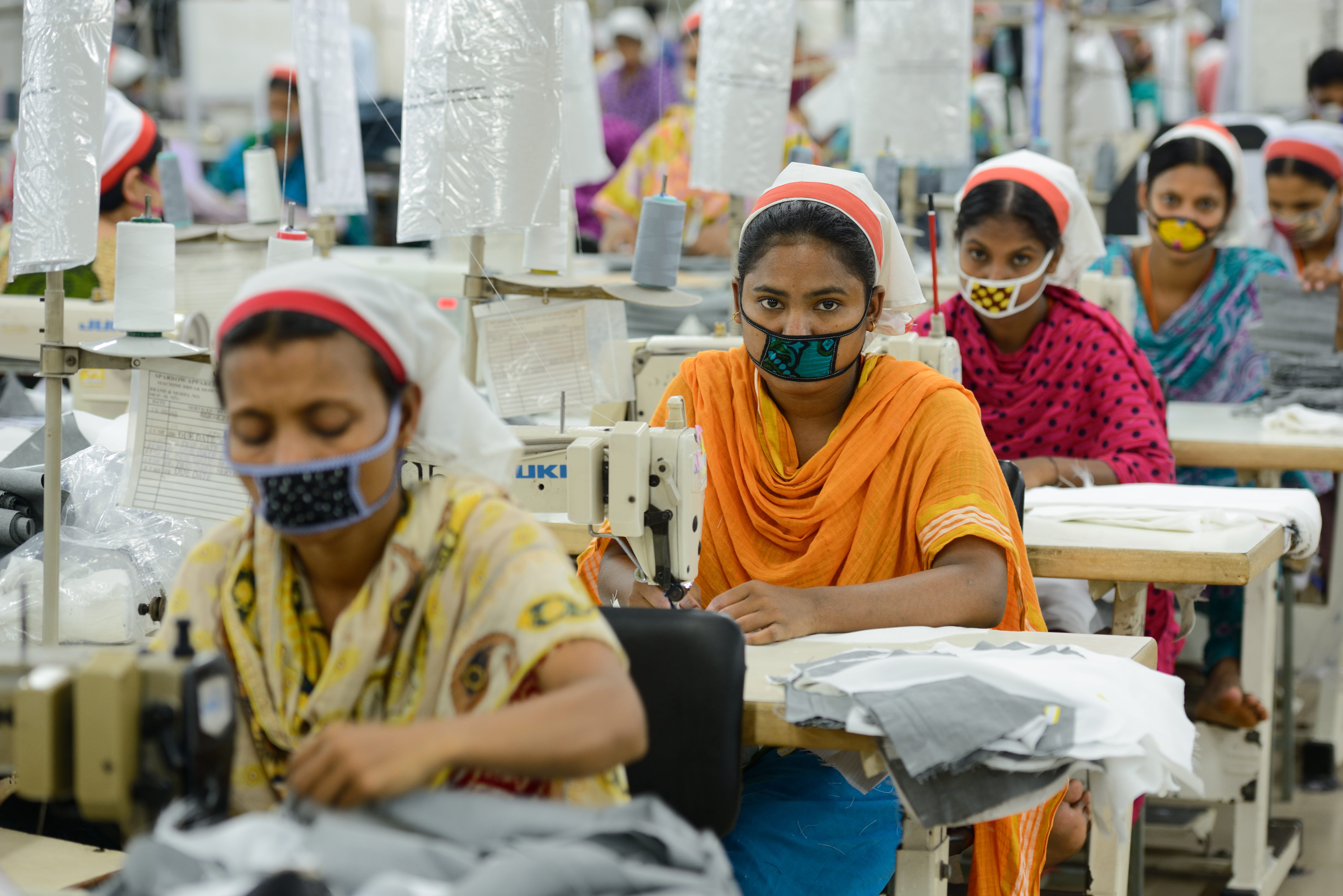
The world’s first industrial revolution took place in Britain starting in the late 18th century and was centered on the textile industry. Textiles were not the first industry to experience soaring productivity due to technological innovation. But while earlier booms like the development of the movable type printing press had a transformative impact on human culture, the total market for something like books or eyeglasses simply wasn’t large enough to be a big deal for per capita economic growth. Manufacturing clothing was different, and sustained innovation in this field is what made Britain rich.
Notably, almost every subsequent economic development success story around the world has featured this exact same first rung of the ladder.
Textile manufacturing is, to this day, highly labor-intensive and involves relatively simple forms of machinery. In very poor countries, even very poorly paid apparel jobs are appealing to people whose best alternative is subsistence farming or informal service work.
Countries that undergo successful economic development move over time from these very simple forms of manufacturing into more complicated industries further up the value chain. Shifting from stagnation to growth is hard, but one piece of good news is that as time has passed, industrialization success stories have gotten faster.
China’s path to catch-up growth was much more rapid than Korea’s, which was more rapid than Japan’s. The United Kingdom’s industrialization, which came first, was excruciatingly slow by the standards of later imitators because it had to make everything up for the first time.
Today’s new industrializers can import foreign capital and expertise, learn from countries that have gone before them, and sell into vast and deep markets in the already developed world. The entire premise of these catch-up growth episodes, however, is that cheap labor abroad will have significant economic benefits to the countries that are already rich.
Free trade is always controversial politically, and there are always demands for protection and concerns about job losses. But trade is, on net, beneficial for countries on both sides of the exchange. When Americans buy products from poor countries, those countries become less poor and Americans get a boost to their real living standards and a chance to reallocate our domestic labor to higher-value opportunities.
But if in the near future, robots can make everything, it seems like there will be no more room for the humble sweatshop and no more path to industrialization. There are many stories out there you can tell about continued demand for human labor even in a world of robust automation. But these are stories about taste-based consumption of services.
Perhaps people will continue to prefer interacting with humans in a variety of scenarios, just as the availability of workout videos has not killed the market for yoga classes. Even if this pans out, though, tradable manufactured goods are the quintessential impersonal commodity. You’re not buying socks based on a deep sense of connection to a craftsperson who made them — that’s the whole point of low-end manufacturing — so the second a robot can do it cheaper, that’s where the entire market will go.
The end of immigration
By much the same token, it seems like the already fraught politics of immigration will take a dismal turn if there’s a structural fall in demand for labor.
Right now, the strongest argument by far in favor of a liberal approach to migration relates to the concrete economic benefits of an expanded labor force. Even Donald Trump is actually increasing the number of H-2B guest workers to try to partially offset the impact of his restrictionist policies. Public support for skilled immigration remained strong even at the height of the 2024 backlash against Biden-era chaos.
As The Argument’s director of political data, Lakshya Jain has found in his polling that the key driver of worries about immigration is concern about crime. Americans are broadly on board with the idea that a well-managed immigration system has meaningful economic benefits, and this has been the central pillar of political advocacy for a liberal approach to immigration for a generation or two.
If the world experiences a massive decline in the demand for human labor, that argument goes up in smoke both politically and substantively. Even if disemployment were limited in the short term to white collar sectors, that would generate a huge new group of potential workers for manual labor jobs and reduce interest in relying on immigrant labor. As robotics improves, that source of jobs would dry up too.
Yes, specific high-skilled immigrants would still be valuable, and it’s possible that an increased demand for care workers would not be satiated by the shifting composition of the native-born workforce. But directionally, this doesn’t seem great for would-be immigrants.
This would be a wrenching social transformation, but as a matter of policy design, it’s easy to imagine taxation and the welfare state being used to make everyone strictly better off than they are today.
But what’s the role for immigrants in a world of fully automated luxury gay space communism? Providing social welfare benefits to foreigners has never been a popular cause, and in the U.S. context, a standard pro-immigration argument is to note that immigrants use dramatically less social assistance than natives and improve the country’s fiscal balance.
In European countries where this is often not the case, the politics of immigration are dicier. Allowing immigrants to come to your country to work is a win-win, positive-sum interaction. Providing immigrants with welfare benefits is zero-sum redistribution from voters to nonvoters. Without labor demand, restrictionism will surge at the exact same time economic development prospects in poor countries are collapsing.
The resource curse
Of course, even under this scenario, there will still be money in natural resource extraction.
But exporting natural resources has proven, time and again, to be a very mixed blessing as an economic development model. There are a handful of countries, notably in the Persian Gulf, who seem to have successfully leveraged oil into broadly high living standards.
A more common scenario, however, is to fall prey to the natural resource curse, by which the ability of a national elite to earn a living off resource rents means there is no incentive to make the kind of stable, growth-friendly institutions that lead to broad-based prosperity.
In an AI-powered world, the resource curse could prove particularly vicious. Obtaining the needed commodities won’t necessarily require human labor, just legal authority to do the extraction. Whoever is in position to hand that legal authority out — the internationally recognized government — will collect all the rents, with no particular need to share them with anyone. Any group that manages to pull off a successful coup will capture vast wealth. Anyone on the outside will be left with nothing. Endless rounds of violence and mass killing could easily be the result.
This is a very depressing picture, and I think it’s possible for things to go better than I’m imagining. First, developing nations have domestic economies with domestic markets. It’s possible that, with increasingly cheap AI tools in hand, these nations could develop domestic industries and rely on domestic consumption. It’s possible that AI could make domestically oriented development more viable by reducing the need for imported expertise and expensive infrastructure.
Moreover, as I mentioned at the beginning of this piece, poor nations could benefit significantly from wealthy nations’ technological innovations. AI could reduce the costs of good education, health care, governance, and infrastructure planning. The entire development ladder exists because poor nations need a way to accumulate capital and technology, but AI could make all that free to access.
But I’m not optimistic.
A problem from hell
When I submitted my above arguments to Claude Opus 4.6 for comment, it told me the resulting piece ended in an abrupt and unsatisfying way because readers “expect some policy thinking even when the answers are uncertain.” And I certainly agree that it would be a stronger article if it ended on a clear call to action — or at least gestured at a few ideas.
ChatGPT-5.2, by contrast, mostly wanted to punch holes in the assumptions and point out that looming full automation of labor is hardly a certainty. Here, too, I agree. Predicting the future is hard, and far too many participants in AI discourse are expressing undue certainty about the capabilities of technologies that do not yet exist.
But prudent scenario planning is still a good idea. Humans have pondered the possibility of widespread automation creating a post-work future at least since Karel Capek’s 1921 play R.U.R., and the odds that we will soon find ourselves in that kind of scenario have clearly risen sharply in recent years.
Managing a post-work world of superabundance is a fundamentally political issue, and politics tends to focus overwhelmingly on domestic issues. It’s therefore unsurprising that almost all AI dooming and boosterism has focused on the domestic consequences.
As a result, the risk is very high that a large majority of humanity could find itself locked out of the benefits of a post-scarcity world. It is too bad that this article doesn’t have a snappy, action-inducing suggestion to end on, but the problem is too important for us to avoid talking about it until someone smarter than me comes along to write a column with a better ending.
More on AI:
Don't get fancy with your labor market fixes for AI

The only thing emerging faster than the AI arms race in America is the debate over what to do about the workers who AI will displace.
When "technically true" becomes "actually misleading"

Worst Take of the Week is a new occasional column where the author will rant about something we found stupid, annoying, bad, and/or irritating. While the title of this column was necessary for palindromic reasons, we cannot promise that entries will come out weekly or that each piece will literally be the worst take that week; this column would be borin…
But Matt, what's the evidence that textile manufacturing (let's say) is going to be done by a robot who will be cheaper than a third-world worker? All the talk about AI today is about text and image processing; and yes, I'm sure there are people out there doing research on machine learning for other kinds of tasks but is there any evidence out there that warrants this kind of worry?
It seems difficult to imagine the AI trajectory in which it *both* essentially ends the demand for labour from rich countries without also creating a situation where poor countries end up ahead. If making a robot that does the work of a human becomes that trivial, they’ll end up ubiquitous everywhere, even if via people giving them away (for instance, this is the mechanism by which many parts of the world that have not succeeded at export-led development have still ended up with an amount of cheap clothing that would be unbelievable to pre-industrial people).