

Welcome to The Weekly Scroll!
The Weekly Scroll is a once-a-week roundup of the funniest, most interesting, and strangest stories from around the social internet.
This week, we’re talking about Substack’s new religious debates, the continuing MAGA influencer scandal, how to retire from YouTube, and aura battles.
Why are the Substackers debating religious miracles?
Over the last year, one of the hottest topics on rationalist-adjacent Substack has been… the veracity of religious miracles?
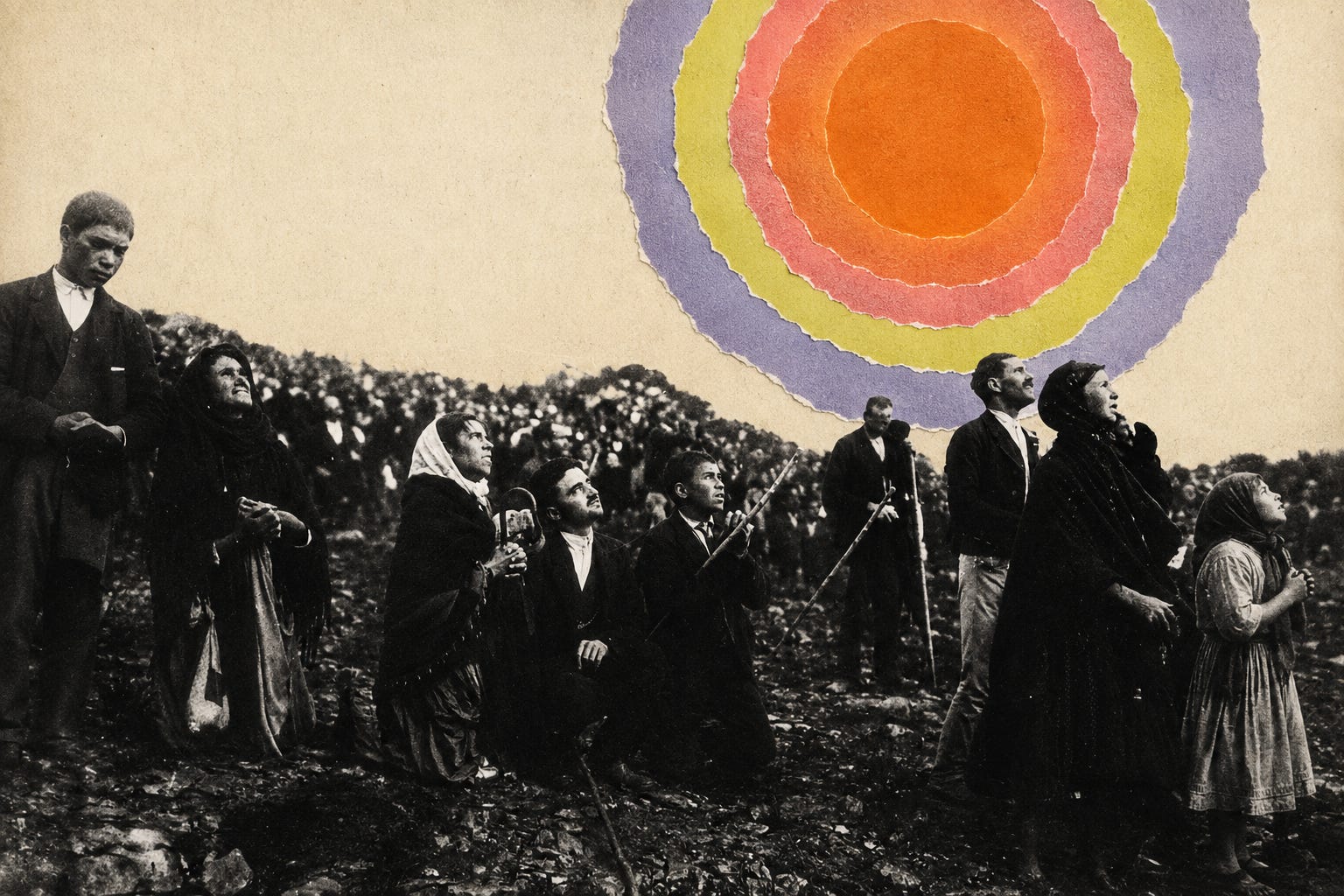
This all kicked off last year when religious Substacker Ethan Muse wrote a heavily sourced essay arguing that the Miracle of the Sun at Fatima — a 1917 incident where large crowds of people reported seeing the sun dance and emit radiant colors — was a genuine miracle, unexplainable by any other method other than divine intervention. This inspired rationalist blogger Scott Alexander to write a more skeptical post titled “The Fatima Sun Miracle: Much More Than You Wanted To Know,” which led to responses and counter-responses.
The discourse continued into 2026 when other bloggers began jumping into the fray and Alexander began investigating similar sun miracles in Buddhism. It seems to have wrapped up with Alexander’s recent pilgrimage to a modern-day holy site where people still claim to see sun miracles to this day.
There have also been back-and-forth essays about the case of Padre Pio, a Catholic saint who allegedly experienced stigmata and other miracles. Muse again argued that the evidence for the miraculous is strong, while other bloggers are highly skeptical.
Amid all that, we’ve also seen a resurgence of classic atheists-vs.-religion arguments: debates between skeptics and theists, arguments for and against various proofs of God’s existence, takedowns, counter-takedowns, and more.
As someone who once spent time as an angsty teenager browsing the /r/atheism subreddit, this was a blast from the past. The teleological argument? Theodicies trying to resolve the problem of evil? We’re bringing back the hits, baby!
But it’s a bit unusual that this is happening now. We’re no longer in the heyday of internet atheism, when Richard Dawkins and Christopher Hitchens became celebrities, New Atheist channels were incredibly popular on YouTube, and /r/atheism was so large it was a default front-page subreddit. That popularity faded over time with the rise of the “nones” — 29% of Americans now say they have no religion, a larger share than Catholics. It became so common to be nonreligious — and this is especially true in the highly educated chattering class — that it was no longer all that interesting to talk about.1
Paradoxically, I think the decline of religious belief explains why religion has become interesting again. It used to be incredibly countercultural to argue against religion. New Atheism began as an underdog movement, a response to the immense power that religious conservatives had held for decades prior to its rise.
But now it’s countercultural (at least among the intelligentsia) to be sincerely religious. It’s transgressive to make unironic arguments for why it’s logical to believe in God. And this is the recipe for a discourse — transgressive beliefs that can be heavily debated without clear resolution.
What I find refreshing is that, for the most part, the quality of these debates is remarkably good. People are combing through old newspapers, checking translations, and closely examining eyewitness accounts. Both sides are trying very hard to make logically consistent arguments, and they’re all studying the historical evidence very carefully. There are nitpicky, technical debates about the way light would refract in different atmospheric conditions.
It’s not perfect, but compared with the rest of social media, it feels positively civilized. It’s easy to find examples of the internet driving us all insane and making society worse, but these debates feel like how the internet should be.
The children are engaging in aura battles
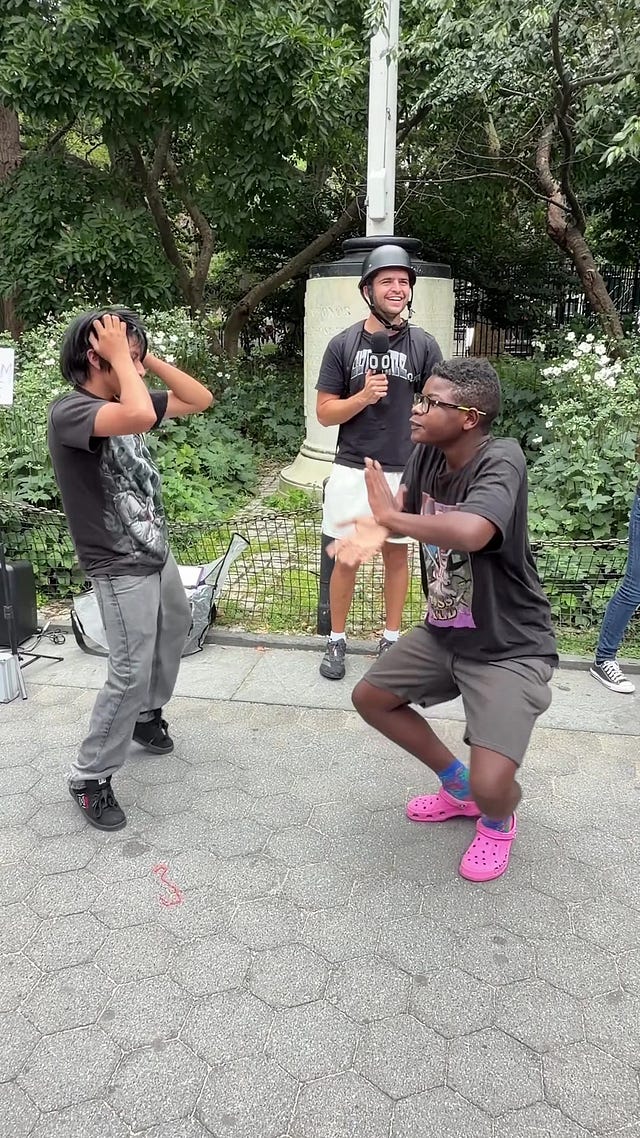
I don’t know man. You tell me what’s going on here:
 Tiktok failed to load.
Enable 3rd party cookies or use another browser
“Aura battles” seem to have originated in Brazil and quickly spread to the rest of Latin America. The idea seems to be that you “farm aura” by striking poses, doing dances, etc., and whoever has more aura gets bigger cheers from the crowd and thus wins? It became a big enough viral hit that politicians started trying to get in on it, and it has now made its way to America.
I guess we should just be happy the kids are actually going outside? And hey, if you don’t want to go to the aura farming contest, you can always hit up the toddler rave.
Boy, that Trump influencer story sure blew up
Last week, we essentially dedicated the entire Weekly Scroll to covering a developing story around the Department of Defense hiring MAGA influencers to work in official roles. The following day, The Washington Post published even more details about the Pentagon’s efforts to build a troll army made up of right-wing social media obsessives. Those efforts included even more accounts than previously realized, including several MAGA influencers who The Post reported have influence over policy.
Personally, I continue to find it extremely funny that MAGA finally found a real-life, no-bullshit conspiracy where there are actually secret feds getting paid by the government while trying to manipulate public opinion… but because of who it is, they now have to pretend that’s a thing they supported all along. Just remarkable.
In theory, there’s nothing wrong with hiring civilians, even influencers, as special government employees (SGEs). But what’s important is that these influencers were pumping out pro-Trump and pro-Hegseth talking points while not disclosing they were being paid by the government. A wise man2 once said:
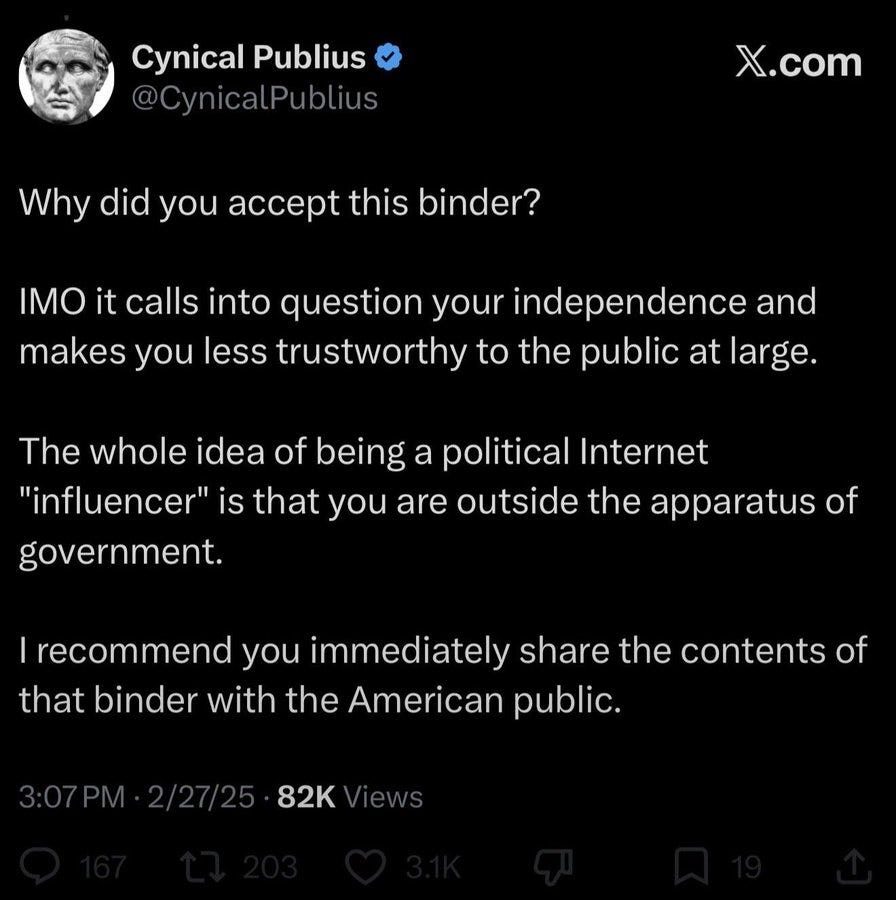
Cynical Publius, of course, ended up being exposed as Thomas Anderson, who earlier this year was working inside the apparatus of government. And his tweet above isn’t wrong! As Anderson wrote last year: “As soon as you allow yourself to be fed privileged information from the government, you cease to be independent.”
Frankly, it seems like a tactical mistake from the administration. As we saw last week with the DataRepublican saga, the people they chose to bring inside the tent are imbeciles. The only value those imbeciles have is that they’re nominally independent. They’re already spreading the messages you want, and paying them ruins the only shred of credibility they have.
But this is what you can expect from an administration where half the cabinet used to be talking heads. One gets the sense, watching the Trump administration operate, that nearly every single person in the administration would rather be doing viral political slop videos and podcasts than actually running the country. It’s why you see HHS Secretary Robert F. Kennedy Jr. yukking it up on cooking shows or Sean Duffy, the current secretary of transportation, going on podcasts with Stephen Miller’s wife to talk about how he still doesn’t trust the government.
They are the government! But they’d rather be podcasters!
In related news, the Mamdani administration is facing some heat because it too has been paying social media influencers to promote city initiatives. This seems like a less serious case, but the principle remains the same — the public deserves to know how and where the government is spending public money to promote its talking points.
No more chicken shop dates
Amelia Dimoldenberg, who shot to fame with her now-famous YouTube interview show “Chicken Shop Date,” has announced that after 12 years of eating chicken with celebrities, she’s calling it quits.
Alongside shows like “Last Meals” and “Hot Ones,” Dimoldenberg’s “Chicken Shop Date” helped chart the path for a new kind of talk show — more intimate, personal, and online, and using food as a way to distract the guest and make them appear more down-to-earth. Those shows are arguably now more important than classic newspaper interviews or late-night television guest spots in film and TV publicity tours.
Dimoldenberg is planning other projects, including a young adult drama series for BBC and a romantic comedy film with Amazon MGM Studios. Even still, her departure is a reminder that retiring from being an influencer is awkward, even at the best of times.
There’s no perfect way to step aside. In 2024, YouTube legend Tom Scott announced that he was stepping back from his channel because he was tired — he had released a video each week for 10 straight years. And after that announcement, he didn’t upload another video to his main channel for more than a year.
Matthew Patrick, host of the popular video game channel “Game Theorists,” retired but attempted to hand over his channels to a new roster of hosts.
Why is it so hard to step aside online? Film, TV, music, and other traditional art forms are fairly discrete. Albums, movies, or seasons of television are distinct things with specific release dates. Each project has an end.
Internet shows, by contrast, can keep going forever. That grind wears on people, especially because so many online shows are entirely dependent on the host’s charismatic presence. So there’s often no elegant way to wrap things up without just announcing “I’m done here.”
Good good? Bad bad.
Good Good Golf was doing so well. The YouTube golf channel had more than 2 million subscribers and last year attracted $45 million in investment to expand as a media and lifestyle brand. It had branded golf products in mainstream stores and a show on the Golf Channel. But last week, it managed to blow up much of its business with a single ill-conceived advertisement.
The video (which was quickly deleted but can still be found on Twitter) showed channel co-founder Garrett Clark knocking down his female colleague Alexis Miestowski, then looming over her and warning her not to touch his new Callaway golf club. The ad drew immediate backlash for making light of violence against women.
Callaway, a sports equipment company, ended its partnership with Good Good, the Golf Channel canceled a Good Good Golf show, retailers pulled Good Good-branded merchandise, and Good Good withdrew as a sponsor of a PGA Tour event. After botching the initial response, Good Good’s CEO and president have both departed the company.
It’s fascinating to me that the backlash to the ad was as severe as it was. To be clear, it’s not a great ad. But I remember when this sort of thing was par for the course3 for spots like light beer ads. Perhaps it’s more evidence that if there ever was an anti-woke, comedy-is-legal-again moment, we’re no longer in it.
Links
“Paid actors, AI writing”: Network operators are paying actors to become “ghost creators,” reading AI-generated scripts focused on U.S. politics, with most videos being rage bait on controversial topics in an attempt to stir up engagement. The content is low quality and full of misinformation, but viewers don’t seem to mind: the videos often get great engagement.
This is one of the crazier influencer stories I’ve ever read. A lawn care YouTuber was gradually coaxed by algorithmic success into a very different, much more toxic form of internet fame. Money quote: “‘I had to become the third baby,’ Greg said. ‘I had to turn myself into a baby.’”
The Reddit Ask Me Anything is no longer the exciting format it used to be, but I cannot recommend the official Wile E. Coyote Ask Me Anything enough. The best AMA in years, especially because he communicates entirely in signs.
Incredible niche drama: The subreddit for the controversial band Falling in Reverse has been taken over by the band’s front man, who began by posting a video titled “Dear Losers” and promising to “fuck up” and “expose” the subreddit’s users.

Posts
A story for another time — the increasing uncoolness of vanilla atheism content has direct links to today’s politics, as one camp created “Atheism Plus” which was a precursor to Woke 1.0, and a separate camp stopped watching epic takedowns of creationists and replaced them with epic takedowns of feminism and GamerGate.
Not actually a wise man.
Hehehe
The "stepping away from YT fame" thing is very interesting to me. I had a weird emotional/nostalgia experience maybe 4-5 years back with this. My son was born in '07, so when the Minecraft Let's Play boom was happening from about '11-'13, he was right in the prime age for it. So there was about 3-4 years there where I heard a bunch of these folks EVERY SINGLE DAY as the background noise for life.
Just through osmosis, I learned about their backgrounds, their lives, some of them got married, had kids, etc. and most of the YTers themselves were about 10 years or so younger than me, so it was like seeing a little brother or sister grow up.
But then a few years ago, a lot of these folks started just being done. Most of them had already kind of ramped down over the years, but I had never unsubscribed on YT. So for some of these creators, I would watch their 'goodbye' video and it was honestly a similar emotional experience to flipping through an old photo album. As they are going through some of their favorite memories from their 10-15 years of doing content, I can recall specific memories from when my now-in-college son had watched some of those videos and cracked with glee.
It kind of felt like if you found out your kid's favorite kindergarten teacher was retiring.
I do think that the golf ad was worse than some of those old beer ads. Like the one you linked to is lighthearted, fun, in the context of a football game, whereas the good good ad is honestly pretty dark & frankly pretty domestic violence coded