
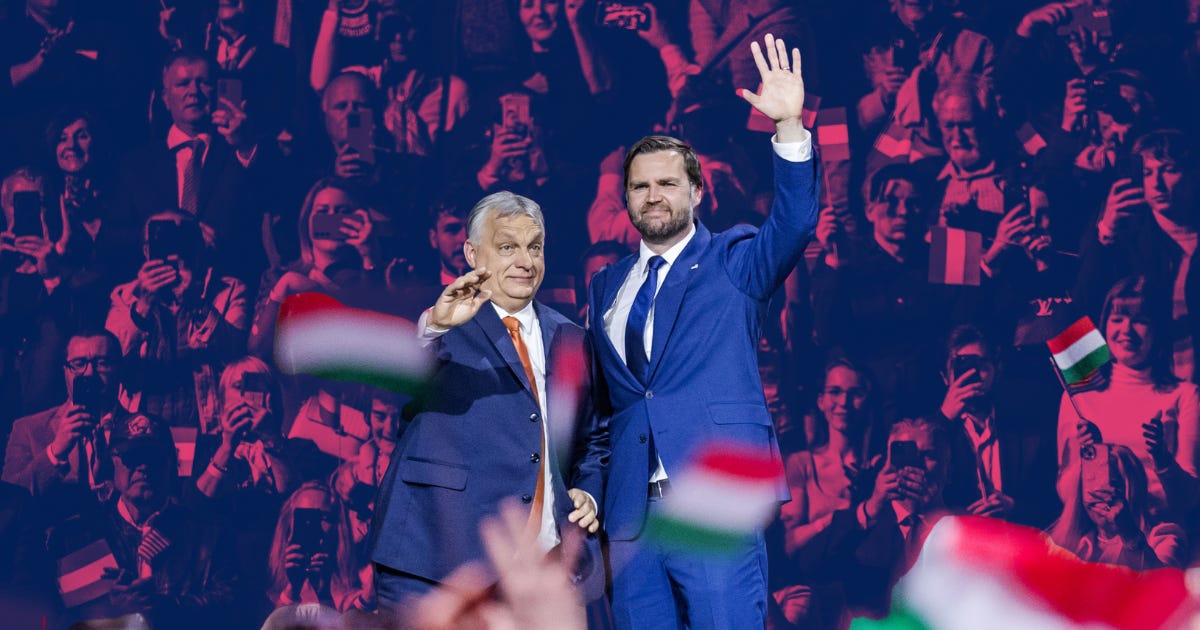
On Tuesday, Vice President JD Vance stood in a packed Budapest handball arena, leading a crowd of Hungarian voters in a call-and-response on behalf of Prime Minister Viktor Orban, a leader trailing by nine points ahead of Sunday’s election. Vance called Trump on speakerphone for the audience and praised Orban as “one of the only true statesmen in Europe,” all while framing his visit around “Christian civilization and Christian values.”
How did the vice president of the United States end up doing campaign work for a Hungarian strongman five days before an election? The answer runs through the most dangerous intellectual movement in American (and world) politics: postliberalism.
In Part 1 of this series, I documented how a visceral disdain for capitalism and economic modernity in general spawned the postliberal movement amid the failed apocalyptic predictions of “Peak Oil Theory” in the mid-2000s. In Part 2, I documented how postliberalism enlists the overtly fascist legal theories of Carl Schmitt to wage an attack on the Madisonian constitutional system of checks and balances and the classical liberal philosophical ideas that animated the American founding.
In this installment, I turn my attention to the postliberal movement’s search for a patron. The fundamental unpopularity of this movement’s ideas has sent them searching — to both the Catholic Church and Viktor Orban’s Hungary — for a top-down authority willing to override public opinion.
In his fiercely satirical novel The Screwtape Letters, C.S. Lewis depicted a fictional priest who bombarded his parishioners with self-righteous and yet seemingly contradictory messages about politics. This priest, he wrote, “is one day almost a Communist and the next not far from some kind of theocratic Fascism — one day a scholastic, and the next prepared to deny human reason altogether — one day immersed in politics, and, the day after, declaring that all states of this world are equally ‘under judgment.’”
Lewis used the example to illustrate how even the devout could succumb to worldly temptations. The titular character Screwtape, a senior devil advising a demon sent to earth to collect souls, quipped how the “Humans are often puzzled to understand the range of his opinions,” but “We, of course, see the connecting link, which is Hatred.”
Published in 1942, Lewis’ message reflects a particular historical context. And yet, over 80 years later, we see the same conflicting stances on full display in the postliberal movement.
Like Lewis’ priest, the relationship between postliberalism and faith is both complicated and eccentric. The postliberal scene often grafts itself onto the ultra-traditionalist Catholic doctrine of Integralism, a 19th-century theological movement that promoted a structured subordination of temporal political authority to the Catholic Church. Integralists see religion as the political instrument through which a postliberal society can be constructed — if only they could convince a religious authority to go along with their vision.
And therein lies the rub. Popular opinion poses a practical problem for this church-infused governing agenda, as most Americans — and indeed most Catholic Americans — do not support the use of religion to reorder our entire political system. The overwhelming majority of Catholics have no interest in postliberal Integralism, and many are likely unaware that it even exists as a movement.
The best data shows that practicing traditionalist conservatives comprise just 10% of the American Catholic community (which numbers about 53 million out of a population of 340 million), and Integralists are probably a tiny percentage of the traditionalist conservatives.
The postliberals argue that — whatever public opinion says — the worldly authority of government is inherently subordinate to the spiritual authority of the Church, seeking to return us to the time when medieval popes asserted their authority over kings (indeed, some prominent postliberals have even fantasized about a bizarre scenario where the Pope appoints Melania Trump as a Queen of America). There wasn’t any polling from that time, but I’d expect attitudes were different toward this sort of thing.
But beyond public opinion, what’s damning for the postliberal Integralist theorists is that the Catholic Church wants nothing to do with them!
Cardinal Christophe Pierre, the Pope’s Nuncio to the United States, recently published a scathing assessment of postliberal political doctrine, characterizing it as a far-right counterpart to the “wokeism” of the far-left. The document is a transcript of a speech Pierre gave in September 2025.
You may recently have heard of Pierre. The Free Press reported that he was invited to the Pentagon where he was subjected to a “bitter lecture warning that the United States has the military power to do whatever it wants — and that the Church had better take its side.”
Reportedly, the American officials went so far as to bring up the Avignon Papacy, an almost 70-year period of Catholic history when the popes resided in France under the influence of the monarchy.
Vice President JD Vance — another recent Catholic convert — was asked about this episode and claimed he did not even know who the Cardinal was.
In Pierre’s speech, he identified Deneen and Vermeule by name as the leading proponents of postliberal theory and suggested that their doctrines conflict with Catholic Social Teaching. As he explained:
“Post-liberalism, in its most radical versions, risks replacing liberal individualism with authoritarian communitarianism. In this framework, the person is defined almost exclusively by its belonging to a cultural or religious community, and its freedom is subordinated to the collective project.”
This postliberal vision runs afoul of longstanding Vatican teachings on the dignity of the individual. Postliberalism “creates the risk of imposing faith instead of proposing it,” thereby “violating religious freedom and the legitimate autonomy of the political sphere.”
While the “Church recognizes the importance of the community,” it is the community itself that “must always be at the service of the person.” Pierre accordingly pointed to a passage in Centesimus Annus, a celebrated encyclical letter of Pope John Paul II: “Authentic democracy is possible only in a State ruled by law, and on the basis of a correct conception of the human person.”
The Catholic Church’s visible unease with the postliberal movement remains little-discussed in postliberal circles, even as postliberals tout themselves as the arbiters of Catholic political thinking. It helps to recall that postliberal identity predates its relatively recent association with traditionalist Catholicism.
Vermeule coined the term “postliberal order” in 2011 in a rousing call for conservative legal scholars to act as “midwives” to a new constitutional system of executive dominance, built around the principles of Nazi legal theorist Carl Schmitt. He made no mention of Catholicism in this charge, for he was not yet a Catholic.
Vermeule converted to Catholicism five years later, appending Integralism onto his preexisting postliberal legal framework.
Vermeule explained this move in a 2017 essay where he advised the like-minded to consult “Carl Schmitt, a one-time Catholic who fell into apostasy,” as a political tactician (Schmitt himself ran afoul of the Church in 1926 over serial adultery and remarrying without obtaining an annulment, thereby getting himself excommunicated).
In an obscure 1923 essay, Schmitt recounted Protestant screeds that accused the Jesuits of fluid political principles, allegedly bringing them into league at various points with monarchist reactionaries, republican reformers, socialists, and even Bolsheviks. To Schmitt, Vermeule explained, the “supposed vice of Catholic flexibility was in fact its great political virtue” because the “universal jurisdiction and mission of the Church” requires a willingness “to enter into coalitions that would be unthinkable for anyone with a merely political horizon.”
For the Christian, this meant “viewing political commitments not as articles of a sacred faith, but as tactical tools” to promote “the cause of Christ” on Earth.
As with Vermeule’s outcomes-based jurisprudence, his political theology justifies its tactics by declaring his worldly goals to be inherently virtuous. It is not difficult to see how, in the words of Cardinal Pierre, this same postliberal vision “runs the risk of falling into authoritarianism and instrumentalizing Faith for political purposes.”
The postliberals’ inability to find spiritual patronage in the leadership of the Catholic Church has not deterred them, though. Instead, they have turned their attention to cultivating worldly patrons in government.
The Marxists of monarchism
In October 2021, postliberal theorist Gladden Pappin delivered a keynote address on the future of American conservatism at an obscure conference in Belgrade, Serbia. Pappin opened his lecture by recounting his personal journey from a professorship at the University of Dallas to his new residence in Eastern Europe. He described making a trip to Budapest, Hungary, the previous spring. Upon returning home to Texas that June, he found himself “surrounded by rainbow-colored propaganda at all times.”
He recoiled in anger at the Pride Month clothing catalogs arriving in his mailbox and at television programming where “every single commercial is like a lesbian couple or a gay couple or some other form of monstrosity.” The ultimate cause of this barrage, he concluded, was not the Biden administration or other usual suspects on the political left, but rather a capitalist corporate culture that “actively hate[s] the conservative lifestyle and want[s] to destroy it.”
Within two months of his return to Texas, Pappin relocated to Budapest. He accepted a new job as a visiting fellow at Mathias Corvinus Collegium (MCC), a nominally private training college set up by Hungarian Prime Minister Viktor Orban to cultivate an elite youth wing of his Fidesz political party. The institution is chaired by Viktor Orban’s main political strategist Balazs Orban (no relation), and its funding comes from a more than $1 billion endowment that the Fidesz government transferred to it, mostly out of publicly owned assets.
In Pappin’s telling, Orban’s Hungary offered him — and conservatism in general — a viable alternative to the corrupted culture he saw at home.
He depicted that corruption by way of a metaphor of an “ideal person” allegedly cultivated by the American consumerist economy — “a genderqueer person” who “lives in a pod at home and consumes a continuous stream of Netflix, pornography, obviously, and food delivered by mobile delivery services. You never encounter anyone else, and you just live in this cocoon of moral degradation plus endless consumption.”
And as with most postliberal attempts at social science, Pappin settled on economic libertarianism as the real culprit for his many flamboyantly articulated objections to modern culture.
American conservatives, he contended, desired a polity governed by natural law and traditional values, but they had outsourced their economic thinking to libertarians and empowered them to “construct a totally free economy” — an economy that sidelined traditional morals in pursuit of economic abundance. This alliance delivered the aforementioned “ideal person that’s created by the modern globalist capitalist system” — or, as Pappin dubbed it, “the globo-homo complex.”
Capitalism, he concluded, exists to cultivate a “lowly, morally degraded person whose being is a kind of tissue of different trendy things pumped at them by these large corporations.”
Looking past the bigoted rhetoric, it’s possible to interpret Pappin’s argument as a far-right reaction to the virtue signal-obsessed cultural manifestations of left-wing “wokeness” over the last decade.
Scholars from across the political spectrum have documented how the left-leaning identity politics of elite academia spilled out of the faculty lounge and into mass media, K-12 education, and even the corporate board room. Sociologist Musa al-Gharbi The Argument columnist Matt Yglesias dubbed this the “Great Awokening” and dated it to the early 2010s. In my own work, I’ve documented how faculty political opinions underwent a hard left turn in this same period and flooded mainstream dialogue with previously obscure jargon from the Critical Race Theory academic literature.
Although the leftward cultural shift is real, Pappin’s diagnosis of its causes misses the mark. Rather than investigating its sources in the classroom, he defaulted to the ideological anti-capitalism and disdain for economics that undergirds the postliberal movement.
Deneen made a similar move in his own cultural diagnosis. In a 2023 interview, he attributed wokeness to a hypothesized merger between the 1960s sexual revolution and a “neoliberal capitalist ethos” in which everything is commodified to maximize consumption and material comfort.
In a curious twist, Marxist academic concepts are not the cause of this development but a partial solution. As Deneen put it:
“[M]any of Marx’s analyses of capitalism are really spot on. I mean, the opening pages of the Communist Manifesto, a conservative can read those and think, “Wow, this is the most powerful conservative critique of capitalism ever written,” because he describes exactly how capitalism operates to undo—to just liquefy all human relationships, all traditions, all customs, all places.”
To postliberals, the main problem with Marxism is the direction that Marx took it. He accurately diagnosed the contradictions of capitalism, only to err by offering atheistic socialism as the remedy. Instead, they desire an Integralist state that takes a similar heavy hand in the economy but directs it toward the “common good” of their own religious prescriptions.
C.S. Lewis’ priest thereby seamlessly transitions from theocracy to communism and back again, all the while projecting his blame and hatred onto the enemy of economic liberalism.
The Budapest Connection
Postliberals turn from crisis to crisis trying to prove their diagnosis — liberalism has failed — and hock their solution: destroy liberalism. But the crisis is always a pretext, and when it passes, they just move on to a new cause to anchor their movement.
For Deneen, it was a failed prediction in the mid-2000s that the world was running out of oil and capitalism was soon to collapse under its own contradictions — obviously, there is still oil, but the anti-market framework he built around it survived. For Vermeule, it was 9/11 and the argument that constitutional checks on executive power were dangerous luxuries in wartime.
Apparently, we needed to override our system of checks and balances specifically in response to 9/11, yet even as that threat has receded, Vermeule has yet to abandon his cause.
Pappin’s story is no different. His own interest in what would become known as postliberalism traces back to his time as an editor of Harvard’s conservative student newspaper, the Salient, in the early 2000s.
During his tenure, the paper took a hard right turn on social issues, presaging the very same arguments he would deploy two decades later.
One of his editorials complained that George W. Bush has “done virtually nothing to stop the feverish assault of homosexuals and libertines on what remains of the nation’s moral fabric,” while another lamented how, “Women, fully liberated by the sexual revolution of the 1960s, find themselves thrown into the corporate world against their better judgment.”
Pappin’s activities caused turmoil at the paper, prompting other conservative writers to resign and embroiling the publication in his own one-man campaign to rehabilitate the Secret Court of 1920 — a now-notorious incident when Harvard expelled a group of students over allegations of homosexuality.
Throughout his undergraduate social crusading, Pappin developed a scapegoat for the cultural “degeneracy” he seemed to find lurking beneath every stone. It all traced back to the libertarian economists.
He blamed “the introduction of the laissez-faire mentality into the moral realm” for the erosion of the “common good” and railed against the Bush-era Republican Party, which in his telling, pushed a “narrow vision of conservatism restricted to quibbles over economic policy, all the while ignoring man’s necessary moral foundation.”
Even today, these diagnoses strike the reader as more than a little off-base. The Bush presidency pursued aggressive foreign policy agendas and dabbled in social conservatism and public religiosity, but the administration that decided certain companies were “too big to fail” was not a bastion of laissez-faire economic thought.
A decade later, though, Pappin was still on his anti-economics kick, and he set out to purge the discipline from the conservative movement entirely.
In 2017, he cofounded American Affairs as an academic journal for postliberalism. The publication’s writers draw from a recurring cast of the initiated who converge to debate the minutiae of their arcane ideology. When it ventures into commentaries on the broader conservative movement landscape, economic libertarians become the recurring scapegoat for the American right’s political setbacks.
In a 2020 “history” of postliberalism for the journal, Pappin blasted 20th-century American conservatism for its purported “devotion to unregulated markets and libertarianism“ — a devotion that allegedly caused “a series of financial crises, the loss of U.S. manufacturing, and a completely demoralized society.” This string of evidence-free assertions carried a parallel lamentation, as “many conservatives continue to speak as though libertarianism is the solution.”
The resilience of free-market economics in the face of Pappin, Deneen, and Vermeule’s attempts to purge it from the American right thus became the seed of another realization in postliberalism’s evolving tactics. Their primary impediment was not the lack of a willing patron in the Vatican, nor even the left’s cultural stranglehold. It was America’s libertarian streak and its economic framework, built around the ability of “an individual consumer able to freely transact in the marketplace.”
To escape this obstacle, Pappin turned to Viktor Orban’s self-proclaimed “illiberal democracy” as the new locale in his search for a postliberal society.
He waxed in awe at how Orban pursued a conservative version of centralized economic planning — how instead of constraining government interference, he wielded it toward social designs that aligned with the postliberal “common good.” By example, Pappin touted Orban’s efforts to reverse declining birthrates by giving generous government grants and public support for families with children.
In time, he predicted, Hungary would reorient its economy around the traditional family rather than the individual, perhaps by “mandating legally some minimum family wage” to incentivize single-salary households with a male breadwinner and a stay-at-home wife tasked with child-rearing.
The welfare state could be repurposed to incentivize this family structure, and the government could strategically invest in economic sectors that reinforce desired attributes of culture, tradition, and religion. Such policies, Pappin concluded, were “completely unthinkable in the United States context for a variety of libertarian reasons.” He reiterated the point when challenged by a Serbian interlocutor, declaring that “libertarianism is always wrong.”
As the Belgrade conference’s organizers summarized Pappin’s thesis, “The only major obstacle to implementation of [his] project” in the United States “is precisely that stubborn libertarian ingredient of the American tradition.”
Hungary, by contrast, had no such ingredient. And Hungary could make Postliberal Paradise a reality.
Orban’s government reciprocated its embrace by the postliberal movement by opening up its public treasury to the cause. After two years at MCC, Pappin received a promotion to lead the Hungarian Institute of International Affairs (HIIA) — a research wing of the government’s foreign affairs ministry.
These and other Orban-controlled institutions now provide a goulash train of emoluments and subsidies to the postliberal movement. They bring postliberal academics to Hungary for speaking tours and conferences, and they deploy public resources to a network of postliberal think tanks in Europe and beyond.
In addition to Pappin, Deneen is a recurring visitor to Budapest. So is Chad Pecknold, a theologian from the Catholic University of America who co-writes for their group newsletter, the Postliberal Order. Journalists Sohrab Ahmari and David P. Goldman, both converts to the postliberal movement who are known for their economic nationalism and reactionary cultural views, make regular visits.
In 2024, HIIA hired Philip Pilkington, a U.K.-based postliberal podcaster with links to the fringe Modern Monetary Theory movement, to serve as its in-house macroeconomist. He has since moved to Budapest and published a postliberal economic manifesto. It features a blurb from Deneen and predicts the coming collapse of the rules-based international economic order while not-so-subtly cheering along this outcome.
As for Pappin, he appears to have parlayed his new position into something of a postliberal influence broker for the Orban regime. He befriended JD Vance in the 2010s before the latter ran for the U.S. Senate, and he has brought a parade of Hungarian government visitors to greet Vance in Washington.
In November 2025, Pappin traveled to the White House as part of Viktor Orban’s delegation to negotiate exemptions from U.S. sanctions on Russian oil from President Trump. That same evening, Vance hosted Pappin, Viktor Orban, and MCC chair Balazs Orban for a private dinner at the Vice President’s residence.
Aided by access to Vance, the Hungarian branch of the postliberal movement has dramatically strengthened its own crossover ties to the MAGA universe. In 2023, MCC chair Balazs Orban published a postliberal political treatise built around his government’s model. He hit the Young Republican club speaker circuit in the United States with Pappin to tout the lessons of the “Hussar Cut” for our own political system.
Pappin himself took the stage at the National Conservatism Conference to promote Hungary as a model for reforming the United States’ education system. He has also penned a policy brief for Oren Cass’ American Compass on how to implement a suite of “pro-family” economic reforms in the United States that resemble the Hungarian model.
Hungary’s experiment with postliberal economic planning has hit headwinds of its own, though. Under Orban, the country’s economy is mired in economic stagnation, high inflation, and a string of corruption scandals. Its attempts to increase the birth rate through government subsidies have failed, and its rankings have dropped precipitously on multiple measures of market openness and the rule of law. As of this writing, Orban trails his challenger in the polls ahead of an April 2026 election.
The postliberals have noticed, with Pappin and Pilkington repurposing their blogs and social media in recent weeks to boost the cause of Orban’s reelection — and preserve their own intertwined careers.
The West hates Orban, Pilkington declared, “because he subordinates Hungarian capitalism to the common good.” Other messages spread wild conspiracy theories about manipulated polling and EU attempts to rig the election against Orban. If you believe that the liberal order of the West is collapsing from its own decadence and its collapse is inevitable, any political setback to postliberalism can only come from the workings of nefarious forces.
The same postliberals also appear to have called in a favor, with Pappin’s old friend JD Vance visiting Budapest to campaign on behalf of Orban.
At a joint press conference in Orban’s monastery headquarters overlooking the Danube, Vance told the Prime Minister that “the president loves you, and so do I.” At the handball arena for a “Day of Friendship” rally, the vice president of the United States led the crowd in a call-and-response and urged Hungarians to go to the polls for Orban, all while attacking EU officials for “one of the worst examples of foreign election interference that I’ve ever seen.”1
I guess they teach irony at Yale Law School.
The postliberal movement, which began two decades ago as a few academics raging against economists and fantasizing about medieval church-state relations, has now captured enough of the American executive branch to send the vice president on an election errand to Budapest. Whether it will be enough to save their paradise is another question — Orban still trails his challenger in the polls.
Come Sunday, C.S. Lewis’ priest may find himself in need of a new patron.
Correction: An earlier version of this post misattributed the coining of the phrase “The Great Awokening.” Sorry, Matt.
Recommended reading:


The next morning, he repeated the “foreign interference” charge in a special event for Fidesz students at MCC, organized by Balazs Orban and Pappin.
This is great. More Phil!
Need to find a fake patronage sinecure type job like these guys 🤔🤔🤔