

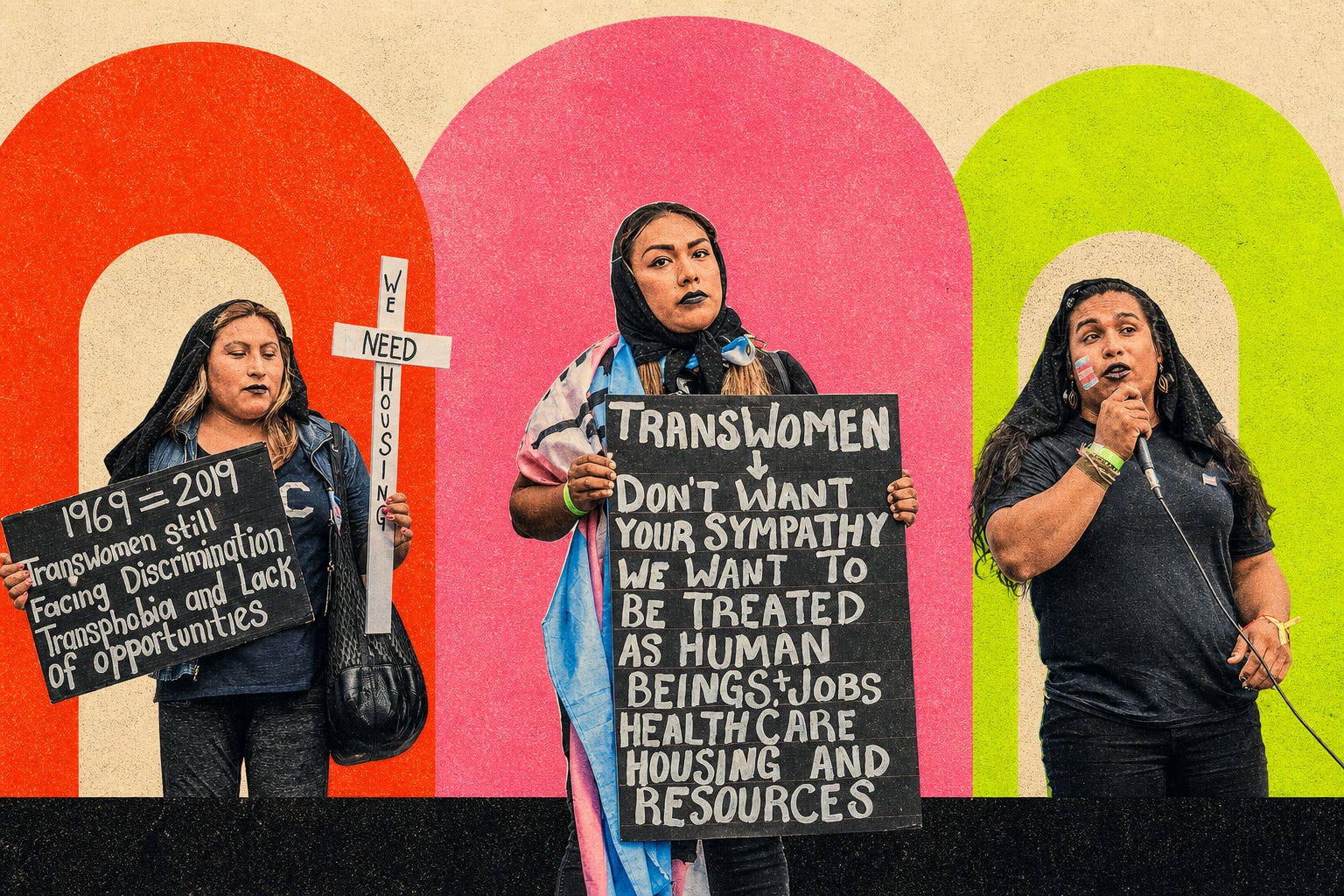
Editor’s note: The first essay The Argument ever published asked, “How do we live with each other?” To mark our first anniversary on August 17, we’re returning to that founding question with a series about what we owe people whose beliefs and choices we may find difficult to accept or even understand. Over the next six weeks, familiar voices at The Argument and new voices alike will approach that question from different angles.
Cassie Pritchard opens the series by confronting the painful reality that many of the people with whom she shares a country will never believe she is a woman. Rather than seek their affirmation, Pritchard demands something less intimate and more important: That they defend her freedom and security anyway.
To receive every essay in this series, subscribe today.
- Jerusalem Demsas
I don’t think of myself as a particularly respectable trans woman.
I didn’t start taking hormones until I was 30; I’m a lesbian; I don’t pass as cis female, nor do I make much effort to modulate my voice to sound more feminine. Not to put too fine a point on it, but I’m also kind of weird-looking. Conventional beauty is the single biggest weapon in a trans woman’s arsenal for assimilation and respect, and I’m decidedly outgunned in most situations.
I say all of this to explain why I find it so odd that other trans people regularly criticize me for promoting “respectability politics.” Their assumption seems to be that I’m one of the small handful of trans people who disagree with the premise that trans people actually are our transitioned sex. But I do not. Indeed, I can’t really imagine why someone would bother going through hormone therapy, hair removal, and difficult surgery recoveries if they didn’t think all that work resulted in a genuine and thoroughgoing transformation.
The core of my contention is that we need to move away from airy, philosophical debates about the ontology of sex and gender and instead ground our advocacy in common values and clear moral narratives. After years of slogans like “trans women are women” functioning as progressive shibboleths — so rarely explained, so rarely justified through persuasion — it’s time to sideline them from our mass politics. That would mean fewer condescending explainer videos about what gender really is and more straightforward appeals to individual liberty, pluralism, tolerance, care for the disenfranchised, and parents’ rights to make medical decisions for their children (including the right to choose youth gender medicine!).
I am not interested in policing what cis people think about me. Many think of me as a man. Others think of me as some strange liminal creature between male and female, a “secret third thing,” as the meme goes. A few (I tend to believe very few, but I’m a bit pessimistic by nature) genuinely think of me as a woman, and that’s lovely! I prioritize those people as friends or partners, as human beings generally seek out those who validate our self-conception, who respect our capacity for self-realization.
That said, what makes for a good social life and secure friendships is not necessarily what builds the kind of popular coalitions needed to secure political and material rights, like access to health care. Pro-trans positions have taken a beating over the last decade. For example, while Pew Research Center found that majorities of Americans opposed bathroom bans in 2016, recent polling has found a complete reversal, with majorities of American voters supporting these restrictions: A February poll from The Argument showed 52% of respondents supporting such bans. I can’t help but think that part of the explanation for this whipsaw in public opinion is that we have built a pro-trans advocacy movement too interested in disciplining thoughts and words — and Americans really dislike a scold.
It’s not just bathroom policing where we’ve lost ground. Even bigger majorities were in favor of banning youth gender medicine and barring trans youth from competing on K-12 sports teams that conform to their transitioned sex.
These majorities reject trans-specific policies that are dependent on a firm belief that trans people like me are our transitioned sex. Sports is a good example: If you believe trans girls are girls, then even if they possessed a generalized advantage over cis girls, excluding them would make no sense. That axis of difference would be orthogonal to the “girls’ sports” classification giving them the right to compete — it would be like forcing especially tall girls to play basketball on boys teams as a remedy for their innate advantage over shorter players.
To put it more bluntly, I see the majority who oppose sports inclusion as a kind of minimum percentage of Americans who reject the ontological premise of transition — that we really are, or can become, the gender we transition into.
Many trans people find this incredibly bleak or downright hopeless. Because we have so thoroughly premised our claims to rights and inclusion on the logic that “trans men are men, trans women are women,” it can feel like an irrevocable defeat to even acknowledge that large majorities of cis people disagree with our beliefs about the nature of sex and gender.
But the same poll from The Argument also found 63% of voters in favor of laws to protect trans people from housing and job discrimination. Other polls have delivered essentially the same result: Majorities of Americans still support classic, familiar civil rights protections for trans people that closely mirror the rights won by other minority groups through persuasive political struggle.
These strong pro-civil-rights majorities point to the way forward: It’s not merely that we can secure some protections while giving up our (presently) losing issues as lost causes. Almost the entire pro-trans platform can be defended in the moral language of civil rights and American pluralism, rather than via the epistemics of gender identity.
As an example, letting me use the women’s bathroom doesn’t have to be premised on your agreeing with (or politely humoring) my self-conception. Instead, you might oppose bathroom bans because the enforcement regimes are necessarily open to abuse by busybodies and delusional conspiracists who think hordes of cis people are secretly trans.
Do you really want to get arrested because a crazy person accused you of being in the wrong bathroom at the airport? Sure, you can prove your natal sex in the end, but in the meantime, you’ve had to endure a humiliating, invasive, and stupid ordeal to get there — and missed your flight in the process.
Such an argument is classically American, in my view: against intrusive government overreach and in favor of sharing public space with people we may not agree with, like, or feel kinship with. The freedom to pee in whatever bathroom you want may seem trivial compared to free speech or religious practice, but, like so many freedoms, curtailing it requires a distinctly un-American apparatus of mutual surveillance, control, and nuisance.
It’s the kind of busybody policymaking that might jibe with, say, the English nanny state, but not here in the land of the free.
These are urgent questions because trans people face real material insecurity: We are about five times more likely to be unemployed than the general population, we make substantially less money when we are employed, we face housing discrimination, and we face concerning levels of violence. Maybe most distressingly of all, the president and his party are assailing us with a wave of punitive policies, including barring us from the military and attempting to restrict youth gender medicine. Though the administration has suffered setbacks on the latter, 27 states currently restrict youth gender medicine.
These very real threats make it essential to have coalitional arguments that foreground civil rights if we want to restore public support for pro-trans policy. This can benefit both trans people and a left-of-center coalition anxious about how our rights might be an electoral drag.
I analogize it to the bedrock American principle of religious freedom: Most Muslim or Mormon Americans don’t premise their rights and dignity on everyone necessarily sharing their religious convictions, but on a mutual ethic of noninterference and nondiscrimination. If trans people can make the same kinds of arguments — that we have a common interest in mutual respect despite different beliefs about gender — we stand a chance at rebuilding the coalitions we need for our security.
Respectability without respect
Still, my opening question remains: Why, exactly, do my beliefs about effective political communication so regularly draw this accusation of “respectability politics”?
The logic of respectability politics is that, by assimilating to hegemonic cultural norms, the minority group in question will be seen less as a threatening and deviant “other” and instead as a harmless, superficially distinct extension of the mainstream. The term was coined by historian Evelyn Brooks Higginbotham to describe efforts to “reform ... individual behavior and attitudes both as a goal in itself and as a strategy for the reform of the entire structural system.”
Classically, this has meant things like Cosby-style advice to young Black men to pull up their pants, efforts to use “correct” English in place of Black vernacular, and so on. In the LGBT rights context, it has generally meant publicly sidelining behaviors like cruising and orgies in favor of the respectable image of two gay people in a monogamous marriage raising children in a house with a white picket fence.
But here’s the thing: I like lesbian orgies, my sex-worker friends, and my natural baritone voice that juxtaposes strangely (for most people) with my 540 cc breast implants. I long ago realized that passing as a cis woman was not possible for me — and I wasn’t willing to put in the work even if it were. I’m trans, I’m odd, and I don’t have much interest in hiding either fact.
The “respectability politics” accusation is all the more confusing because, to my mind, requiring cis people to agree that “trans women are women” seems precisely to be a demand for respect — in this case, a respect for the ontological status of our transitioned sex. Doing that while decrying respectability politics — the effort to secure the majority’s respect by appealing to its normative sensibilities — is an incoherent position.
The position of my accusers seems to be that the majority’s respect is politically essential, that we need to secure it as the foundation of our political advancement. But the very same people argue that we have a moral duty to eschew any effort to actually cultivate that respect by appealing to majority sensibilities.
It’s the solicitousness of respectability politics without any of the practical upside. We might call this degenerated form of respectability politics “respect me!” politics instead.
Anyone who has spent time in progressive or leftist circles is immediately familiar with this dynamic: an unyielding commitment to rhetorical hostility coupled with a demand for affection from the very people they’re attacking. There seems to be a belief that respect, affinity, or solidarity can be enforced through disciplinary measures like shaming, belittling, and ostracism.
While, mercifully, this rhetorical strategy seems to be on the decline on the broader left (perhaps best exemplified by Zohran Mamdani’s refrain that we need to “[go] from lecturing to listening”), it remains alarmingly pervasive on trans issues. This was particularly evident in the online reaction to The Argument’s February poll.
The survey simply reported the dire facts about public opinion on trans issues, yet it resulted in a wave of backlash in which commenters accused Lakshya Jain, The Argument’s director of political data, of “preemptive surrender” and “suggesting Dems abandon trans rights.” One of the top Twitter responses captured the anti-democratic implications succinctly: “fuck whatever a poll says.”
Whenever I make the case to other trans people that we need to stop making demands on cis people’s feelings, beliefs, and speech — and instead appeal to common principles like liberty and equality — I am met with choruses asking me, incredulously, “Where’s your self-respect?” This further complicates the picture; it seems that self-respect is curiously tied up in the active antagonism of the majority.
On the one hand, the insistence on securing cis people’s respect for our gender identities betokens a kind of insecure, almost conservative premise shared by classic respectability politics. On the other hand, those committed to antagonism recognize that there’s something a bit beggarly in this premise, something self-consciously weak.
Instead of reconciling the tension between these two urges — for self-respect and pride on one side, and longing for the majority’s normative respect on the other — by simply choosing one and following through, “respect me!” politics amalgamates both into a miserable chimera. The resulting creature craves approval but loathes the prostration required to secure it; instead, approval is demanded but never obtained, because you can’t actually browbeat people into liking or respecting you. It is a self-defeating urge, simultaneously haughty and insecure.
The way I choose to resolve this problem is not by denying its existence or capitulating to it. Instead, it is precisely because I believe trans people are not generally respected as our transitioned sex that I believe we must shift to an argument for our rights and safety premised on moral narratives and values that sit apart from that question entirely.
You do not need to believe I really am a woman to think I deserve protection from employment or housing discrimination. You don’t need to believe people really can change their sex to think that trans people deserve access to the primary kind of medical care that resolves the empirically documented harms of gender dysphoria. You do not need to think gender is a spectrum to think that parents and doctors — and not the government — should be making health care decisions for their children.
I’m willing to be part of a coalition where many people do not believe the things I believe about transsexuality and gender. I’m not thrilled about it, and it’s often dispiriting. But I am willing to tolerate those beliefs, even when they’re uncomfortable or painful, for the sake of obtaining our freedoms and material security.
Without improving trans people’s actual security, I don’t think we’ll ever arrive at the kind of social acceptance that will eliminate the insecurities at the heart of “respect me!” politics.
Recommended reading:
How to win a culture war from behind

Marriage equality won by changing the question. Trans rights activists are fighting on the wrong terrain.
Why Americans think other Americans are bad people

The U.S. is the only country where the majority of people rated the morality of people in their country as bad.

A while back, it occurred to me that due to the sheer diversity and complexity even of LGBT-friendly gender theories, it’s functionally impossible to ever have even a plurality agreement on gender.
The only workable way forward is to promote a gender-theory agnostic libertarian formulation of rights: “None of us has to agree with each other about gender in order to simply leave each other alone”.
"You don’t need to believe people really can change their sex to think that trans people deserve access to the primary kind of medical care that resolves the empirically documented harms of gender dysphoria." -- and also, you don't have to agree that trans medical care is a good idea to think that adults get to make their own medical decisions!