


In today’s hyperpolarized, hyperfactionalized political climate, one of the most reliable ways to get hosannas from every corner of the internet is to fulminate against the tyranny of America’s elderly.
Case in point: Last week, a reporter for the San Francisco Chronicle tweeted out a photo of a local town hall where residents were gathered to discuss a proposed set of new housing developments.


As one would expect, the audience members were… grayer than the average San Franciscan.
This spurred some normie YIMBY arguments about how community meetings are unrepresentative venues for political debate, as well as some ruder commentary about how old people suck and we should get rid of them.


The implication is that we live in a gerontocracy — a society where American seniors are not only clogging community meetings with their unreasonable opposition to new development but also hoarding power and opportunity in every profession and at the highest levels of government.
There are, of course, some valid concerns about the fiscal consequences of population aging and some very real cases of elected officials who have overstayed their welcome. It’s also just true that, from the C-suite to the legal profession to academia, there are more old people hanging on longer than ever.
It’s hard not to sympathize with ambitious young elected officials tired of waiting for plum congressional seats to open up or academics angry that it’s so hard to get on the tenure track these days. But it’s worth reflecting that the primary reason you see older people hanging on to prominent roles these days is entirely benign — Americans are living longer.
This fact is broadly known, but I think the specific dynamics are a bit misunderstood and underrated. A recent working paper by Liran Einav and Amy Finkelstein, for example, looked at nearly three decades of data from the Medicare Current Beneficiary Survey and reached the conclusion that, while declining mortality and morbidity has increased Social Security costs by 14% per beneficiary, it has only driven up per-beneficiary Medicare costs by a much more modest 6%.
Why the mismatch between the two programs? Well, it’s because people aren’t just living longer; they are living better. The authors wrote that the increase in expected lifespan since 1992 has featured additional years that “were entirely healthy — free of physical or cognitive limitations — while the expected amount of time spent with severe health limitations fell by about 30%, reducing expected lifetime nursing-home and home-health use.”
That’s boring accounting stuff, far removed from the fun of hot takes about elderly opportunity hoarding. But it’s very relevant to how we ought to understand the gerontocracy problem. If people are living not only longer, but specifically longer in good health, then of course they are going to linger longer in leadership positions.
And, of course, not all of those people will retain their mental faculties or know when to call it.
Five members of the House of Representatives and one U.S. Senator have died in office this Congress with many cases involving members who had been ill or infirm for a while and missed the opportunity to stand down in a timely manner.
That said, congressional deaths are not exactly a new phenomenon. There was a run of about 50 years before the Civil War in which at least five members died in office in every single Congress. Congress was also much smaller back then, so the mortality rate was consistently a lot higher than in the present Congress. Further, dying members were younger, on average, than today’s dying members — but that’s because people died much younger 200 years ago.
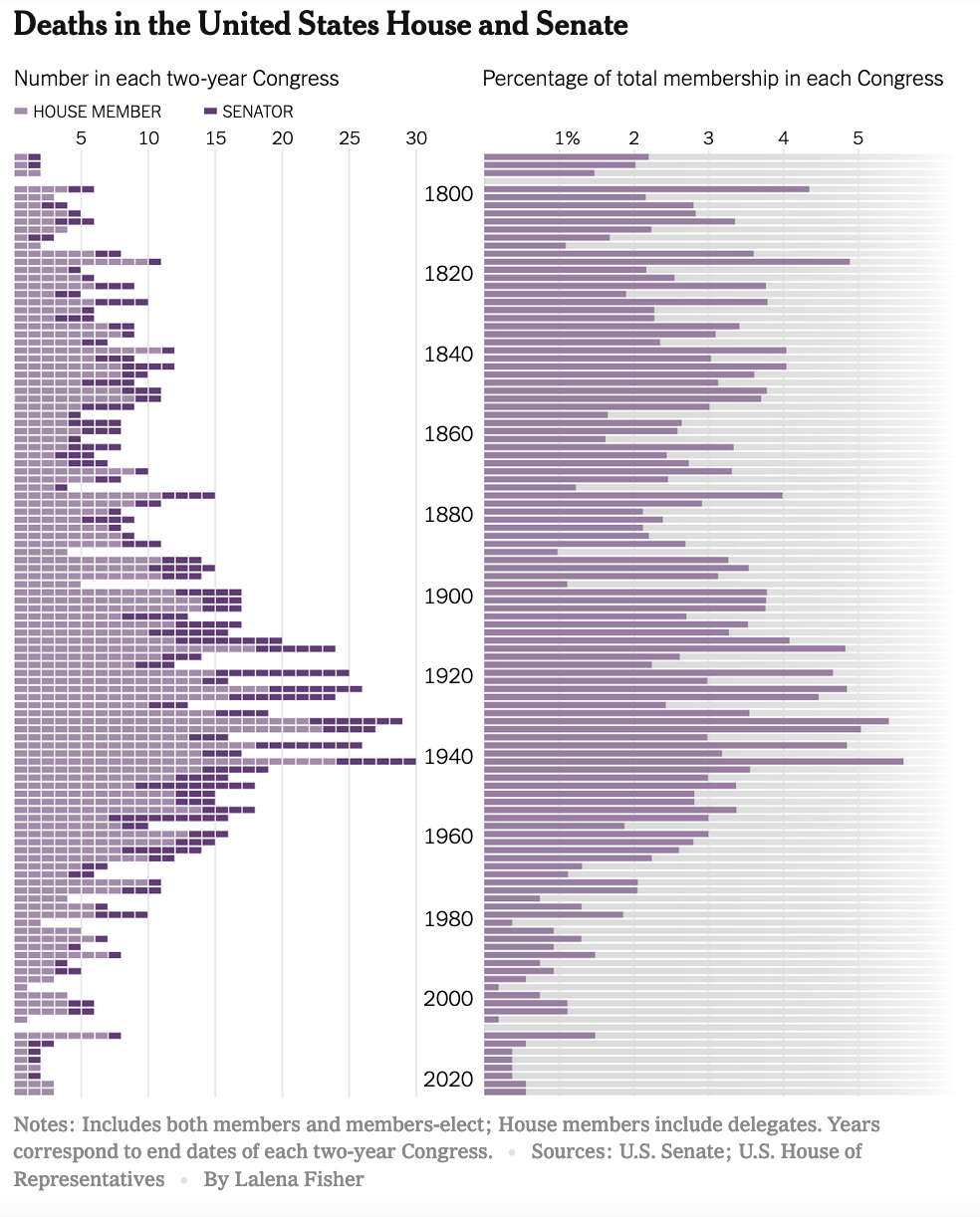
Congressional mortality reached its peak in the 1930s and 1940s when you would routinely have over 20 members dying in a single Congress. As Slate’s Ian Prasad Philbrick wrote in April, the past few Congresses have seen a genuine uptick in deaths. But that’s because the 2010s had unusually low death rates, not because the 2020s have had unusually many.
Of course, death is a crude measure of impairment. But paired with the finding that, population-wide, people are living more unimpaired years, the fact that the congressional death rate is lower than normal, not higher, should give us some confidence that things are OK on average.
Similarly, the fact that the “gerontocracy” trend isn’t limited to politics or academia but includes corporate America ought to be viewed as reassuring.
The business world is quite ruthless and competitive. Changes in corporate legal structure over the past 40 to 50 years have only made it more cutthroat. An executive team that doesn’t deliver shareholder value is liable to get fired by the board of directors. If inertia, office politics, and the old boys’ club prevent that from happening, these days, there are any number of activist equity funds eager to sweep in, buy up companies with depressed share prices, and make changes.
Nobody should be utopian about the efficiency of real-world markets, but unless you believe American finance has become cuddlier over the past generation, you ought to acknowledge that we have less reason than ever to think that for-profit companies are irrationally coddling the elderly. We have more old managers than before because it makes business sense, which is a reassuring signal about parallel trends in other fields.
Or consider the medical evidence on dementia. Due to rising life expectancy and lack of good treatments, widespread dementia is a problem that is very much still with us. But dementia rates are falling at all ages. People in their early 90s today appear to have sharper mental acuity than people who were 10 years younger in the 1980s.
If “gerontocracy” just means that a higher proportion of people live into their 70s while being in much better mental and physical shape than the septuagenarians of the past, then what is there to complain about?
We should complain about real problems
Well, of course there is plenty to complain about in life. Renters, disproportionately young, have taken it on the chin due to America’s accelerating housing shortage. By the same token (and for essentially the same reason), it has become harder for young people to buy homes.
These are real problems, and you can lay them at the feet of the elderly in the sense that the relevant policies were mostly put in place in the 1970s and the 1980s when today’s old people were around and today’s young people weren’t. But if you look at the various state-level YIMBY success stories in recent years, it’s not as if they were achieved by somehow disempowering old people.
Indeed, America’s oldest state, Maine, passed sweeping housing measures last year that have the state now exceeding its annual housing production goals. The second-oldest state, New Hampshire, also passed sweeping reforms.
But, of course, the battle for housing abundance is not yet won. People have widespread erroneous opinions about the relevant economic issues, and there is widespread irrational dislike of developers. Trying to tackle these problems directly with better arguments, new cultural products, and political organizing seems a lot more fruitful than complaining about gerontocracy and needlessly antagonizing old people.
Now, it’s true that if we ameliorate the housing shortage, we will likely see people forming new households and new families at younger ages. This will lead to at least somewhat more children being born and alter the demographic trajectory of the country in a more youthful direction. But that’s to say that population aging is in part an effect of other bad policies, not that the existence of old people is bad.
Similarly, a very real problem in Congress is that the vast majority of members do not face competitive general elections. This allows infirm members to linger in office longer than they should. This is bad. But the badness is not unique to age. Democratic House nominee Darializa Avila Chevalier seems like a crazy person and is all but guaranteed to prevail in her general election due to the low levels of electoral competition, but she’s definitely young.
The tendency for political power to be controlled by low-turnout primaries, in other words, is worth fixing. It would address some legitimate concerns about “gerontocracy” while also addressing a bunch of legitimate concerns that have nothing whatsoever to do with age.
Meanwhile, though America’s frustrated young academics yearning for greater upward mobility cut a wide swath in the discourse thanks to their strong verbal skills and abundant free time, I’m not persuaded that this is a legitimate social problem. The fundamental reason that it’s hard to get a job as a historian is that there is not a lot of demand for the services of historians. This is aggravating for the specific people involved, but there are lots of fields where the number of people who would like to do the job exceeds the number of positions actually available. And there’s plenty of the opposite:
America really could use more good K-12 teachers. We could use more people with the kind of progressive values prevalent in academia working as police officers. We could use more research scientists.
For better or worse, in life, you need to find something to do that is useful to other people. Looking at declining demand for certain categories of academic work and pronouncing it gerontocracy is unhelpful.
The good news about the bad news
This all brings us back to the boring green eyeshades. The United States committed, some time ago, to meeting the financial and medical needs of its elderly population. As the older share of the total population has grown, this commitment has become increasingly burdensome.
That’s a genuine problem.
Russ Greene, a right-wing economic commentator and executive director at the Prime Mover Institute, coined the term “Total Boomer Luxury Communism“ to describe the mass redistribution of wealth from younger families and workers to the elderly. In many ways, his argument is similar to that found in Samuel Moyn’s recent book Gerontocracy in America. But as a right-wing rather than left-wing guy, he is willing to bite the bullet and say we need to cut entitlement spending.
But to a certain extent, the gerontocracy frame makes this harder rather than easier to solve.
For starters, the simple fact of the matter is that the political durability of Social Security and Medicare is not a question of older people exerting raw electoral power.
These programs are broadly popular with all age groups in the electorate.
Both programs are seen as working well, with funds seen as going to largely worthy, sympathetic recipients.
Voters are also just fairly change-averse. If you proposed creating new programs on the scale of Social Security or Medicare, voters would be alarmed by the vast new spending. But these have existed for a long time and have grown slowly, so instead, the idea of cutting them alarms people.
Logically, though, if the problem is that people are living longer, then a big part of the solution should be to ask people to work longer.
I used to worry a lot about this idea because the prospect of compelling nice-but-frail old people into the labor market feels ghoulish. But understanding that “gerontocracy” is just downstream of the reality that people are living more years in perfectly good health changes the picture.
People are staying on longer as CEOs and members of Congress and professors because they are remaining sharp and healthy for longer. It’s true that not every job is as glamorous or status-rich as those positions. But that’s life.
Now, what’s true is that despite improved health, there are still many Americans in their late 60s who are genuinely infirm and unable to work.
An unfortunate reality of American life is that our disability income support programs are rather threadbare and poorly designed. What we ought to do is fix this, rather than use untargeted assistance to the elderly as a very expensive substitute. Help those in need, but acknowledge that we can ask more of able-bodied older Americans, whose physical and mental health is better than it’s ever been.
In one sense, this would make the country less of a gerontocracy in the sense that the basic fiscal bargain would be less tilted toward older people. In another, we would be more gerontocratic than ever, with more older people encouraged to hold on to their roles in the workplace and society.
Which I think mostly goes to underscore that it’s an unhelpful term.
When you watch as Lionel Messi competed credibly for the Golden Boot while LeBron James remained a prized free agent for years, both at unprecedentedly advanced ages for high-level athletes, you’re watching extraordinary human achievement, not a nefarious conspiracy of the elderly.
These star athletes are outliers, but so were their predecessors as star athletes. The curve of age and performance is shifting quite broadly, so the outliers — whether in sports or politics or business — are just somewhat more visible. And though there are some adjustments that need to be made as a result, the basic pattern is fundamentally benign and, in fact, worthy of celebration.
Recommended reading:
Why Americans think other Americans are bad people

The people blaming immigration and multiculturalism for the trust crisis have the story almost exactly backward.
The fox in liberalism’s henhouse

Critical Race Theory and related identitarian ideas fooled many of us into thinking it was just a new, strange version of liberalism.
I think there is a distinction to be drawn between
Gerontocracy: Rule BY old people
and
Gerontocracy: Rule FOR old people
I'm personally fine having older more experienced leaders, but I dont want them catering to a myopic electorate dominated by whichever group has the most free time.
It also seemed to me that you defend SS and Medicare primarily by saying "they poll well". This is not a good argument imo. Earlier in the piece you point out that most people misunderstand housing economics and have unreasonable opinions about developers. Is it possible that people like SS AND its a bad program?
Wish I could survive long enough to see Gen Z become old and watch all of this play out again and again in an infinite regress