

Reminder: Join The Argument this week for a live event on Oct. 16 in Washington, D.C.!
Liberalism isn’t just about designing optimal technocratic policies — it’s about building a society where people have the freedom to create great art. Great art doesn’t have to be irreproachable to be worth reading; you don’t have to agree with Plato to learn from him.
Few people make that case better than Naomi Kanakia, who writes the popular literary newsletter Woman of Letters. Jerusalem Demsas will be interviewing her about her new book, What’s So Great About the Great Books?
The conversation kicks off at 7 p.m. at Solid State Books (600F H St. NE). [Details here].
In 2010, the libertarian writer Julian Sanchez accused the American conservative movement of “epistemic closure.” The right had spent decades building an alternative media ecosystem, and Sanchez was concerned about the health of that ecosystem.
Conservative media, he argued, had become increasingly self-contained and insular. It boxed out all but its own sources and its own interpretations of events, thanks to a reflexive hostility toward information originating outside the conservative bubble. Sanchez’s insight was that conservatives weren’t too closed-minded — if anything, their insular media world made them too open to nearly any bizarre or outlandish story, provided that story came from trusted voices within their own ranks.
Sanchez wrote about that problem over 16 years ago. In 2026, things have gotten considerably worse. The frightening thing now is that declining standards at conservative media institutions are the least of our worries — because those institutions are being eclipsed by more powerful voices online and in the White House.
Between the unchecked agenda-setting power of right-wing influencers and a Trump-controlled Republican Party fully committed to instrumental lies and misinformation, any truth-seeking actors within conservative media now seem to be fully obsolete. They turned on the conspiracy machine for cynical political reasons, but they’re increasingly realizing that the machine doesn’t have an off switch.
Conspiracies all the way down
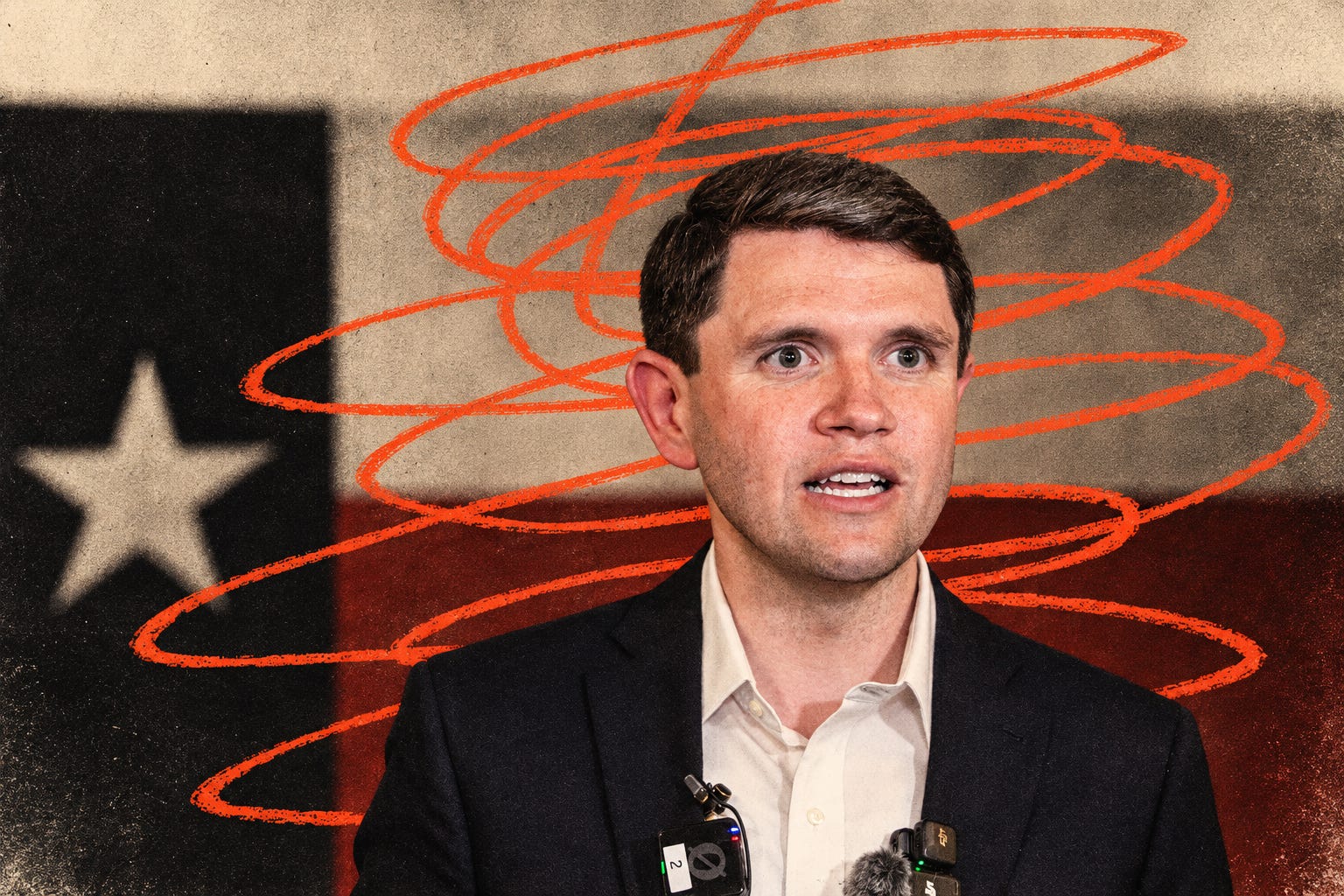
These dynamics were perfectly demonstrated by the fracas that followed Democratic Senate candidate James Talarico’s disappearance from the campaign trail earlier this month. Talarico spent the first week of October off the campaign trail, at home in Texas recovering from the flu. There was never any mystery about what was happening: He appeared virtually at an event where he told attendees that he had come down with the flu.
But that didn’t stop Talarico’s opponent, Texas Attorney General Ken Paxton, from demanding “proof of life,” setting up a tip line for information about Talarico’s location, and leading a “Where is James Talarico?” chant at a rally. Trump declared the Democrat “MISSING IN ACTION” in a Truth Social rant. (He also called him “James TalaFREAKo.”)
Talarico appeared at a music festival in Austin on Oct. 9, and he attended a Kacey Musgraves concert in Dallas the following day. But during his absence, right-wing influencers began promoting a theory that Talarico wasn’t sick at all. Instead, they claimed he had suffered a nervous breakdown and had been secretly admitted to a psychiatric hospital.
The theory went viral just as Talarico was emerging from his illness, thanks to repeated posts from personalities such as Jan. 6 organizer Caroline Wren and former Los Angeles mayoral candidate Spencer Pratt. (Pratt even claimed to have “sources” confirming the story.)
On Sunday, MAGA influencers Nick Sortor and Rhein Amacher claimed they had real proof: An employee at a psychiatric hospital in Ohio had allegedly admitted, in a phone call to Amacher, that Talarico was a patient. Right-wing social media absolutely erupted in anticipation of a scandal that would destroy Talarico’s credibility and thus his campaign.
Nobody in the MAGA media sphere seemed to notice the story’s obvious problems. For one, Sortor and Amacher’s “proof” supposedly described Talarico checking out of the Ohio facility on Saturday. But Talarico, as noted above, was demonstrably present at the Austin City Limits Music Festival on Friday. And in the full audio of Amacher’s phone call, which was obtained by The Bulwark, the Ohio hospital employee repeatedly denies that there’s anyone named James Talarico in the hospital’s system.
Later Sunday evening, the hospital itself flatly denied that Talarico had ever been a patient, killing the conspiracy for good.

Haha, just kidding! Despite the overwhelming evidence against the “Talarico was institutionalized” story, it kept circulating. And it wasn’t just anonymous accounts: Former Fox News personality Megyn Kelly was still demanding answers after the hospital’s denial, and White House Deputy Chief of Staff Stephen Miller kept conspiracy-posting even after The New York Times confirmed with time-stamped security images that Talarico was at his home just as he claimed.
To some on the right, the very fact that they got embarrassed was its own form of conspiracy. Once it became clear that there was no evidence for the mental breakdown thesis, conservatives began to blame Talarico for not heading off the false story effectively enough.
Trump-friendly blogger Mickey Kaus wondered why Talarico never announced his illness with a tweet. Washington Free Beacon reporter Chuck Ross seemed unable to believe that the campaign wouldn’t release photos of a bedridden Talarico to clear his name. The Current Revolt podcast asked why the Talarico campaign hadn’t said anything (it had). Perhaps it was a false flag, suggested @CynicalPublius, one of the influencers who were secretly installed as a Department of Defense employee under Secretary Pete Hegseth.
What we’re witnessing here is a group of people grasping for a meta-conspiracy theory in order to avoid the dawning realization that they were set up — by their own side.
Are there any gates left to keep?
The epistemic closure that Sanchez described in 2010 is now overwhelming in right-wing circles. It has made conservative media incredibly vulnerable to failure modes such as the one we saw in the Talarico conspiracy theorizing. And social media compounds the problem further by destroying the ability of traditional media gatekeepers to keep out bad information.
One of the most interesting details to emerge from this entire episode is what happened before Nick Sortor posted his supposed scoop. According to reporting from Current Revolt, Amacher, who made the phone call to the Ohio psychiatric hospital where Talarico was falsely reported to be hospitalized, said that he initially pitched the story to The Blaze and the Daily Mail. But the story didn’t pass legal muster with those outlets, despite their ideological sympathy.
Instead, Amacher turned to Sortor, who is essentially a random grifter and was happy to blast the allegation out to millions of people on social media.
Before the rise of social media, getting repeatedly turned down by formal publications would have been the end of the road for a story like this. But today, algorithmic incentives dominate professional standards. Amacher himself acknowledged that influencers aren’t held to the same standards as journalists.
Whatever vestigial safeguards still exist at institutions like the Daily Mail or Fox News are so easily bypassed on social media that they’ve been rendered obsolete. Gatekeepers used to have enormous power to determine what stories became news and which withered on the vine, but social media has eroded that power.
In practice, gatekeeping is dying. Con artists can go viral and drive national stories without institutional help.
This all starts, of course, at the top. Technology alone can’t explain how we got here, or why the problem is so acute in conservative circles. President Donald Trump, for essentially as long as he has been in public life, has been a connoisseur of conspiracy theories. He lies as easily as he breathes, so much so that one can’t help but wonder whether he even understands the concept of truth at all. Maybe expecting him to be honest is like lecturing a raccoon about property rights as it rummages through your trash.
In 2008, the late Sen. John McCain famously shut down a woman spreading conspiratorial views about then-Sen. Barack Obama at one of McCain’s campaign rallies. In those days, Fox News was certainly biased, but it still maintained a certain level of professionalism and would have been loath to broadcast completely unsubstantiated claims.
But Trump was the exact opposite of McCain. Just a few years after McCain’s act of decency, Trump was eagerly spreading lies that Obama had not been born in the U.S. and demanding to see a birth certificate. And under Trump’s malign influence, the entire conservative media ecosystem has corrupted itself.
Conservative media now selects for loyalty and against competency and honesty. That’s why Fox News had to pay $787.5 million to Dominion Voting Systems in a defamation suit concerning Trump’s claims that the 2020 election was stolen. And Fox, despite its decline, is sadly still among the more responsible actors in this space.
MAGA has plenty of people calling themselves “investigative journalists” these days, but almost none of them are competent and honest. Christopher Rufo remains a conservative power broker despite spreading lies about Haitian immigrants eating cats in 2024. Dinesh D’Souza’s documentary 2,000 Mules, which purported to prove that the 2020 election was stolen, was so dishonest that its distributor eventually apologized and withdrew it. James O’Keefe has built a career on amateurish sting operations and selectively edited recordings. Yet figures like these continue to command attention in conservative media.
The rot runs deep, and it runs through the entire MAGA movement. Many of those who spread the most baseless rumors on social media also work for the administration.

To a first approximation, there are no responsible MAGA journalists. There is no last redoubt, no “good ones” who are pro-Trump but still cling to honesty and competency. Anyone who could have been that type of bulwark left for, well, The Bulwark. The mainstream of conservative American media is now just baseless, vile conspiracism. And the bad news is that there is no bottom.
It can always get worse, and it probably will. After all, the White House just chose a new press secretary who is a Pizzagate conspiracist and has reposted claims about how Michelle Obama has a penis.
This isn’t a both-sides issue. The left wing of American politics has a number of its own problems, and plenty of liberal voices have embarrassed themselves by spreading misinformation. But there’s substantial evidence that conservative social media users share more low-quality information than liberal users do.
A 2023 study in Science found that conservatives were in a deeper social media bubble than liberals and that misinformation was more concentrated inside that conservative bubble, with “no equivalent on the liberal side.”
The Talarico conspiracy is disturbing, but it’s not unique. This kind of wild misinformation is becoming more and more frequent in conservative circles. The upshot here is that conservatives in America are losing the ability to self-correct — and are thereby frequently losing touch with reality. This is happening at the very bottom, with anonymous social media profiles, and it extends all the way to the top and the man in the Oval Office.
Any movement that prizes loyalty above truth will eventually lose its ability to distinguish reality from fiction. And once it loses that ability, there’s no obvious mechanism to bring it back.
Recommended reading:
Four things I changed my mind on after a year of polling

Issue polling is dominated by interest groups. We wanted to do something different.
Why Americans think other Americans are bad people

The people blaming immigration and multiculturalism for the trust crisis have the story almost exactly backward.
The fake reality in which I’m right beats a real reality in which I’m wrong.
The human ability and endurance in forging realities of their own choosing is one of the most profoundly shocking way stations on my human understanding journey.
[And once it loses that ability, there’s no obvious mechanism to bring it back.]
The mechanism to bring it back is when the people involved decide they actually care about building something that works. The car dealership owners of the world[1] can enjoy conspiracy theories about Talarico because to them it's all a game. It doesn't matter. If it somehow begins to impact their ability to stock and sell cars[2], they'll start to care about why that is actually happening and what can fix it.
[1] Nothing against car dealership owners; I've just been told they're the core of the Republican party.
[2] By which logic the tariffs should start to make inroads on the movement... eventually, right?