

After 75 years of conservative attacks on college professors, journalists, and bureaucrats, hardly anyone — including Trump voters — calls those groups elite.
Way back in 1951, conservative William F. Buckley Jr. wrote God and Man at Yale, a book that tarred his alma mater as a hotbed of left-wing radicalism: “The institution that derives its moral and financial support from Christian individualists … persuad[es] the sons of these supporters to be atheistic socialists.”
Spiro Agnew, President Richard Nixon’s vice president, called network news leaders a “small and unelected elite” for being hostile to the president’s message. Irving Kristol, the father of neoconservatism, defined an elite “new class” including teachers, journalists, social workers, foundation staff, and bureaucrats.
Today, the standard-bearer of the left-wing-elite theory is surely the Manhattan Institute’s Christopher Rufo, who has turned his ire on “a small number of people with influence in the knowledge-based institutions” who are acting “in their own interest and against the interest of the vast majority of the American people.”
Rufo has compared his project to Nixon’s to “tame the national bureaucracy” and dismantle “radical organizations.”
But despite decades of effort on this front, according to The Argument‘s most recent poll, elite basically means billionaire or celebrity to the majority of American voters — including Trump 2024 voters:
It’s clear from this data that the Buckley-Nixon-Rufo project has had some effect on Republican voters: Trump 2024 voters are 11 percentage points more likely to view journalists as part of the elite than Harris 2024 voters, 5 points more likely to view government employees as part of the elite, and 13 points more likely to view college professors as part of the elite.
Still, none of these categories crack 20% for Trump voters.
When I was designing this poll with our director of political data, Lakshya Jain, I was particularly interested in going deeper. Not just “Who are the elite?” but “What are the public’s perceptions of elites?”
We discovered a strong correlation between elites and “people who hold positions I don’t like.” “Elite” is not just a socioeconomic category; it carries negative baggage.
Trump voters overwhelmingly imagined elites to be more liberal than the country, while Harris voters overwhelmingly imagined them to be more conservative. Forty-nine percent of Trump voters placed elites to the country’s left, compared with just 21% who placed them to its right. Among Harris voters, the pattern reversed: 68% said elites were more conservative, while only 10% said they were more liberal.
As a result, the “elite worldview” produced by our poll results was ideologically incoherent, a grab bag of positions from both sides.
Sixty-six percent of voters support government-provided health insurance for all Americans, yet 59% think elites oppose it.
Eighty-one percent of voters think men and women are equally suited to leadership, yet 50% of voters think elites disagree with that statement.
Just 11% of voters support government ownership of most businesses, but 28% attribute that position to elites.
The public’s picture of elite opinion, then, looks like a map of beliefs that ordinary voters find objectionable.
While this is ideologically incoherent, it is consistent. Elites believe what ordinary people reject; therefore, since ordinary people are ideologically incoherent, so too are elites.
I also don’t want to overstate the incoherence here — voters are remarkably consistent — across party, class, race, age, and every other demographic we polled — about the category of person that qualifies as elite: billionaires and celebrities yes, but to a lesser extent politicians and businessmen.
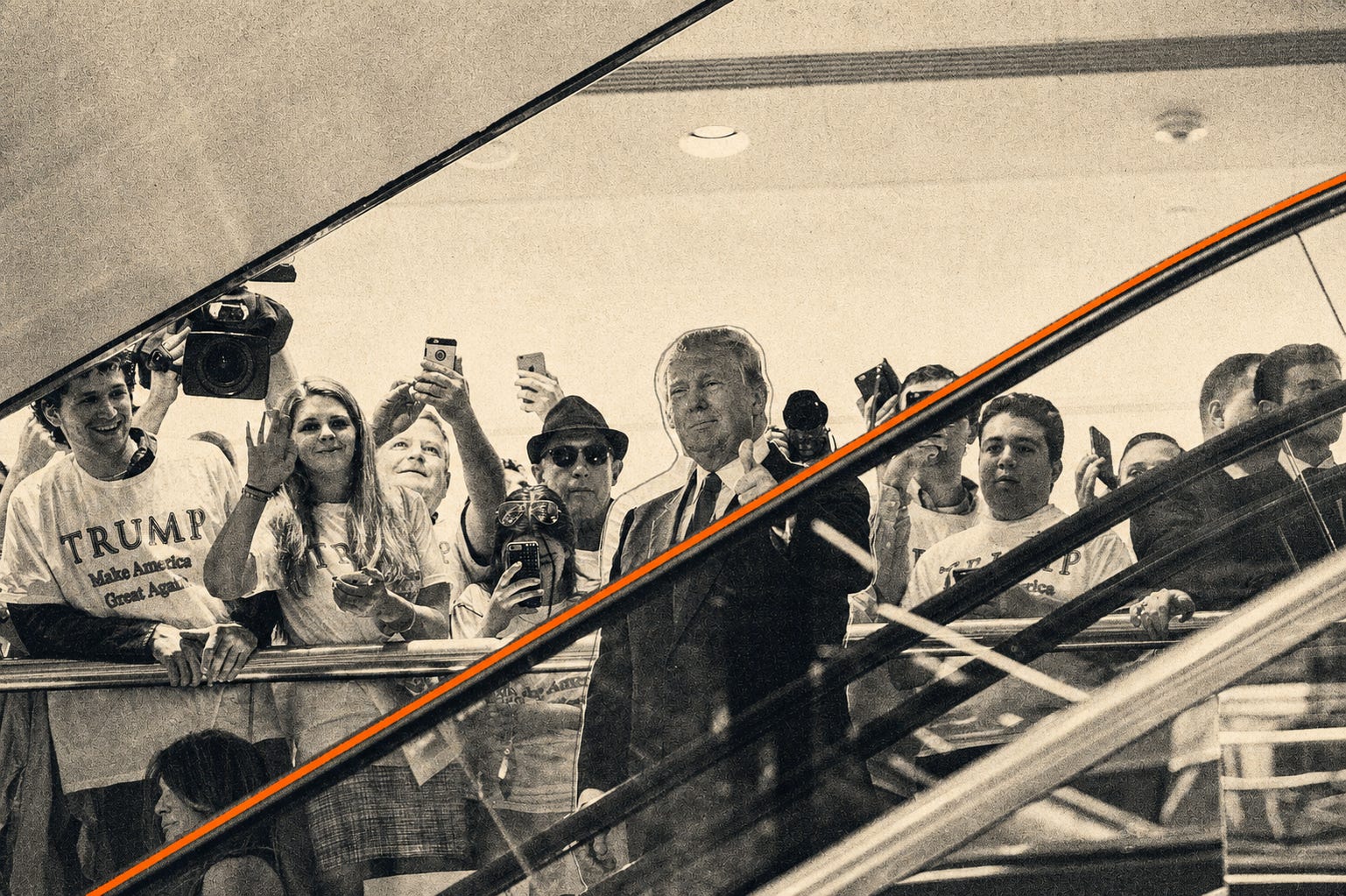
The strangest part of all this: In such an environment, how does a billionaire, celebrity, politician, businessman — the poster child for what is considered elite — become president not once, but twice?
Notably, Trump is incredibly unpopular, so I wouldn’t call what he’s doing a strategy for success. But it does call into question how much our poll is really capturing about anti-elite politics.
Many people viewed 2016 as an election where the public overthrew the liberal elite — personified in Yale alumna and former Secretary of State Hillary Clinton. Trump himself explicitly presented the election as ordinary Americans reclaiming power from a corrupt establishment.
There are many ways to interpret these findings all together, but my interpretation is that hostility to elites only explains a small part of electoral outcomes. Particularly in 2016, the sense was that Trump was aligned with many of the relevant swing voters on certain issues like immigration and trade.1
After we dropped this poll, my co-host Matt Yglesias was excited to talk about it on the podcast. During our conversation, he argued that elite status should be defined by consequential decision-making power. We also debated the most interesting part of the poll (to me): what the celebrity findings mean for political and cultural change.
Next month, we’ll be reading F.A. Hayek’s The Road to Serfdom. If you have comments or questions about the book you’d like us to discuss, drop a line in the comments below!
Watch or listen wherever you get your podcasts.
The Argument. Libbing out.
Paying subscribers can find the transcript for this post beneath the paywall.
WATCH THE EPISODE ON YOUTUBE HERE
New episodes post every Thursday.
For an ad-free version and full transcript, subscribe at TheArgumentMag.com.
Show notes:
“The elites aren’t who you think they are,” July poll release on elite ideology, discussed at length: The Argument article
Full list of monthly, original, in-house polling: The Argument page
“The trans rights backlash is real,” February poll release about gender and LGBT issues: The Argument article
“61% of U.S. women say ‘feminist’ describes them well; many see feminism as empowering, polarizing,” 2020 poll release about views on feminism: Pew Research Center article
Films referenced in this episode:
One Billion Americans: The Case for Thinking Bigger, book by Matt arguing that Americans’ path to prosperity lies in increasing the size of our population: Goodreads page, Amazon page
“Nobel Laureate Goldin Says Male ‘Duds’ Are Weighing on Birth Rates,” article in which Nobel Prize-winning economist Claudia Goldin blamed low birth rates on men being unimpressive: Bloomberg article
“The People Who Hate People,” Jerusalem article about how restrictionist arguments trace their lineage back to zero-growth environmentalism: The Atlantic article
“From Field to Firm: College Sports and Early-Stage Career Choice,” article by Paul Gompers, George Hu, Will Levinson, and Sachin Srivastava, about how college athletes are more likely to hire other college athletes, particularly from the same team: NBER working paper
(Responding to the intro, not the podcast. Haven’t read the transcript yet). I wonder if the survey asking what professions are elite is granular enough. At the very least, there are absolutely some journalists I would consider elite, but I’m not sure I would extend that to the whole profession.
Jerusalem really missed how Barbie producer (and star) Margot Robbie advanced the discourse:
2017 produces and stars in Oscar winning film about class and gender discrimination (I Tonya)
2019 co-stars in Oscar winning film about workplace harassment (Bombshell)
2020 produces Oscar winning film about sexual assault (promising young woman)
2023 produces and stars in openly anti-patriarchy Oscar winning film that grosses $1.4b.
Really hard hitting films rarely dominate the box office. But she did do them, and early. They just didn’t get famous. They influence other cultural leaders and the Oscar wins and nominations (and modest box office success) suggests they had some success.
Barbie transmits those ideas to a mass audience. Including people who aren’t up to speed with the discourse. Which is most people! The average person is very much not a highly online media professional.
There is actually a feminist podcast about another somewhat groundbreaking Robbie production, Birds of Prey, about an all female superhero team.
https://podcasts.apple.com/gb/podcast/the-bechdel-cast/id1180733925?i=1000475296661