

Editor’s note: The first essay The Argument ever published asked, “How do we live with each other?” To mark our first anniversary on August 17, we’re returning to that founding question with a series about what we owe people whose beliefs and choices we may find difficult to accept or even understand. Over the next few weeks, familiar voices at The Argument and new voices alike will approach that question from different angles.
In today’s essay, Maibritt Henkel examines the growing panic that, as Americans read less and less, the very foundations of liberal democracy are threatened. What behaviors, norms, and ideas do we need most people to commit to in order to sustain a liberal society? Is reading really one of them? Maibritt ruminates on these questions.
To receive every essay in this series, subscribe today.
- Jerusalem Demsas
Most people for most of history could not read. Writing systems have been around for just 5,000 of the 300,000 years of Homo sapiens’ existence, and, until very recently, most of us were illiterate.
By 1900, only around 1 in 5 people above the age of 15 could read and write a short simple sentence. That the global literacy rate today is at 88% — and approximately 93% for 15- to 24-year-olds — is an astounding triumph of social progress.
And yet, despite this remarkable fact, a sense of doom has settled around the issue of reading. Many argue that we are entering a “postliterate” era, where written text is being replaced by oral and visual forms of communication.
That concern is not unfounded. In the United States, high-level reading proficiency is decreasing. Americans are, on average, reading less and becoming worse readers as a result: SAT scores for reading and writing are falling, vocabularies are shrinking, and the sentences that we can comfortably understand are getting shorter.
Across the country, educators report that their students struggle to finish the same books their predecessors breezed through. Look around a waiting room or an airplane and you’re unlikely to see anyone killing time by reading a novel. Chances are they’re scrolling instead.
If by literacy we mean people’s propensity to pick up a book, read it front to back, and have a sophisticated understanding of its content, then it is true that America finds itself in a literacy crisis.
Some see this as a political crisis as well. The decline of reading, the argument goes, is not like the decline of other pastimes. It is different from stamp collecting or bowling, both of which fewer and fewer Americans now do for pleasure, because only reading produces the kind of rational and analytical thought well-suited for democracy. Reading must be protected because it shapes the human mind. Specifically, it shapes the mind to be fit for modern liberal democracy.
In her recent cover story for The Atlantic, “The End of Reading Is Here,” Rose Horowitch cited the philosopher Marshall McLuhan: “The liberal world by definition is literate,” and argued that the inverse is also true. In a viral essay, critic James Marriott prophesied that “without the critical thinking skills instilled by print, many of the citizens of modern democracies find themselves as helpless and as credulous as medieval peasants.” British journalist Mary Harrington wrote in the Christian magazine First Things that the “most momentous effect” of the postliterate era is “to undermine the cultural norms and habits of thought that form the bedrock of modern liberal democracy.”
The slump in American literacy is sad and concerning for many reasons — one of those simply being that Americans express wanting to read way more than they actually do. For many people, particularly those who work in newsrooms and at universities, disappearing into a literary universe is one of life’s great joys. We should defend it as a practice — not least by reading more ourselves.
But how much someone reads does not determine how liberal they are. Respecting democracy, celebrating pluralism, and giving moral primacy to the individual do not rest on a Great Books education.
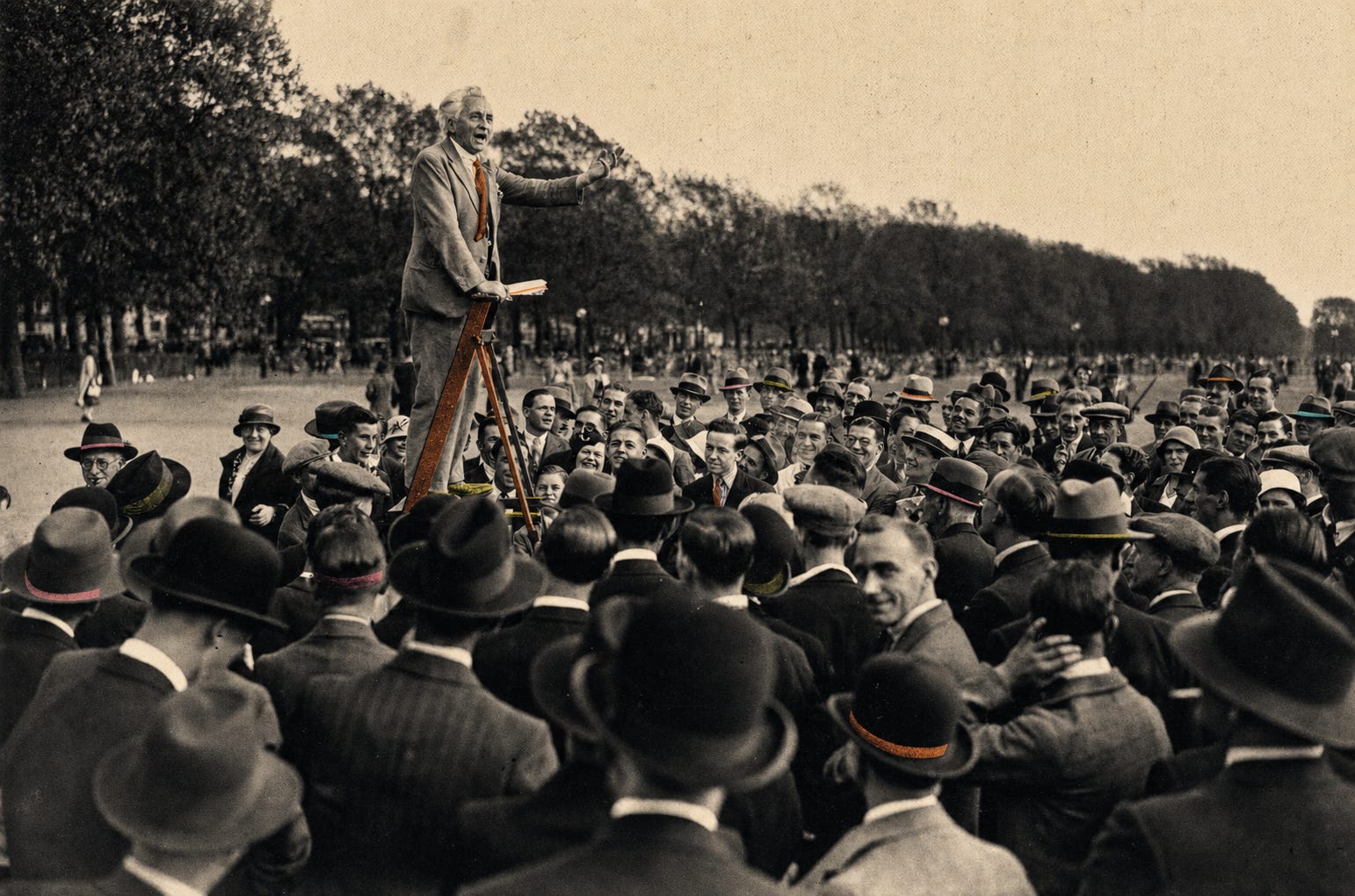
Typography, when it did eventually come about, was revolutionary because it allowed for private encounters with information. There is plenty of that in the 21st century. What there ought to be more of is the collaborative exchange of ideas. Liberalism depends on productive disagreement, on accepting that difference is a permanent feature of free society. Some literature will teach you that. But, mostly, your best teachers will be other people.
People were liberal before the printing press
Scholars have long warned us that the technological shift away from text-based media would have consequences for liberalism.
In 1982, Walter J. Ong wrote in Orality and Literacy that it was the transition from an oral to a literate culture that made logical and abstract thinking possible. Written language promotes higher-order cognition because it allows for reasoning ordered across many linked steps, he argued.
Without text, it is difficult to construct an argument where the conclusion of one syllogism becomes a premise of the next: Given A and B, therefore C. Given C and D, therefore E. The amount of information we can store only in our heads is limited; most of us need a shopping list to remember five basic grocery items from the store. This explains why expression in purely oral cultures (of which there are virtually none left) tends to be repetitive and formulaic, optimized for retention at the expense of nuance or complexity.
Literacy, according to Ong, with its dictionaries, encyclopedias and structured management of knowledge was “absolutely necessary for the development not only of science but also of history, philosophy, explicative understanding of literature and of any art.” You can paint a painting without language, but you cannot meaningfully analyze or classify it without the abstract categories that writing and reading afford.
Orality trains the mind to relate to the physical world right in front of it and derive meaning situationally: “I see a painting of two angels looking down at a woman next to a fire that looks hot.” Literacy allows for decontextualized abstraction: “I see a triangular arrangement of mass against negative space and warm coloring.”
Although Ong was clear that he didn’t think oral people are “essentially unintelligent,” he cast the literate subject as comparatively cerebral and cogent. In classical liberal theory, the fundamental building block of society is the rational individual.
But the decline in reading is an imperfect proxy for what actually matters for liberalism: an ability to engage in the exchange of ideas, a willingness to change one’s mind, and a tolerant attitude toward difference. Unlike getting a good score on the reading and writing section of the SAT, the skills of civic life do not necessarily come down to reading comprehension.
Between 2017 and 2023, the proportion of American adults scoring at the lowest literacy level rose from 19% to 28% (although changes in the test’s design make the precise size of that increase uncertain). And that decrease was mainly seen in Americans with already low performance.
But does that decline necessitate democratic decline?
The namesake of this magazine is a book by the Indian economist Amartya Sen, The Argumentative Indian. For Sen, the actual bedrock of democracy is “public discussion and interactive reasoning,” a practice that he traced back to a time long before mass literacy. He pointed, for instance, to some of the earliest recorded general meetings in the world: the Indian Buddhist councils of around 300 B.C.E., which helped to “consolidate and promote the tradition of open discussion on contentious issues.”
What Sen was describing there was a preliterate proto-liberal culture: Not until the mid-20th century would the Indian literacy rate rise above 30%. The analytical, logical mind, to which Ong ascribes so much of Western progress, was less important to Sen than the tolerant, interactive one.
Possibly the ancient Buddhist councils would have been more effective if everyone in attendance could read and write — or not. “It would be a great mistake,” Sen wrote, “to assume that because of the possible effectiveness of well-tutored and disciplined arguments, the argumentative tradition must, in general, favour the privileged and the well-educated, rather than the dispossessed and the deprived.”
The illiberal readers would like a word
You can be a liberal without reading books. You can also most certainly read books without being a liberal.
Not so long ago, I myself was a college student at an elite university, and while conservative students were few and far between, most of them were found in the philosophy department. Reading the completed works of Tolstoy and Plato does not by definition make you someone who respects personal freedoms and civil rights.
As writer Sam Kriss recently noted, Russian society’s high literacy rates have not produced liberal democracy: “One result of the Soviet Union’s mass literacy campaign is that today, Russians are essentially the only truly literate people left. The vast majority of Russians read regularly, more than anywhere else in the world … But somehow, political culture in Russia is not saner or more democratic than in the mentally enfeebled West. If anything, the opposite.”
Consider, also, the most prominent members of the postliberal right. Say what you will about Adrian Vermeule or Gladden Pappin, but they are certainly literate. Between them, they have almost 20 years of higher education. Even if you doubled that, I doubt you would make particularly liberal thinkers out of either of them.
It might seem obvious, but equating reading with liberal politics assumes that readers can’t be fascists. But, unfortunately, reading alone does not guarantee that you don’t become a Nazi. The German public had exceptionally high literacy rates when Hitler came to power in 1933, and some of history’s worst dictators were avid readers. Stalin reportedly read hundreds of pages a day and kept a personal library of around 25,000 books.
Distraction is a problem
Neil Postman has become a bit of a hero among the reading doomers: He foretold that screens were going to ruin everything long before the iPhone was invented.
In his most famous work, Amusing Ourselves to Death, Postman argued that print language encoded the ideal of rational, sequential argument. Consider the Lincoln-Douglas debates: seven debates held in town squares that followed a sequence of affirmative construction and rebuttal.
In 1858, such an event drew a massive and engaged crowd. Could it do the same in the postliterate era? Not according to Postman, whose primary concern was the explosive rise of television. While the standard for political discourse in the 19th century was “generally coherent, serious and rational,” fast-paced television has made it “shriveled and absurd.”
In what he dubbed the “Age of Show Business,” visual media made entertainment the primary currency of politics, rather than rational argument. A modern audience demands at all times to be amused, and therefore cares more about good looks and shock factor than the substance of ideas.
There is no denying that the printing press made most things better, and that a lot of subsequent media seems to have made many things worse. But people tend to overrate how literate people were in some imagined golden age.
Mass literacy never meant that most citizens spent their evening reading George Eliot. In Victorian Britain, expensive new novels and works of history were purchased largely by circulating libraries; even the largest of those libraries had just 50,000 subscribers at its peak.
In 1989, an NEA study estimated that just 10% to 25% of American adults had read what its researchers classified as literature “of merit.” And just 7% to 12% had read serious contemporary writing.
Print mattered enormously, but its influence on our politics clearly did not require even a large proportion of people to work through philosophical treatises or highbrow novels. A society can be shaped by books that most of its members have never personally read.
And, in fact, the thing that Postman most feared television would replace wasn’t reading; it was meaningful social interaction. In Amusing Ourselves to Death, Postman wrote: “Americans no longer talk to each other, they entertain each other. They do not exchange ideas; they exchange images.”
His central argument had less to do with the in-vogue panic over how many books anyone read in a given year and was much closer to the question we’ve been asking ourselves at The Argument: How do we live with one another?
Years later, Postman would clarify more of his pedagogical vision. In his lesser-known book, The End of Education: Redefining the Value of School, he advocated for schools being places where students learn together as a group. Textbooks, he wrote, are the “enemies of education.” Only interactive dialogue can give rise to what school is actually for: not to serve the public, but to create it. As he put it in an interview: “School has never been about individualized learning.”
True, Postman was exceedingly worried about the distraction of technology. The medium of written text functioned for Postman as a metaphor for how we should approach most things in life: with full attention. And perhaps this is why we are so panicked about reading — and about reading books in particular. We think of books as the last thing left that might get us to focus.
Sen recounted in his book how Nelson Mandela’s democratic education began with the community meetings he watched as a boy in Mqhekezweni. Anyone who wished to speak could do so, and ordinary people openly criticized the regent. These meetings weren’t liberal — women were excluded from equal participation — but they cultivated habits liberal democracy depends on, like hearing disagreement, tolerating criticism, and treating people of different ranks as citizens whose opinions counted. Those habits did not require everyone to sit alone reading political philosophy.
Call me a debate kid, but I think interacting with other people, especially when you disagree with them, can get you to focus, too. The classes that taught me the most at university were the ones that forced me to contend with other people’s ideas in real time. They were also the ones that made me want to do the readings.
More than how much people read, we should care about whether they feel they have something to say — and, in Sen’s words, whether they have the opportunity “to speak and listen, without fear.”
Books and the knowledge they offer people are part of that liberal project. But they are not in themselves the holy grail.
Recommended reading:
Can liberalism survive the algorithm?

Simplistic good-versus-evil narratives are easier to communicate quickly, and they’re more likely to provoke the behaviors that platforms measure: clicking, liking, sharing, and replying. Illiberal politics thrives in this kind of environment.
No, Senator Murphy, I don't want to join your cult.

The cult of the common good begins with an Official Version of the Good Life and then treats the law and politics as the way to direct people toward it.
This was great. I think what the literary and scholarly-debate traditions share — but which the television, 'morning radio', and short-form-video traditions do not — is the extension and refinement of the train of attention out into sufficient breadth to form a world-model.
Interestingly, I can quantify this a little bit: I came of age in the professional Magic: The Gathering community where there was an astounding amount of print content people regularly consumed to get a sense of metagames and matchups. Now it's virtually all video. And consequently, the density function of people at tournaments with robust model-level understandings of the dynamics of what's going on is way, way down — even as the level of overall talent remains as high or higher. Exposure, and the ability to solitaire, is more refined than ever. But 'theoretical understanding' is vastly lower, and is exploitable.
Not sure if this is still going on, but when I was in med school there was a big focus on making doctors more empathetic and kind and just better people by exposing us to humanities. Meanwhile right after med school most residents work 80+ hours a week and we are surprised when these sleep deprived residents working an intense 80 hour week and dealing with lean staffing standards (i.e. covering a lot of patients at once, meaning it’s going to take awhile for many patients to be seen) are cranky and seem overly efficiency focused! I don’t think reading is going to be the answer to that…