

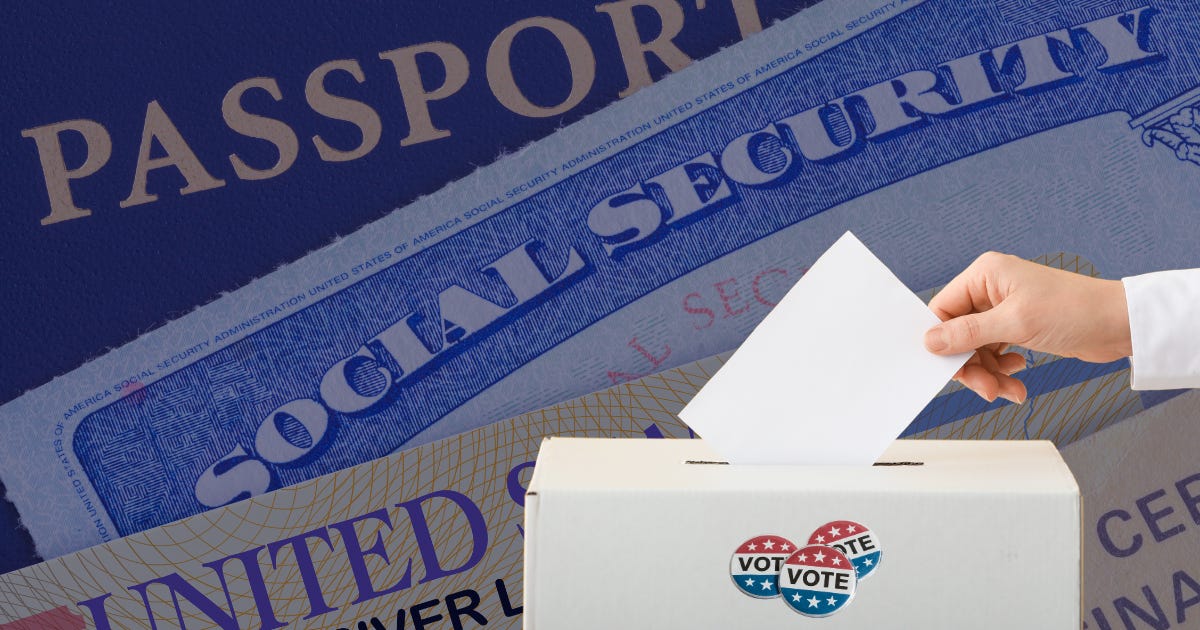
The logic of voter ID laws has flipped, but the politics are still stuck in 2012.
There’s a traditional story where Republicans seek to make it harder to vote so that the electorate skews to the highly educated. But that dynamic is odd in a world where Democrats have become the party of the highly educated.
The SAVE America Act is a bill currently under debate in the U.S. Senate that would require proof of United States citizenship in order to register to vote in federal elections.
Donald Trump has pushed for the inclusion of unrelated provisions related to transgender issues — specifically, provisions banning trans women from participating in women's sports and restricting gender transition treatments for minors — that have muddied the debate, but at its core, this is an argument about election administration: Republicans say the bill is necessary to prevent immigrants from voting illegally. Democrats say this kind of voting fraud is so rare as to be a non-issue and that it will make it more difficult for American citizens to cast their ballots.
If you think about the party coalitions as they existed circa 2012, this kind of voter suppression measure could have provided Republicans with a meaningful electoral advantage.
But over the course of the Trump era, Democrats have lost their historic advantage with lower-socioeconomic status (SES) voters: If everyone who was eligible had voted in 2020, Biden’s popular vote margin would have been about two points higher, but if everyone had voted in 2024, Harris’ popular vote loss would’ve been about one percentage point worse.1
In The Argument’s aggregated national polling data, we see that richer and more educated voters are more likely to have backed Kamala Harris and more likely to say they will vote for a Democratic candidate in the midterms this fall.
The upshot is that a strict voter ID law designed to suppress turnout among low-SES voters would probably net votes for Democrats. Specifically, higher-income voters are more likely to own a valid passport, which is one document the SAVE America Act could require people to present when registering to vote for federal elections (the alternative is to present a birth certificate and valid driver’s license).
And taking the sports and youth transition issues off the table would also help Democrats, since the party’s stances on both issues are incredibly unpopular.
I do not believe that we should “nationalize elections” or end mail-in voting.2 But I do think there is a case for Democrats to embrace voter ID laws (though not the SAVE Act itself, which is now chock full of poison pills). Not because these laws would suppress Republican votes, but because they might restore trust in the electoral process.
And to the extent that Democrats are resisting voter ID out of concern that it will skew the electorate in a MAGA direction, that’s a fear they should get over.
The not-so-great history of voter ID laws
Barack Obama’s reelection in 2012 launched a thousand takes about how Republicans were on track to be locked out of power in an increasingly diverse America. According to the exit polls, Obama ran very poorly with white voters, but still won because of record turnout among young and nonwhite voters.
What actually happened was that the exit polls simply underestimated the number of white voters in the electorate, particularly white voters without a college degree over 45. Compared to previous Democratic candidates, Obama ran worse with southern whites but stronger with northern whites.
But by the time voter file-matched postmortems come out, narratives about election outcomes have often crystallized.
After 2012, the RNC released an autopsy report arguing that the GOP needed to change its messaging on immigration to appeal to the growing Latino electorate: “If Hispanic Americans hear that the GOP doesn’t want them in the United States, they won’t pay attention to our next sentence. It doesn’t matter what we say about education, jobs or the economy; if Hispanics think that we do not want them here, they will close their ears to our policies.”
Another, ultimately more dominant, reaction among Republicans was to become obsessed with changing voting rules.
Donald Trump, in 2020, worried about turnout scenarios featuring “levels of voting that, if you ever agreed to it, you’d never have a Republican elected in this country again.”
As a young lawyer in Reagan’s Department of Justice, John Roberts wrote dozens of memos arguing that the Voting Rights Act should be weakened. In the oral argument for Shelby County v. Holder, Antonin Scalia described Section 5 of the VRA — which requires jurisdictions deemed to have a history of voter suppression to pre-clear changes to their election laws with the Justice Department — as the “perpetuation of racial entitlement.”
Voter ID rules, which poll well but tend to make it somewhat more difficult to vote, were part of the same push. In 2012, Mike Turzai, then-Republican majority leader in the Pennsylvania state House, listed among his accomplishments, “[v]oter ID, which is gonna allow Governor Romney to win the state of Pennsylvania, done.”
In 2010, the GOP won unified control of the North Carolina legislature. Under the leadership of then-state House Speaker Thom Tillis, they passed a strict voter ID law and drastically cut early voting hours, both of which disproportionately impacted nonwhite voters.
The Fourth Circuit Court of Appeals found that these laws targeted “African Americans with almost surgical precision.” While drawing up the state’s voter ID law, Republican legislators and their aides asked the state election board:
“Is there any way to get a breakdown of the 2008 voter turnout, by race (white and black) and type of vote (early and Election Day)?”
“Is there no category for ‘Hispanic’ voter?”
For “a breakdown, by race, of those registered voters in your database that do not have a driver’s license number.”
In 2015, Texas enacted a voter ID law that allowed concealed-carry permits as proof of citizenship but not student ID cards — making the intent to engage in differential vote suppression about as clear as it gets.
Voter ID laws don’t actually suppress many votes
All of that is to say that it is true that the intent behind voter ID laws is often to suppress certain people’s votes. But do these laws actually do that? The literature is mixed.
The Brennan Center for Justice has pointed out that in states that enacted voter ID laws, the racial turnout gap has increased, and that in North Carolina, turnout among individuals lacking proper identification went down following the passage of the state’s voter ID law, even after the law was struck down.
But a more comprehensive working paper published in 2019 by Enrico Cantoni and Vincent Pons looked at data from 2008 to 2018 and found that voter ID laws “have no negative effect on registration or turnout, overall or for any group defined by race, gender, age, or party affiliation.” The likelihood that nonwhite voters were contacted by a campaign increased by nearly five percentage points following the passage of ID laws, suggesting that mobilization efforts might offset any reductions in voter turnout. The study also found that ID laws had no impact on real or perceived levels of voter fraud.
A 2019 working paper by Mark Hoekstra and Vijetha Koppa looked at data from 2,000 elections in Michigan and Florida. They found that “at most only 0.10% and 0.31% of total votes cast in each state were cast without IDs” and even “under the extreme assumption that all voters without IDs were either fraudulent or would be disenfranchised by a strict law, the enactment of such a law would have only a very small effect on turnout” — and that only the freakishly close 2000 presidential election in Florida could have plausibly flipped due to ID requirements.
Voter ID is really popular
Confession: I used to be a part of the small minority of Americans who opposed voter ID laws. Back in 2020, I wrote my first-ever article3 for my high school newspaper: a somewhat prescient, if a bit overwrought, critique of the anti-democratic strain in the Republican Party. I stand by a lot of what I said in that piece — the Senate is an undemocratic institution; gerrymandering is bad; Congress should renew the Voting Rights Act — but my thinking on voter ID laws has changed.
It’s not that I think voter fraud is a significant problem — it’s extraordinarily rare — but that the last few years have seen a collapse in trust in the electoral process, in large part driven by our beloved president4 lying about the 2020 election.
Do I think that voter ID will magically make Republicans stop believing in conspiracy theories? No. But I do think that it just might help restore some trust in the fairness of elections.
In poll after poll, voter ID laws are really popular. In fact, it’s one of the most popular electoral reform proposals out there: It consistently polls well over two-thirds support, with majorities of all parties and races in favor.
In fact, for a lot of people, it’s surprising that showing a photo ID isn’t already required when you vote. It just seems like common sense to ask someone to show proof of eligibility before they cast a ballot.
The fact that voter ID is so popular and yet Democrats resist it seems to drive further suspicions in the electorate. What possible reason could Democrats have for being so stubborn about this if not a desire to cheat in elections?
Understanding that concern about suppression is overstated — and that with modern coalitions, lower turnout probably helps Democrats — could help the party get to yes. But the view that voting should be easy rather than difficult has a legitimate principled basis.
The good news is that you can do both. Just ask Kentucky.
How a red state made it easier to vote early
Michael Adams is a Republican who was first elected as Kentucky Secretary of State in 2019. In 2020, he pushed the state legislature to pass a voter ID law and a law creating in-person early voting options. I wanted to know how he was able to get that package over the line in one of the country’s reddest states.
“I built a coalition that was literally everybody from the furthest left of our Democrats all the way to Rand Paul,” Adams told me over the phone. “The sponsor of our bill was a former staffer for Rand Paul, and I got ‘em on board.”
Part of how he did it was by selling access measures as security measures. “I said, if you want to make it harder to cheat, make the election several days long instead of just one day. And if you’re trying to commit vote fraud, you’ve got to have a four-day operation, not just one, right? And that actually helped us get some votes,” Adams said.
Other liberal ideas were rebranded as conservative populism.
“For example, I said Democrats want to vote by mail, but Republicans want to vote in person, so let’s expand voting in person, and that got Republicans interested,” he explained.
Crucially, Kentucky Democrats remained supportive of the proposal when it came under fire from national figures. At one point, Adams told me, “various celebrities on social media, and Hillary Clinton also, for that matter, all put out disparaging tweets about our election process because they had read misleading information about how we were doing it. To their great credit, our Democratic governor, the NAACP, all the Kentucky left — all said they’re wrong. We have a fair election. We don’t have suppression.”
If anything, Adams believed that the criticism helped him win support for his package:
“I used that to get Republicans to rally around what we were doing. I’m like, Hey, Hillary Clinton doesn’t like what we’re doing. Maybe you should.”
When I asked him about the prospect of federal legislation making a similar compromise — tighter ID requirements in exchange for expanded voting access — Adams was skeptical. But he did hope that Congress would update the National Voter Registration Act. That law is now over 30 years old and makes it “very hard for us to do our jobs with voter registration and maintenance of the rolls.”
For example, people sometimes move from one state to another. But each state maintains its own voter file, so if someone moves to another state, they might remain on their old state’s voter rolls. There’s no legal requirement that states share their voter rolls, which would make it easier to clean up duplicative registrations.
“When I first ran for this office, there was a lawsuit against my predecessor that alleged that there was, I forget the number, but 103% registration in some of our counties,” Adams told me. “And what’s frustrating about that is, again, it doesn’t mean that there’s fraud, but it lends to conspiracy theories.”
Faith in democracy is worth fighting for
The final point about conspiracies is important. Voters having faith in the system matters, just as making voting broadly accessible matters.
That doesn’t mean Democrats should swallow the existing SAVE America Act as written; among other things, it would make it harder for married women who changed their last names and students who move out of state for college to vote. But it would make sense for Democrats to work with Republicans to enact voter ID laws that are popular with the public, allow all eligible voters to cast a ballot, and bolster faith in elections.
Ideally, such legislation would be paired with Kentucky-style measures to offset other barriers to voting. But whether or not a deal like that is achievable, it’s worth saying that the call for voter ID is defensible, and it’s simply not true that enacting it would give Republicans a daunting advantage — or even any advantage at all — in elections.
Rhetoric from Democrats like Chuck Schumer comparing the legislation to Jim Crow suggests something so abhorrent as to be beyond dealmaking, and it gives a false impression of the stakes — both moral and in terms of electoral outcomes. Democrats should instead give the people what they want on voter ID and start rebuilding faith in the integrity of the democratic process.
Recommended reading:

Is the Supreme Court going to doom the Dems? We did the math.

Gutting Section 2 of the Voting Rights Act will make it much harder for Democrats to win the House, but not impossible.
The first link in this sentence shows results for white voters broken out by income cohort, but you can see the same pattern among nonwhite voters if you look at Catalist’s data — specifically Table 1, which shows that Democrats have lost substantial ground among nonwhite voters without a college degree since 2012.
My views on youth transitions and trans women in women’s sports are different. The short version is that I don’t think it’s fair to let trans women compete in women’s sports, and I think there is too little regulation of hormone therapy, gender transition surgery, and puberty blockers for minors.
As far back as I remember, I always wanted to have opinions about politics online.
In The Argument’s latest poll, Trump’s net approval rating was -16.
Great article Milan. This plus thoughtful moderation on trans issues (probably just restrictions on sports participation) and immigration (close asylum loophole) would do a ton of repair to the damaged Democratic brand.
I would not object to some sort of voter ID implementation as part of a deal that also got something for Democrats.
But I think the idea that a voter ID law would restore trust in elections is mostly wishful thinking. "Give Republicans some of what they want and they will back off" is just disastrous, beause it relies on expecting the Republican Party to behave in good faith?