

On May 13, a prestigious literary organization — Commonwealth Foundation — announced the regional winners of the 2026 Commonwealth Short Story Prize. There was just one problem, as people noticed very quickly: Several of the winning stories appear to have been written by AI.
There are a lot of unreliable AI detectors out there, but one has strong evidence of efficacy: Pangram. University of Chicago economists studied AI detectors in 2025 and found that Pangram had a 0.005 or lower false positive rate — it was the only tool to satisfy such a strict cap. Another study found Pangram matching the near-perfect accuracy of a panel of human expert AI detectors.
Some detectors will falsely flag pre-2020 texts as AI-generated, but Pangram almost never does so. One benefit of Pangram is that it errs on the side of false negatives. That is, Pangram would rather mistakenly assume that text is human when it is actually AI than falsely accuse human-written text of being AI-generated (false positive).
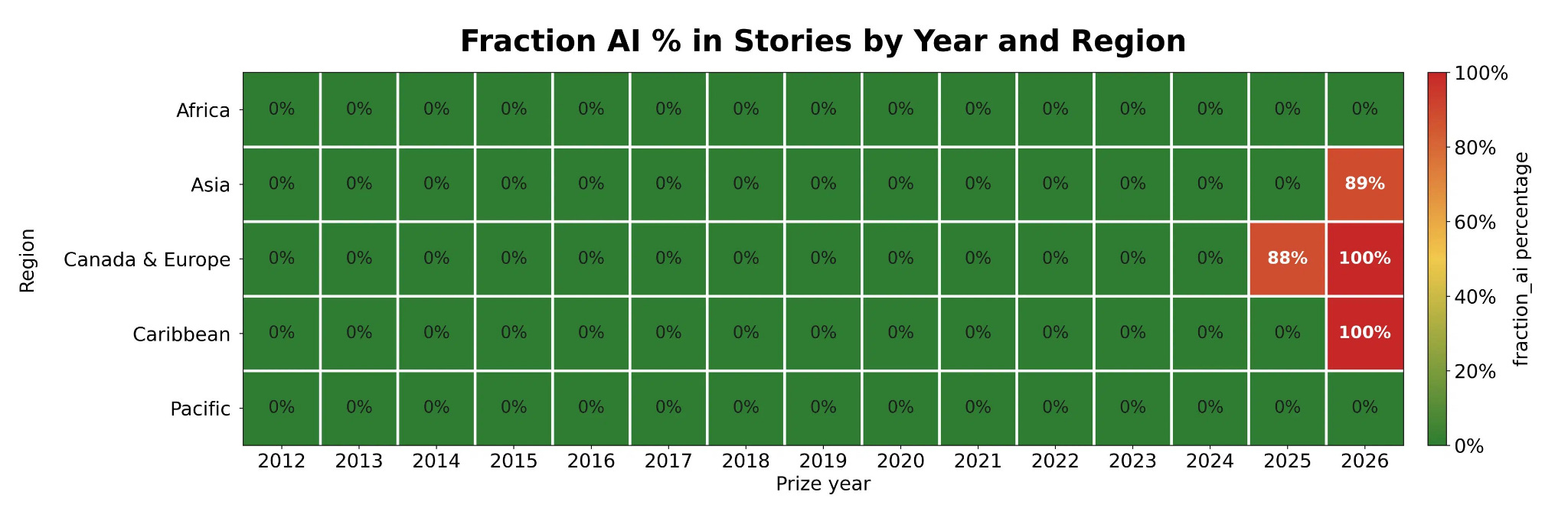
And Pangram says that the award-winning short story “The Serpent in the Grove” is AI-written. In fact, once people started looking, Pangram also says that the winning story for the Canada and Europe region — “The Bastion’s Shadow” — is AI-written and that the winning story for the Asia region, “Mehendi Nights,” is substantially AI-written.
In fact, on further investigation, a 2025 winner is… also substantially AI-written. (Though no pre-2025 winners flag any AI content, which is an encouraging sign of Pangram’s accuracy.)
There are, let’s say, also some noticeable similarities in the prose style between the winning stories that were flagged for AI use. AI chatbots love metaphors and similes, and they often spit out ones that sound vaguely pleasing but are logically incoherent or ascribe properties to things that don’t make sense.
“The Serpent in the Grove” gave us, “The girl smiled like sunrise over a sink.” “The Bastion’s Shadow” says, “She carried it now in her bag, heavy as a charm.” “Mehendi Nights” describes something as “swaying against plaster like a warning bell.”
(According to the Commonwealth Foundation, “all shortlisted writers have personally stated that no AI was used.”)
Similes that don’t quite work are not the only characteristic tic of AI prose. A year ago, commentators pinned down a bunch of stylistic features of AI “trying to write impressive prose,” and that list of tics has held up well even as AI has advanced.
My favorite analysis is from Nostalgebraist’s “Hydrogen Jukeboxes,” which meticulously documented “a narrow, repetitive, immediately recognizable style that doesn’t quite resemble that of any human author I’ve ever read,” particularly its fondness for “conjunctions that combine one thing that is abstract and/or incorporeal” with “another thing that is concrete and/or sensory.”
He gave examples of AI writing he had encountered: “collect your griefs like stones in your pockets,” “connections between sorrow and the taste of metal,” “its presence a quiet pulse against her thigh.”
It’s the same pattern I noticed in “The Bastion’s Shadow’s” “stone had begun to carry the stories it couldn’t release,” or in “The Serpent in the Grove’s” “A fact that felt like a small warm animal in her hands” and “her laugh is bright as zinc.”
It’s not bad writing, necessarily — the AI does it because it has been trained that it’s good writing! But it is very distinctive to AI writing.
I did, while working on this story, read, for comparison, the winners not flagged by Pangram as AI. Perhaps this overwrought style is simply what wins literary contests these days? But having reviewed the regional winners that were not flagged as AI, I don’t think that’s true.
The non-flagged winners are indeed metaphor-laden. But here’s the Pacific winner, on skinning a lamb: “She had to lift the head to cut around the underside, and something in the lolling floppiness of it reminded her of Eddie when he was a newborn. It had frightened her at the time, holding this delicate creature and realising how his life was entirely in her hands. She pushed the thought out before it sprouted roots and put her off the task.” This has metaphors, sure, but they’re coherent and non-cliche.
Or take the Africa winner, dissecting the advice to “just” leave her husband in “Me and Ma’am”:
“When I hear Ma’am say just, it feels like the cotton balls I grab by the handful and try to stuff into the glass jar in the master bathroom. It’s the same feeling I have whenever I see butterflies on the big lavender bush at the entrance to the complex. Ma’am says just in the same voice I use when I’m reading to the kids from the big red book. Stories about princesses in pink dresses. Happy birds in forests. Rabbits and foxes that stop to greet you. Ma’am’s just is light and innocent. Whatever comes next sounds, well, easy.
just leave him.”
That’s a metaphor. But it’s not the throwaway, sourceless, third-person metaphor found in the stories Pangram identifies as AI-written.
In both of these unflagged stories, the narrator’s choice of comparison is itself characterizing. We learn about our viewpoint character — the scope of their imaginations and therefore the implied scope of their lives — from which analogies they have to hand.
“Me and Ma’am,” my favorite of the five, hums along, powered almost entirely by the mismatch between what its narrator knows and what she can say. The metaphors are also lingered on, or flow naturally into the next sentence, where in the three suspect pieces, the metaphor has no relationship to anything that follows it.
I do not think that all three of the flagged stories are the rare Pangram false positive. I think that they’re AI and that they are pretty obviously AI if you’ve read a lot of AI prose. One obvious conclusion is that the judges who picked these winners hadn’t read a lot of AI prose.
A head-in-the-sand approach to AI
A lot of my lefty friends hate AI. Sometimes this is for reasons I agree with — like that the people building it admit their goal is to do something extremely dangerous that might kill us all — and sometimes it’s for reasons I’m not that worried about — like that it uses a lot of electricity.
But because they hate AI, a lot of these friends refuse to use it. I have one good friend who refuses to even hear about other people using it.
This is a good way to end up badly mistaken about AI. It changes rapidly over time, and usage is climbing rapidly over time. If you are unwilling to check it out, you will be wrong about what its strengths and limitations are — and you’ll miss that a growing share of the words you are reading are AI-generated.
Literary magazines in particular cannot afford a head-in-the-sand approach. After the AI revelations, Commonwealth stated that it does not screen entries for AI use and does not intend to start doing so: “Until a sufficient tool or process to reliably detect the use of AI emerges that can also grapple with the challenges pertaining to working with unpublished fiction, the Foundation and the Commonwealth Short Story Prize must operate on the principle of trust.”
But Pangram is such a sufficient tool and process! It has been empirically validated, it has extremely high reliability, and text run through Pangram is not used for training further AI models.
It is a good thing when institutions can run on trust, but in the age of AI, they clearly cannot. It would suffice for them to instead run on expert human judgment — which is, at least as of today, as good at identifying AI-generated text as Pangram is — but that only works with humans who read a ton of AI text, so it isn’t compatible with an anti-AI political orientation and a lack of experience with AI tools.
But even if you don’t trust Pangram or any other tool, passing familiarity with AI-generated text would have flagged many of these stories as suspect. One would hope that the poorly written metaphors would, on their own, have been sufficient to disqualify some of these submissions. But that’s a matter of taste.
Perhaps AI-generated content is genuinely award-worthy to some people. If so, you’re either going to be handing out awards entirely to AI, or you’re going to have to screen for AI-generated content.
But what I’ve seen so far is a world that wants to have it both ways: People don’t want to check whether stories are AI, and they want everyone to stop pointing it out when the stories are. Of course, this will result in more stories being AI-generated.
The Commonwealth Foundation, in a floundering series of responses to the scandal, did everything from ask Claude if the story was AI (Claude said almost certainly yes) to argue that, somehow, it would harm disadvantaged people if they screened for AI. “The prize has an important role in supporting underserved communities and enabling new writers to find a voice,” Razmi Farook, the director general of the Commonwealth Foundation, told The Observer.
That, to me, seems like an argument that you should work particularly hard to disqualify AI, which robs those communities and new writers of a pathway to recognition and achievement. But that’s not Farook’s takeaway, according to The Observer:
“It is worth asking, she said, what kind of texts the AI detection tools train on. The answer is surely that the – stolen, let’s not forget that – work that has fed them comes from dominant cultures. But what would you do, I asked, if it were proved in a cast-iron way that a winning story was AI-generated? ‘Take stock, for sure. We would take stock and review our processes today,’ she reiterated.”
The incoherence of this response — pointing out that AI trained on works that were, in many cases, pirated as a defense of letting people cheat and citing the magazine’s mission to enable new writers to have a voice as a reason not to check whether stories are written by writers at all — is a good reminder that not all nonsensical writing can be blamed on AI. Some makes no sense because humans don’t know what they want.
I don’t like it any more than anyone else, but the age when you can run a literary magazine on trust is over. You can either decide AI submissions are fine, or you can filter for them. You cannot simply get everybody in the world to be trustworthy — and several of these winners are first-time writers, so it’s not even like they have a longstanding reputation to defend.
When you try, you are rewarding liars.
Recommended reading:
AI could destroy the labor market. We already know how to fix it.

Stop overthinking this. In reality, the most boring, well-established social democratic policy approaches will work perfectly fine.
Why Americans think other Americans are bad people

The people blaming immigration and multiculturalism for the trust crisis have the story almost exactly backward.
"But because they hate AI, a lot of these friends refuse to use it... This is a good way to end up badly mistaken about AI."
My goodness, this divergence is so real in my life. I'm a heavy user, paying for multiple AI services and getting great value from them. But I sometimes bump into people who are very dismissive and negative, and it's hard to even have a conversation with them about AI. They clearly have no idea what they are talking about, and they criticize how it works in ways that clearly demonstrate they are not trying to use it in ways that would help them.
So strange. It will be fun to watch this sort itself out in the years ahead. They are in for a heck of a surprise, I expect.
“You’re right — I was hand waving, those metaphors were not load-bearing”