



Welcome to The Closing Argument, our verdict on the news, plus everything The Argument published and appeared in this week.
Thanks to everyone who came out to our first-ever, sold-out West Coast event last week, where Jerusalem Demsas debated Kelsey Piper on whether AI could actually cure cancer. The Argument will have more live events coming soon and paid subscribers will get priority access!
The Verdict, by Jerusalem Demsas
Discourse about genetics is always fraught, and one way that it is needlessly so is the overly simplistic way in which many people tend to understand the line between “genetic predisposition” and “environmental influence.”
In reality, those two things are extremely interrelated, a fact I was reminded of when reading a new study about the effect of moving start times for high schools to later in the morning. The study isn’t about genes directly, but it is a clean test of what behavioral genetics keeps pointing at: that a lot of what can look like a genetic advantage is really just a lucky match between someone’s biology and their environment.
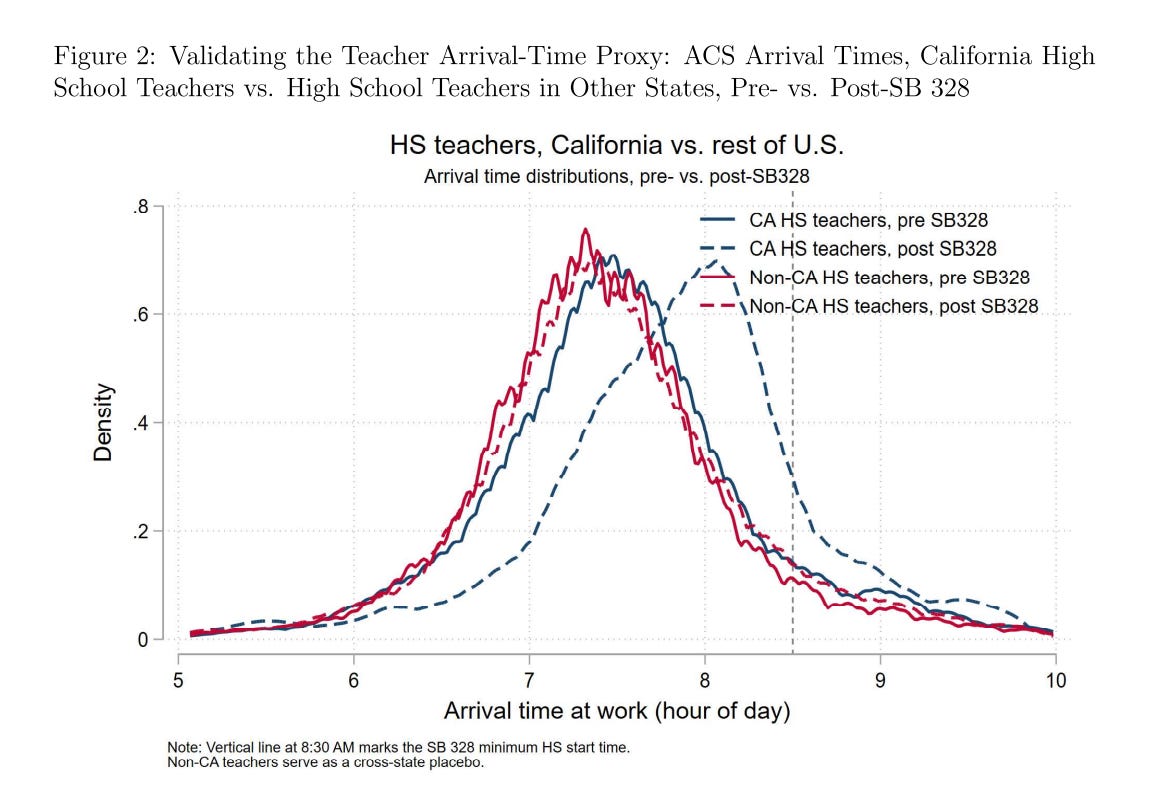
In 2019, California passed SB 328, requiring high schools to start no earlier than 8:30 a.m. and middle schools no earlier than 8 a.m. That is, a bill to let kids sleep in. And they did, according to a promising new study — roughly 46 more minutes a night.
The researchers examined Youth Risk Behavior Survey (YRBS) self-reports and American Time Use Survey (ATUS) time diaries to figure out how much sleep teens are getting. The ATUS pattern is very clean: the share of 15- to 18-year-olds awake before 6 a.m. fell 86%; the share awake before 7 a.m. fell 61%. Kids do go to sleep a little later but not enough to wipe out the gains. (Rural districts in California were exempt and did not see similar patterns, which adds credibility to the findings.)
Furthermore, eighth-grade math and English scores improve by a modest amount. For context, those improvements are significantly larger than those found in the large new study on the impact of removing phones from schools that rocketed through the internet a few weeks ago.
As someone who naturally likes to stay up late and, if left to my own devices, would sleep in until noon, I have always chafed against the pervasive belief that early rising is a virtue. Behavioral geneticist Kathryn Paige Harden has been one of the best scientific communicators trying to explain what’s in the grab bag of genes that make up the polygenic score for educational attainment.
The discourse has largely moved past the simplistic idea of a “smart gene” now that we know there are many, many genes that contribute to something as complicated as “how many years of schooling does an individual complete.”
There’s nothing intrinsically better about being a morning person, but in a society where high school begins at 7 a.m., one’s genetic predisposition to early rising will have a much larger effect than in a society that starts high school at 8:30 a.m. or even later.
The more you learn about the way genetics interacts with the human environment, the harder it is to take moral credit — or assign it — for landing on the lucky side of an institutional arrangement.
One can take this lesson too far. You do have to just pick a start time for public high schools, and someone will be harmed by whatever time you end up picking.
But Harden’s point still stands: Genes don’t produce outcomes on their own. Genes in environments produce outcomes.
Top stories this week, by Maibritt Henkel
As we grow, we want to make sure you see everything we’re doing without flooding your inbox with dozens of emails. But for the real libs, you can get every post as it drops by opting into The Mag here.
This week in The Argument, law professor Nicholas Bagley and economist Robert Gordon contributed a piece addressing the uncomfortable tension between the left’s supposed commitment to high-quality government services and their support of public sector unions. They argue that collective bargaining agreements often are too indiscriminate, protecting public workers based on seniority rather than performance. Bad teachers and bad cops don’t just lead to worse schools and unsafe cities; they undermine the broader Democratic vision.

If you know Kelsey Piper, you know she loves a Waymo. In this piece, she defends self-driving cars from accusations that modern vision algorithms are worse at detecting people of color. To make her case, she goes on a deep-dive into the engineering literature and safety data, as well as the mechanics of imaging radar. I’ve recently come around to the robots, and Kelsey is a big reason why. If you’re looking to be converted, I suggest you give her a read.

🌟Abundance Wins of the Week🌟
A recent study published in Nature Nanotechnology details how artificial neurons can interact with brain cells. There are many potential applications of electronic devices that can communicate with living neural systems, such as improved implants for hearing and vision loss.
On Thursday, Meta and renewable energy producer DESRI signed a deal providing the tech company with 850 MW of energy capacity from solar and battery storage projects across nine states, including Oklahoma, Texas, and Mississippi.
Connecticut has had a moratorium on new nuclear plants since 1982. Last year, it partially lifted that moratorium, and the state is now holding public informational workshops to get localities interested in hosting new nuclear reactors.
Worth watching...
On the pod this week, Matt and Jerusalem debated the great Spirit Airlines debacle. They cover anti-trust under Biden, the weirdness of airline markets, and ask what it all reveals about our political moment.
Subscribe: Apple Podcasts | Spotify | YouTube | Overcast | Pocket Casts
Did Joe Biden really kill Spirit Airlines?

Spirit Airlines is dead, and the right, true to form, is blaming Joe Biden.
Midterm polls range anywhere from Democrats leading by a whopping 15 points to a nail-biting three. In a Substack live conversation, Lakshya Jain and Split Ticket’s Armin Thomas discussed what to make of these numbers.
What’s News with The Argument
The Argument recommends, by Maibritt Henkel
Some members of the team headed to San Francisco this week for The Argument’s event Wednesday night. What better opportunity for cultural enrichment than a flight west?
On the plane, Milan Singh watched Wuthering Heights, reporting back that it was “not even that risqué.” (Although he admits that he might have missed some stuff because he watched it with no headphones, just closed captioning.)
There were also some readers on board. Jerusalem Demsas read The God in the Woods by Liz Moore, which is “sort of true-crime-y” but about “class politics and misogyny.” Our head of operations, Angela, blew through Muriel Spark’s The Driver’s Seat, leaving her wishing she’d packed another book — always a good sign.
Our SF local and in-house education expert, Kelsey Piper read What Your Preschooler Needs To Know by E.D. Hirsch with her toddler, who loved it. Apparently, Hirsch was an early proponent of “knowledge-focused curricula - ones that try to give kids more information about the world, which makes them stronger readers.”
Lakshya Jain wasn’t sure his favorite news story of the week counted as a culture rec, but I think it does: turns out basketball coach Steve Kerr worked the entire lyrics of Taylor Swift’s hit All Too Well into his press conference remarks over the course of a season, without anyone noticing. You can read about that crafty bit of oration here.
Finally, an anti-rec rec from Eli Richman, who, after struggling through a viewing of The Coffee Table, kept wondering: “If you set out to make an unwatchable film and accomplish that goal, have you succeeded or failed?” He concluded that he could not recommend the movie to anyone in good conscience.
We have merch!
We have quarter-zips, keychains, hats, and stickers. Each one is a great conversation starter in its own way. Buy them here.
More to read:
"Are we kind of being pricks?"

Before David Modica confronted the Town Meeting of Marblehead, Massachusetts, with the question that would make him viral, he already knew the answer.

As a fellow night owl I approve this substack post. Getting up at 6 am does not make you morally superior. Long live night owls and day light savings time.
I watched The Coffee Table and thought it was one of the worst, if not the worst, film I’ve ever seen in my life. A friend who I watched it with really enjoyed it, pushing back that the very things that I hated about it are what the director was going for and why it was a good movie (I don’t believe he thought it was great or amazing). The paradox you laid out is exactly right. On one level, it’s a technical feat to make a film that is so unsettling and awful that people came away angry, but why make that movie, because no one will watch it then……….right?
I land at the same spot, Eli. I will never recommend that movie to anyone. Ever.