


Fewer American women are choosing to have children young. So much is obvious. The big question is whether they will go on to have them in their 30s and 40s or not have them at all.
According to provisional data published by the CDC earlier this month, the fertility rate reached another historic low in 2025. About 3.6 million babies were born in the U.S. last year, compared with 4.3 million in 2006. That’s a difference of around 15.4 births per 1,000 women of reproductive age.
The pronatalist movement is feeding off these numbers — as are social conservatives looking to pass a final verdict on liberalism’s failure. “See where gender equality landed us? No babies.”
So when The New York Times’ The Upshot published a piece titled, “Women in Their 20s May Not Be Having Babies, but by 45 Most Probably Will,” it was a welcome change. The authors argued that we should interpret the dip in the birth rate as temporary — and that a boom of postponed births is waiting just around the bend.
If this is really what is going on, it would undercut handwringing about imminent population decline and childless cat ladies.
But The Upshot has since caught serious flak. Many called the graphs featured in the piece misleading and the headline conclusion overly confident.
So what is going on here: liberal deceit or a genuine paradigm shift in how we should be thinking about fertility?
Both, and neither. The New York Times is right to point out that, strictly speaking, it is possible for birth rates to catch up. Gen Z opting out of parenthood is not a foregone conclusion.
And yet, to project that by 45, “most” women will have two children is a statistically dubious claim, one that is wide open to attack.
This is why no one should be banking on the postponement story. All polls point to young women today not just wanting children later, but being unprecedentedly hesitant about ever having them.
Assuming that their minds will change — even as the economic and cultural circumstances that they are responding to do not — is wishful thinking.
Total fertility rate: an imperfect metric
Measuring fertility is tricky business. What you want is precise information about how many children every woman alive today is going to give birth to in her lifetime.
Unfortunately, perfect information about the future is very hard to come by.
The completed cohort fertility rate, which tracks the number of kids women have by the end of their reproductive years, is the ideal fertility metric. The catch is you have to wait until all women in a given cohort have ended their fertile years to calculate their completed fertility. We won’t know the completed fertility rate of millennials for another 20 years or so.
The most commonly used short-term proxy is the total fertility rate (TFR), which is the expected average number of children per woman, given current birth rates.
To measure the 2024 TFR, researchers looked at the rates of childbirth women actually had in each age bracket in 2024 and added them up. They then extended that reality out into the future.
That meant assuming women in their early 20s would one day behave exactly as women in their 40s are doing right now. So, if millennial women are not having many children today, TFR assumes Gen Z women won’t go on to have many children either.
Since its high of 3.77 children per woman in 1957, the American TFR has plummeted. It is currently around 1.6.
Baby Boom nostalgia aside, this is well below the “replacement level” needed for a population to maintain itself (not counting immigration, that is). Each couple needs at least two children just to replace themselves when they die.
To give you an idea of why some people are so freaked out about this, if the global TFR fell to the American rate and stayed there, after 300,000 years of evolving out of the darkness to create modern civilization, humankind would have just 1,000 years left.
The Upshot is intervening against precisely this pessimism. Things aren’t as bad as they seem. Gen Z isn’t like earlier generations. The TFR is capturing both the low birth rates among young women (who may very well be postponing having children) and the low birth rates of older women (who already had children), collapsing them into one gloomy number.
Can women in their 40s make up for women in their 20s?
For the first time in U.S. history, the number of babies born to women over 40 now surpasses the number born to teenagers.
The question is whether this catch-up fertility will make up for the decline in younger births.
One of The Upshot graphs that got a lot of heat is this one:
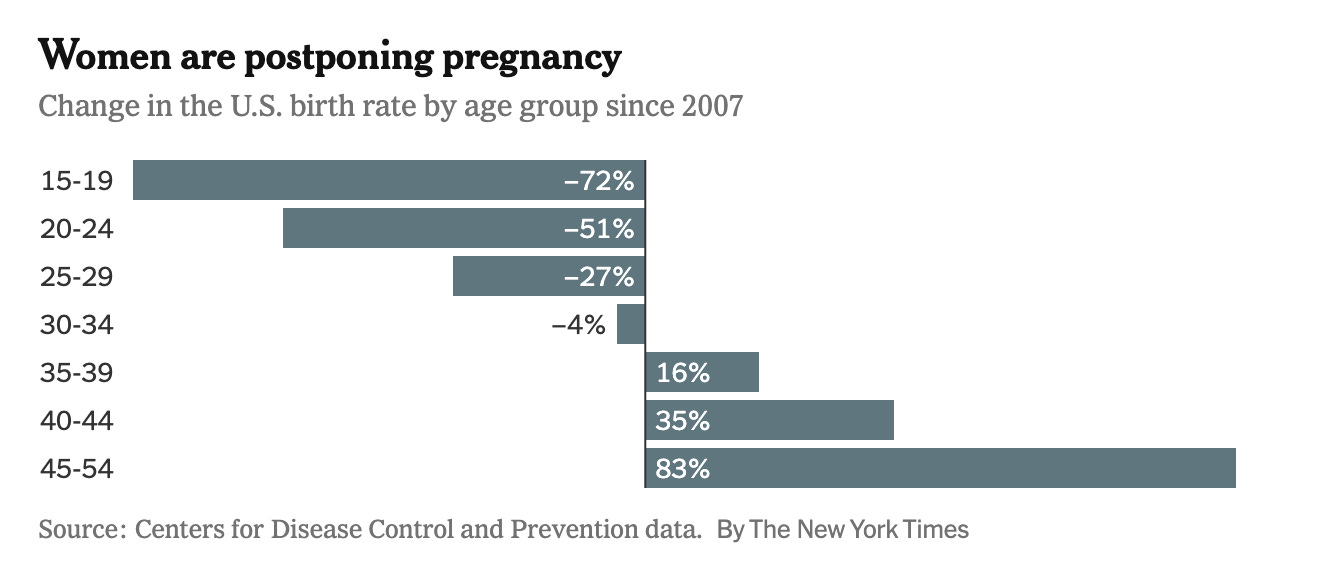
At first glance, it appears to be a perfect illustration of The Upshot’s argument: “[American women] have become much less likely to have [babies] in their teens or 20s — and much more likely to in their 30s or 40s.” The 83% rise in births over 45 appears to more than make up for the 72% drop in teen births. (And who doesn’t want a drop in teen pregnancies?)
But, as Dartmouth economist Paul Novosad pointed out on Twitter, the chart is deceptive. If you have $5 and your income doubles, that means you have $10. But if you have $100 and your income drops by half, you have $50. A chart that shows growth rates would depict those as offsetting, but a chart that shows the actual number of dollars would show the vast difference.
According to CDC data from 2007, the birth rate for 45- to 49-year-old women was 0.6 per 1,000 women, compared with 106.3 per 1,000 women at age 20 to 24.
Novosad redid The Times’ graph with the number of births instead of percent changes. The difference is striking. By his calculation, an 83% increase from 2007 in the 45 to 54 birth rate actually only translates to around 6,103 more births per year.
Gains in births among older mothers are being asked to offset a decline that is considerably larger in aggregate. For the postponement theory proposed by The Times to work out, women over 34 would need to have children at around 10 times their current rate.1
And, to be fair, that is possible.
Biology is not as unforgiving as it once was. Assisted reproductive technology (ART), like IVF, has become increasingly available. Around 36% of all egg retrievals for 35- to 37-year-old women led to live births in the U.S. in 2022. Even in the absence of medical intervention, recent studies have largely debunked 35 as mother nature’s big game over. The majority of women in their late 30s will conceive naturally within a year.
If every Gen Z woman in America decided to wait until 35 to have children, we could still plausibly end up with around two babies each. In fact, assuming affordable access to ART, high rates of happy partnership, and a concerted team effort, we could probably knock that completed cohort rate out of the park.
What’s being disputed here is whether or not that is likely to happen.
In his Substack takedown of The Upshot’s argument, Lyman Stone, director of the Pronatalism Initiative at the Institute for Family Studies, wrote: “You can forecast fertility usually with >90% and often >95% accuracy just by rolling prior years forward for sufficiently high-level variables. When somebody advocates for a major break in trend in such a high-momentum variable, they need a compelling reason why.”
You may not generally see eye to eye with Stone, but it’s hard not to concede his point that the probability of a sudden rise in births among older women at an unparalleled scale is very low.
Everything can change
When I ask Paul Novosad what he thinks the most likely scenario is, he said “probably somewhere in the middle.”
We won’t have decisive evidence until young women today wrap up their reproductive years. The pessimistic take is that catch-up fertility will always be insufficient, producing lower cohort rates than earlier generations. The more optimistic outlook is stabilization; a return to above replacement rates is highly unlikely.
But the marginal differences really do matter. A birth rate of 1.3 vs. 1.8 is not a rounding error. Pushing back against the doomsayers prophesying the end of civilization doesn’t make you naive, but pretending there is nothing to see here almost certainly does.
The real issue is that it genuinely seems like an increasing number of women do not intend to have children. Which is sad, not for creepy Blessed Be the Fruit reasons, but because intent does not always signal desire; sometimes it indicates settling. Recent research suggests many women want kids, but are not confident they will be able to follow through on that wish.
Pronatalists like Lyman Stone tend to cite the desire-intention gap. For conservatives, it can serve as convenient proof of concept: Women want kids but the careerist liberals and radical feminists won’t let them.
However, contrary to popular belief, gender equality was never a scheme to keep women childless. It was a project of opportunity.
So it should concern everyone, the liberals and the feminists above all, when there is a discrepancy between what women say they want and what they feel is possible to achieve.
Recommended reading:
Against white-knuckle parenting

It is both morally permissible and actively a good idea to structure your life so that the kinds of play your kids seek out from you are kinds that you don’t hate.
No country for young families

U.S. towns routinely discriminate against families with children by using homes for the elderly as a cover.
The figure is derived from Novosad’s implied birth count chart. Summing the losses across mothers aged 15 to 34 yields approximately 1.237 million fewer births per year compared with 2007. Summing the gains across mothers aged 35 to 54 yields approximately 123,000 additional births per year. Dividing losses by gains (1,237,075/122,902) gives a ratio of roughly 10.1 — meaning older age groups would need to generate 10 times their current gains to fully offset the decline in younger age groups.
The social conservatives' idea that the recent US drop in fertility is the product of "liberalism" makes no sense. There was a far greater decline in the period 1962-67 (prior to the rise of feminism) and then a second one in 1971-76 (during first-wave feminism), but then the rate rebounded and stabilized during the period 1977-2007. The period of decline we're in begins with the Great Recession and reaches bottom during the pandemic. (I'm using CDC data.)
Only one of these drops could reasonably be attributed to social liberalism. The first marks the end of the anomalous Baby Boom and the first wave of easy access to contraception. (A comparably large earlier drop from 1910-1930 may reflect sharp drops in childhood mortality.) To account for the current drop we need to examine the very substantial social changes occurring from 2008 on, including economic uncertainty, rising expectations for parenting, and the spread of virtual culture, including the last's correlation social isolation and delays in dating, sex, and marriage (among many other factors).
The current drop is part of a global drop in fertility rates that includes countries like Russia, Hungary, Kenya, Pakistan, Indonesia, etc. (I'm relying on a site called Macrotrends.) It is clearly not generated by political or social ideology. The likely causes range from drops in childhood mortality together with more available contraception in less developed countries to rises in living standards and virtual culture in more developed ones.
I think the NYTimes piece is clearly superficial, as Ms. Henkel indicates, but the problem is real. From the US perspective, commenter Austin L's point is the key one. After 2030 the US is going to be entirely dependent on immigration to maintain (much less grow) its total population. Working-age population is tightly linked to economic output, and if we allow population to fall we are either betting on AI to replace people *without* causing chaotic social disruption or accepting a future far less opulent than our present (while US declines help buffer negative trends in other countries).
The best theory I've heard about the decline in birth rates in developed countries I found in a tweet from Aella: "I suspect it's that civilizational advancements improved the quality of childfree life much more than it improved the quality of life with children. Before, life without kids might have been nearly as hard as life with kids, so you weren't actually losing much." I think about this often and am surprised that I haven't seen this specific angle discussed more.